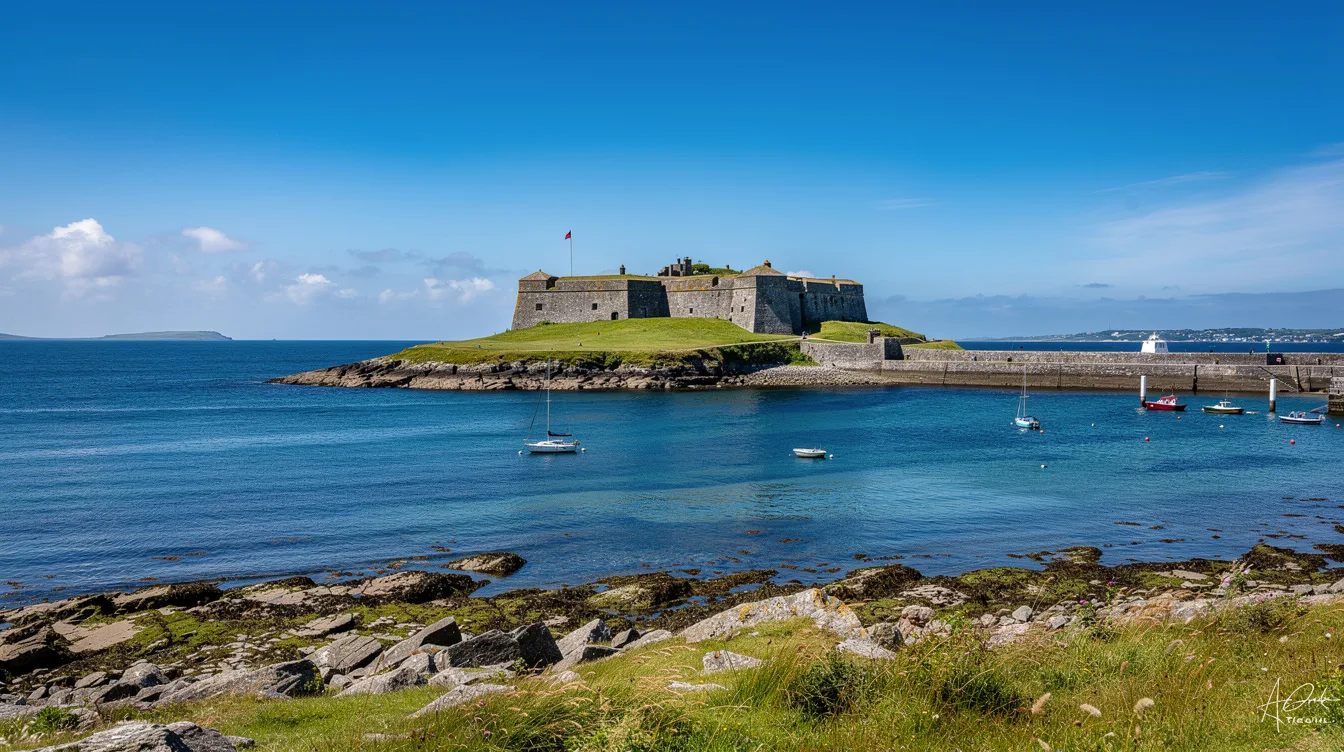
Kinsale is the Irish harbor town where the Battle of 1601 helped decide a national struggle, and where Charles Fort still watches the water. It’s south of Cork City, yet the tight streets and sail-filled marina make Cork feel farther away.
Come for the colored facades and seafood lunch. But stay long enough to understand why this small County Cork port kept drawing armies, ships, and travelers toward its narrow harbor entrance.
Charles Fort explains why Kinsale mattered
Charles Fort, built in 1677, guards Kinsale Harbour from Summercove. Its star-shaped form was designed for defense, and the broad harbor view makes the military logic immediately clear: control this water, and you control who arrives.
You can see the town across the harbor from the fort’s walls. And that view changes the experience from a history stop into something more physical, with wind off the water and boats moving through the same channel once treated as a threat.
The fort is partly restored, so it doesn’t feel polished into a theme-park version of itself. But that’s its strength. The walls, angles, and open ground make you notice how exposed a harbor town can be.
Across the cove sits James Fort, completed in 1607 after the battle. In wartime, a chain was stretched between the two forts to damage or stop incoming vessels, which gives the harbor mouth a sharper meaning than any postcard view can.
The battle is the town’s real turning point
The Battle of Kinsale took place here in 1601, when English forces defeated Irish forces allied with Spain. The date matters because Kinsale wasn’t merely a pretty southern port, it was a place where the contest for Ireland tightened around one harbor.
And you don’t need a battlefield reconstruction to feel the strategic pressure. The water is right there, folded into the town’s daily rhythm, while the fortifications sit on opposite sides like a long argument preserved in stone.
Start in the center, then let the harbor pull you outward. You’ll pass narrow streets, independent shops, pubs, galleries, and houses painted in bright blocks of color. It’s lively in summer, but the town’s historic weight keeps it from feeling frivolous.
St Multose Church, dating to 1190, offers another deep layer of time. It’s worth seeking out because the town’s story doesn’t begin with cannons or end with them. Kinsale has had centuries to build its character.
Summer brings crowds, and the harbor earns them
Summer is when tourism peaks, so expect the streets and restaurants to be busiest then. But the harbor gives the town room to breathe, especially when you step away from the central lanes and watch the masts tilt against the water.
Kinsale is known for seafood and local produce, and its food reputation is a fair reason to visit. Don’t rush lunch. A plate from the sea makes more sense here than a hurried snack, because the port still shapes what lands on the table.
The town is also one end of the Wild Atlantic Way, so it can work as a base for southern and western County Cork. That said, the compact center rewards a slower day better than an ambitious checklist.
Give yourself time for the marina after dinner. The evening light catches painted storefronts and rigging, while the town’s old defensive geography fades into the background for a few quiet hours.
Old Head adds a harder edge to the coast
Old Head of Kinsale brings cliffs, a lighthouse, and Atlantic views into the same outing. It’s a stronger counterpoint to the town’s tidy streets, because the coast feels more exposed and the sea stops behaving like a sheltered harbor.
The headland is also connected to the RMS Lusitania, sunk on May 7, 1915. Some survivors and recovered bodies were brought to Kinsale, and the town held the inquest on the recovered bodies in its courthouse.
But don’t treat that history as a quick stop between photos. The Lusitania connection adds another reminder that this port has long received the consequences of events happening far beyond County Cork.
Can you visit Kinsale without staying overnight?
Yes. From Cork City or Cork Airport, the drive takes about 30 to 45 minutes, and Bus Éireann’s regular service connects Cork and Kinsale, including the 226 route. A day covers the center, harbor, Charles Fort, and a seafood lunch.
Two nights are better if you want the pace to loosen. You can take the Scilly Walk, explore Old Head, consider a harbor cruise, and leave room for pubs and restaurants without turning each stop into a timed appointment.
By the time the harbor quiets after dinner, Charles Fort is still across the water, dark against the shore, and Kinsale feels less like a colorful detour than a town that has always watched what comes in.