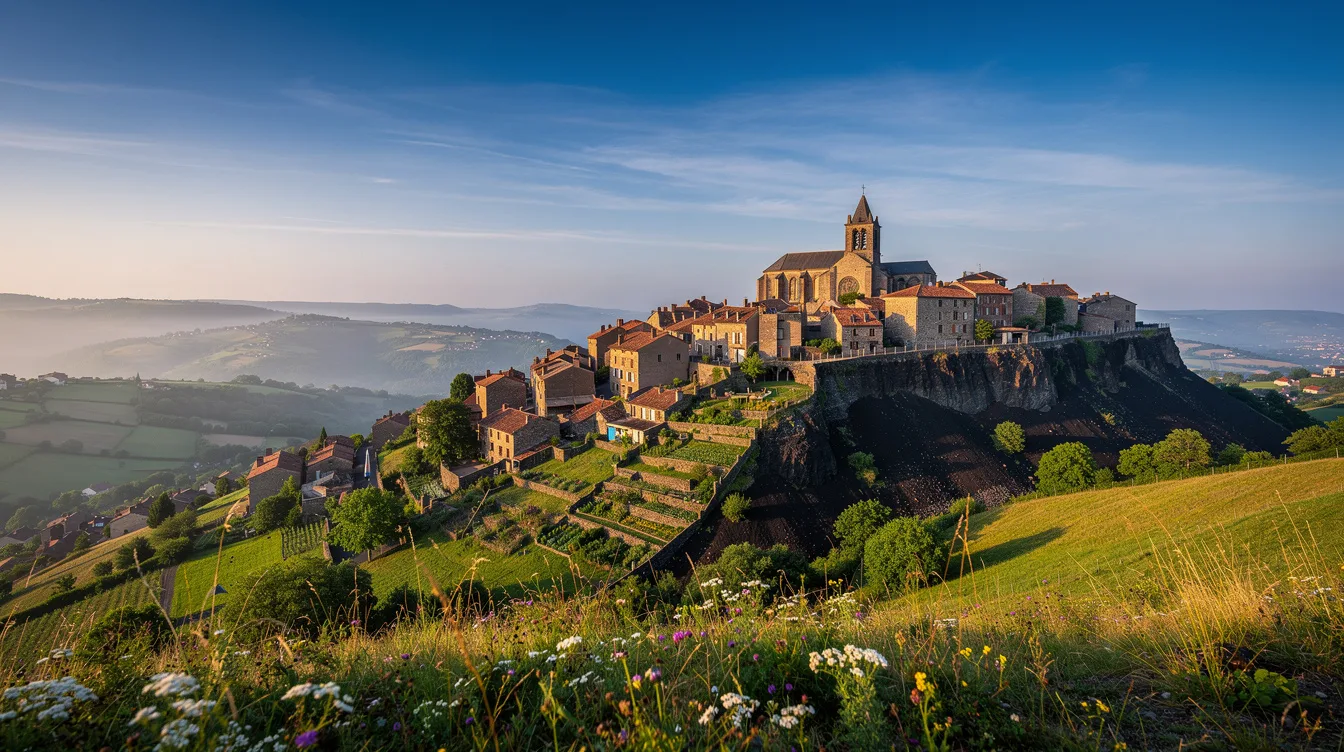
Usson rises on a volcanic perch in France’s Puy-de-Dôme department, and its central story is unusually intimate: Marguerite de Valois lived here from 1586 to 1605. The village is small, but that long stay gives its uphill lanes a dramatic pull.
You come for the view, then keep looking for the traces of a queen who was sent far from court. Usson is only about 5.6 miles from Issoire, yet the climb makes the place feel apart from the busy world below.
A volcanic summit with room to look around
The village climbs a volcanic butte reaching about 2,080 feet. At the top, the panorama turns in every direction toward the Auvergne volcanoes, the Monts Dore, and Livradois-Forez. It’s the kind of stop that makes a half-day itinerary pleasantly fall apart.
And the ascent is part of the appeal. You park below, walk up through old stone streets, then ease back down through the village. It isn’t a hard expedition, but the uphill approach asks you to slow down.
Usson has 286 residents in the supplied 2023 figure, so don’t expect a large-town rhythm. That small scale is its advantage. The silence between houses feels deliberate, broken mostly by your own steps on the slope.
Why Marguerite de Valois stayed for 19 years
Marguerite de Valois, the first wife of Henri IV, made Usson her home for nearly nineteen years. The title “Queen Margot” still follows the village, because her residence here remains the story visitors come to understand.
But this was no dreamy retreat invented for postcards. Usson was one of Auvergne’s major fortified sites, and its position on a volcanic height made distance feel tangible. From the summit, you can see why a stronghold belonged here.
The château that held that history no longer stands intact. It was destroyed in 1634 on Richelieu’s order, leaving ruins and former fortifications rather than a fully preserved royal residence. That absence gives the visit more force than a polished reconstruction would.
Can you still find the queen’s Usson?
Yes, though you’ll find it through memory and setting rather than furnished rooms. Follow the route associated with Marguerite de Valois, take in the castle remains, and let the high ground do some of the historical work.
Stone streets, winegrowers’ houses, and no rush
Usson’s old houses reflect its winegrowing past, with stone walls that catch changing light as the lanes bend uphill. The Romanesque church and its old furnishings give you another reason to pause. It’s historic, but it doesn’t feel staged.
And the summit has a statue of the Virgin near the lookout. You might arrive expecting a single royal-history stop, then spend longer reading the ridgelines beyond the village. The view is broad, while the streets remain close and enclosed.
Les Plus Beaux Villages de France has included Usson since 1983. The label raises expectations, and rightly so, but this is not a place for checking off attractions at speed. Its best moments happen between the listed sights.
You should also accept the limitation: Usson’s scale means its interest is concentrated. If you need museums, shopping, or a packed program, pair it with a larger stop. If you want an afternoon of stone, height, and history, it has enough.
How to make Usson part of your day
Start in the lower parking area and give the village a half day. Walk upward first, when your curiosity is fresh, then return through the bourg at an easier pace. The route works because the summit gives every lane below it a sense of direction.
Beyond Usson, you can combine the visit with Sauxillanges, Montpeyroux, Saint-Floret, or Issoire for a day in the Issoire area. That said, don’t overpack the plan. Usson rewards lingering more than rushing toward the next village.
Its setting within the Livradois-Forez Regional Natural Park explains the spacious feeling around the compact commune. The roads and destinations may be nearby, but the volcanic rise creates a clean break between the village and the wider countryside.
By the time you reach the summit, the old fortifications are fragments, the queen’s residence is gone, and the wind has room to move across the height. What remains is a village still holding its ground above the plain.