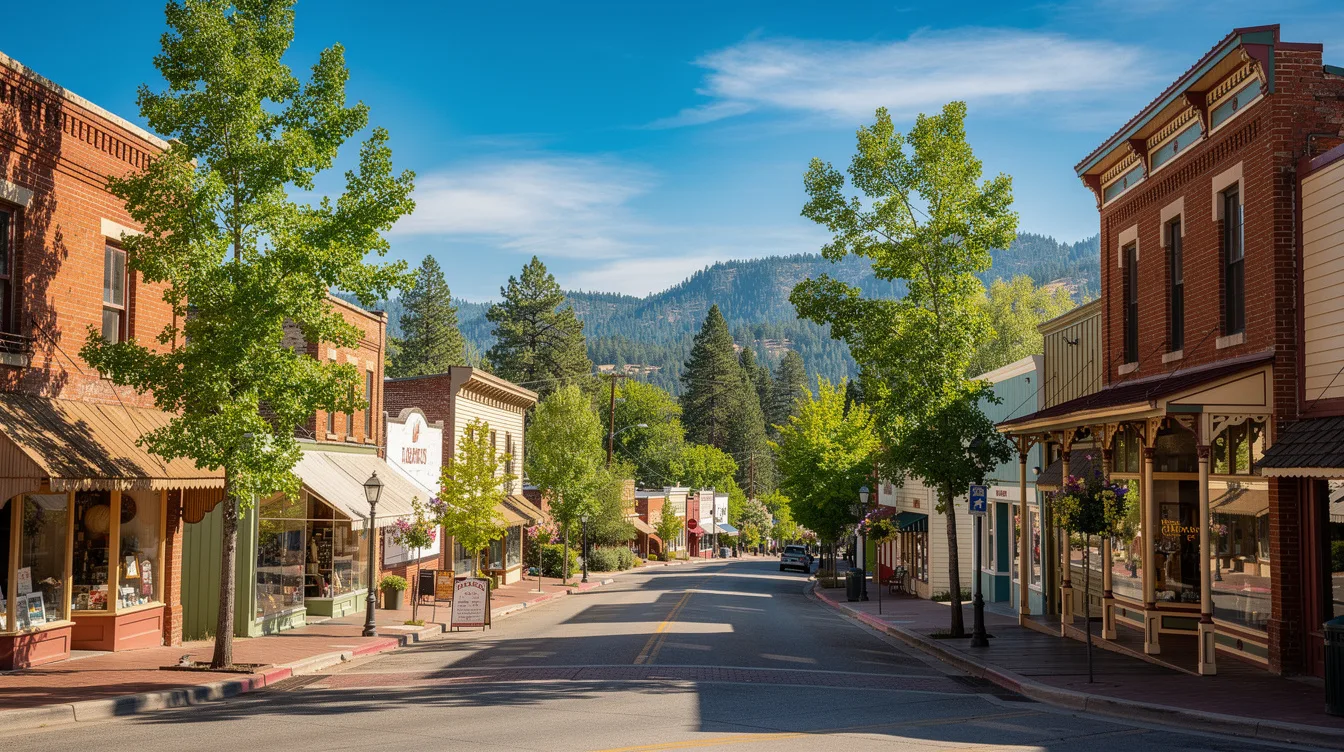
Nevada City began as a mining camp in 1849, and its historic center still gives the Gold Rush more than a passing mention. This Nevada County town keeps its old downtown in full view rather than behind museum glass.
But don’t confuse it with Nevada. This is California, in the Sierra Nevada foothills, where the streets tilt and old facades make even a quick walk feel deliberate.
Start where the Gold Rush still sets the pace
The downtown is the reason to come. Victorian-era buildings hold independent shops, galleries, restaurants, and historic hotels, so you can spend an afternoon moving slowly between doorways instead of trying to cover a giant attraction.
And that compactness is the town’s advantage. You don’t need a detailed plan to feel the pull of the historic center, but you should give yourself time to wander without treating it as a stop between Sacramento and somewhere else.
1849 matters here because it marks the beginning of Nevada City as a mining camp. The town was later renamed Nevada City to distinguish it from the neighboring state, a practical detail that still saves visitors some confusion.
The Nevada Theatre is more than a photo stop
The Nevada Theatre, dated 1865, belongs on any downtown walk. Its presence gives the historic center a focal point, and it’s more persuasive in person than any plaque could be.
But this isn’t a town where every block feels frozen. Restaurants and shops keep the center useful, which is why it feels lived in rather than arranged for visitors.
If you enjoy old towns but dislike places that turn every corner into a souvenir pitch, Nevada City makes a strong case for itself. It is tourist-friendly, yet the real pleasure is simply following the streets and seeing what remains.
At 2,500 feet, the outdoors starts close by
Nevada City sits at about 2,500 feet, on the edge of Tahoe National Forest. That setting puts you close to the South Yuba River, Deer Creek, Sierra lakes, and routes for hiking or mountain biking.
And the town works best when you pair its streets with one outdoor stop. Swim or hike around the South Yuba River, then return downtown when you want a meal and a chair instead of another trail.
Can you make Nevada City part of a wider weekend?
Yes. Nearby Grass Valley and Empire Mine State Historic Park extend the Gold Country story beyond Nevada City, while the Nevada County Narrow Gauge Railroad Museum offers another local stop.
But don’t cram every option into one day. The river, museum, mine, and downtown deserve different moods, and the better choice is usually two of them rather than a rushed circuit.
In spring, Crystal Hermitage Gardens adds a garden visit to the mix. From spring through fall, the town’s outdoor access gives you a useful counterpoint to its historic streets.
Getting there is simple, parking takes a little patience
California Highways 49 and 20 reach Nevada City. You can also approach from Reno, about 84 miles away, though Sacramento, about 60 miles away, is the closer major-city reference.
Downtown has some metered street parking, plus free lots nearby. That is convenient, but you’ll still want to arrive ready to walk once you’ve parked, because the center rewards a slower pace.
The town is small, with a 2020 population of 3,152, and that scale shapes the visit. You’re not coming for an endless menu of attractions. You’re coming because a Gold Rush center still holds together block by block.
By late afternoon, the old storefronts catch the changing foothill light, and Nevada City’s historic streets make the car feel like the least interesting place to be.