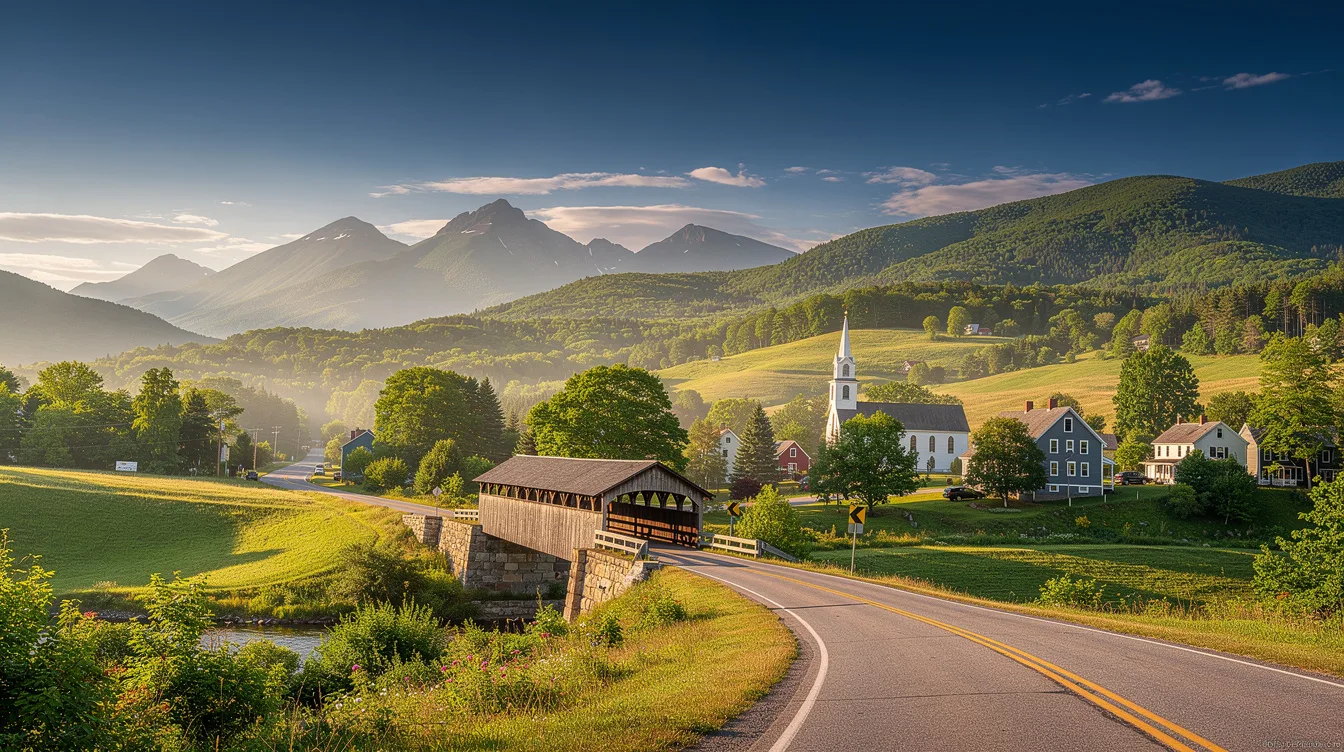
Jackson, New Hampshire, is about 3 hours from Boston, and its entrance makes the drive feel immediately justified. The village’s red covered Honeymoon Bridge sits at the approach, a compact New England welcome with enough character to slow down even a determined weekend itinerary.
But Jackson isn’t a city break with a packed checklist. It’s a small White Mountains town where you come to trade noise for mountain air, old inns, and a bridge that has become the village’s calling card.
The red bridge answers the title’s promise
The Jackson Covered Bridge is the red-covered structure visitors photograph at the village entrance. Its nickname, Honeymoon Bridge, gives the scene an easy romance without making it feel staged. You’ll see why people pull over: the bridge frames the first real sense that Jackson has its own pace.
And that pace is the appeal. This is not an urban main street built for constant entertainment. It’s a quieter stop in the Mount Washington Valley, north of North Conway, where the village setting does more of the work than a long list of attractions.
From Boston, Jackson is roughly 140 miles by car, mainly via Route 16. That makes it plausible for a long weekend, but far enough away that you should resist treating the bridge as a quick roadside photo and leaving immediately.
Jackson Falls gives the village a summer pause
Jackson Falls sits in town, with cascades and natural pools that make summer visits feel less like sightseeing and more like stopping somewhere on purpose. The water is the point here. You can hear it before you settle into the village rhythm.
But don’t expect a huge resort-style attraction. Jackson works best when you accept its smaller scale, then let a bridge, a waterfall, and the surrounding mountains fill an unhurried day. If you need nightlife and a crowded dining scene, North Conway is the more logical base.
Can you use Jackson as a mountain base?
Yes. Jackson is close to the White Mountain National Forest, Pinkham Notch, Glen Ellis Falls, and Mount Washington. That proximity matters because you can spend the day in the mountains, then return to a town that feels calmer once the hiking plans are over.
And you don’t have to make every day strenuous. The nearby mountain options give active travelers choices, while the village itself gives you permission to keep the schedule loose. That contrast is Jackson’s strongest argument: outdoorsy, but not relentlessly demanding.
Autumn is when the setting earns its reputation
Fall foliage is the season that best fits Jackson’s character. The New England colors give the covered bridge and White Mountains a stronger visual pull, so an already photogenic village becomes a natural stop on an October drive.
But autumn attention brings company. You won’t have the bridge to yourself if foliage is at its peak, and that is the trade-off for arriving when the area looks its most dramatic. Go with patience, and leave room in your day for a slower approach.
Winter shifts the village toward cross-country skiing, snowshoeing, and easy access to Wildcat Mountain. The setting remains quiet, but it’s not isolated. That balance makes Jackson a better choice for travelers who want mountain access without committing to a large ski-town atmosphere.
A small town, not a busy destination
Jackson had 1,028 residents in the 2020 census, and that number helps explain the mood. This is a tourist town, certainly, but it doesn’t pretend to be a bustling city. Historic inns and outdoor access set the tone instead.
And that’s why it suits couples, foliage chasers, and anyone who likes a weekend with fewer decisions. You can make it a base for the White Mountains or simply give the village a day. Both approaches work, though the second is more in keeping with the place.
By the time you pass back through the red bridge, the sound of Jackson Falls is behind you, and the road toward Boston feels a little too direct.