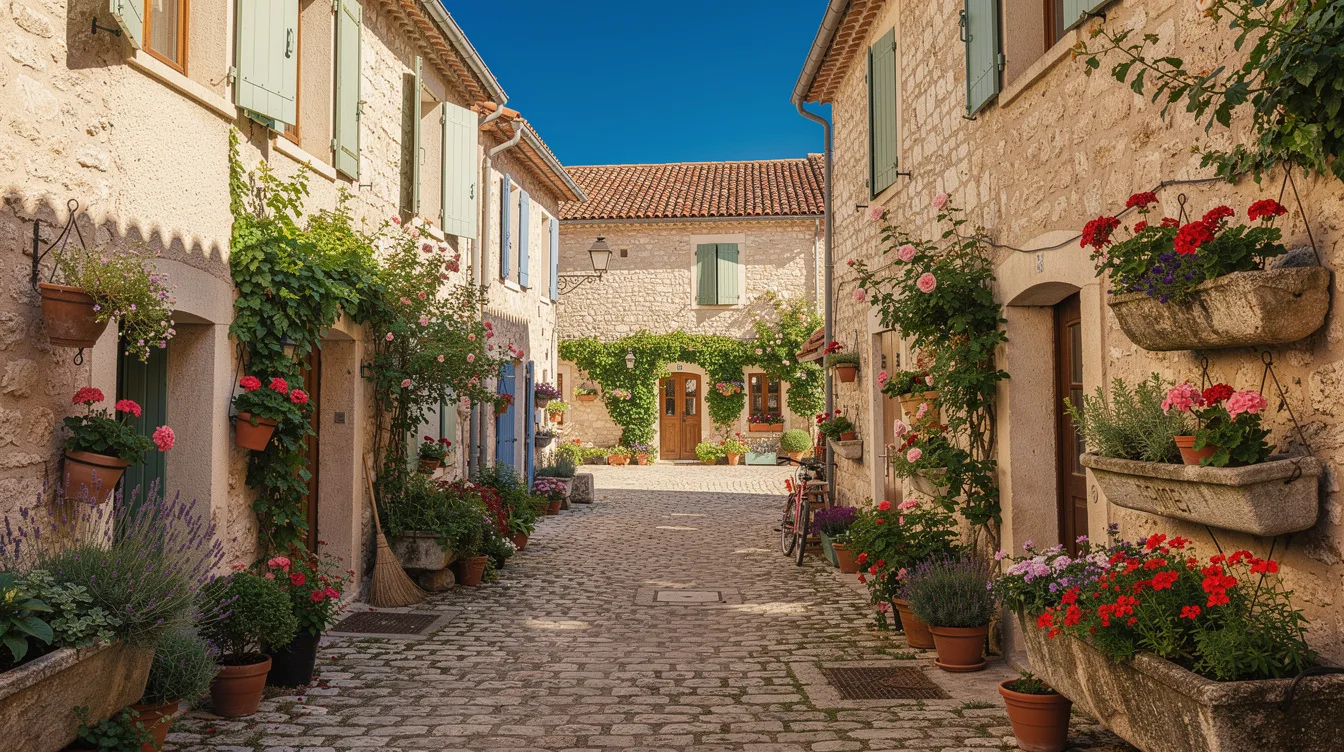
Châtillon-en-Diois, in France’s Drôme department, puts nearly 300 plant species on its facades and small squares. That’s the point of coming: flowers interrupt the stone lanes, so a simple walk through the old center feels less like sightseeing and more like following a living map.
It sits about 7.5 miles southeast of Die, beneath the Vercors and near the Glandasse massif. Come from spring into early fall, when the planted walls give the village its best argument.
Nearly 300 species change an old-stone walk
The botanical village idea could sound precious. Here, it works because the plants share space with real village life: narrow paved lanes, fountains, arched passages, shutters, and steep little turns. You don’t need an itinerary.
You need time to look up.
And the plants are not confined to one garden gate. They appear across facades and placettes, which makes the village feel lively but never loud. A patch of leaves beside old stone can stop you mid-walk, especially when the afternoon light reaches the upper walls.
The old center is known for its “viols”, the narrow, sloping paved streets that twist through the medieval core. They’re charming because they aren’t polished into a museum route. But the incline and uneven paving mean you’ll want steady shoes.
Start in the old center, then let the lanes decide
Châtillon-en-Diois belongs to Les Plus Beaux Villages de France, a designation that can bring expectations. The village earns it through texture rather than spectacle: vaulted passages, fountains, flowering houses, and streets that reward a slow pace.
But don’t rush through seeking a single famous viewpoint. The appeal is cumulative. A fountain follows a shaded passage, then a planted facade catches your eye, and suddenly the detour feels more useful than the direct route.
If you’re planning a wider Drôme trip, Châtillon-en-Diois makes sense as a quieter stop after Die. Its setting has vineyards, cliffs, and southern Vercors relief close together, so you can shift from stone streets to open country without much ceremony.
Can you pair the village with local wine?
Yes. The area is tied to the AOC Châtillon-en-Diois and Clairette de Die, giving a botanical stroll a local follow-up that feels natural rather than scheduled. You can spend the morning in the lanes, then make room for a tasting nearby.
And that pairing explains the village’s best rhythm. It isn’t a place that demands a packed day. It’s better for travelers who like a long walk, a local glass, and the freedom to linger when a square turns quiet.
The Vercors nearby gives the stop some range
The village is a starting point for the Haut-Diois and Vercors, including the Cirque d’Archiane and the Gorges des Gâts. That makes it useful for walkers who want a village base, not merely a photogenic lunch stop.
But the notes here are simple: the surrounding terrain is for hiking, and conditions matter. Plan your route locally and don’t assume the old center’s gentle wandering predicts what the larger countryside will ask of you.
The communal territory helps explain the meeting of mountain relief and vineyards around town. You can see the contrast in the atmosphere: dry-looking stone and cultivated vines, with larger slopes holding the horizon.
A small village with a recent municipal change
Châtillon-en-Diois had about 669 residents in 2023, though its communal area is far larger than the compact old center suggests. In 2019, Treschenu-Creyers merged with Châtillon-en-Diois, joining the former commune to today’s municipality.
That scale is worth remembering when you visit. The historic core is intimate, but the commune reaches into a broader rural setting. It feels remote enough to slow you down, yet Die is close enough to make the stop practical.
Is it a good stop for a few days?
It can be, especially if you want village streets, wine country, and hiking in one base. The trade-off is that its appeal is quiet. If you need constant activity, you may run out of reasons to stay inside the center itself.
For most travelers, that’s not a flaw. Walk the viols before dinner, when the fountains soften the sound of footsteps and the planted facades hold the last light.