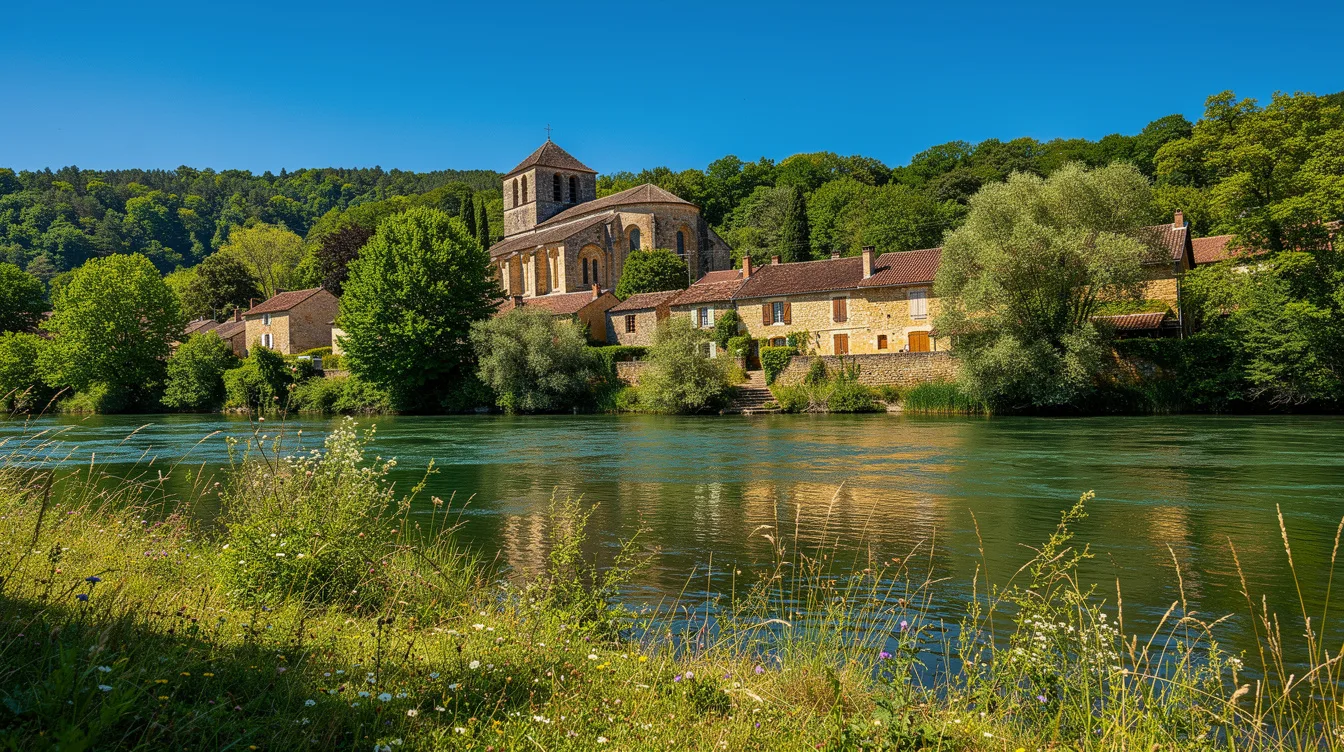
Saint-Léon-sur-Vézère belongs to Les Plus Beaux Villages de France for a reason you can see on foot. This tiny Périgord Noir village sits in a bend of the Vézère, between Montignac-Lascaux and Les Eyzies, where pale stone houses meet narrow lanes and riverbank paths.
It has only around 430 residents, so this isn’t a place that needs a full itinerary. You come for a few quiet hours, then realize the Vézère has slowed your plans down.
Its setting makes the case before you enter the church
The village’s official membership in Les Plus Beaux Villages de France is the central fact, but the setting explains why it fits. The Vézère curves around the settlement, so the river keeps appearing at the end of lanes and beside the old stone walls.
And you should walk without treating the village like a checklist. Its tight streets, known as couredous, are part of the experience, with blond stone façades and Périgord roofs catching the changing light.
It is photogenic, but not in a polished museum-piece way. The village is very small, which means you’ll run out of streets quickly, but that also leaves room for an unhurried walk along the riverbanks.
The 12th-century church gives it real weight
Saint-Léon Romanesque Church dates to the 12th century and is listed as a historic monument. That age matters because the building is not simply a scenic backdrop, it is one of the village’s defining places.
Inside, the church has frescoes, a detail worth seeking out rather than rushing past. But don’t expect a large urban monument with endless side chapels, its appeal is the close scale and the sense that the village grew around it.
In summer, the church hosts events from the Festival Musical du Périgord Noir. If concerts are your reason to visit, this is the season that changes Saint-Léon-sur-Vézère from a hushed stop into a cultural evening.
The old buildings are more than a pretty walk
The Manoir de la Salle reaches back to the 14th century and includes a square keep. It gives the village a medieval edge without turning the center into a theme set.
And the contrast is useful: you can admire serious old architecture while still moving through a lived-in place. You’ll see the history in the walls and roofs, then hear the river beyond them.
Château de Clérans, from the 16th century, overlooks the Vézère. It remains private property, so it is something to take in from the village rather than a castle visit you can plan your day around.
That limitation is part of the honest appeal here. Saint-Léon-sur-Vézère rewards looking and lingering more than collecting admissions, and you should arrive with that expectation.
See the Vézère from the bank, then from a canoe
A walk beside the Vézère River is the simplest way to understand the village’s position in its bend. The water gives the stone streets a softer counterpart, and the view opens up once you leave the tight lanes.
But a canoe outing is the better choice if you have time. From the water, you can see the valley and village from a different angle, which is why the river is more than a pleasant edge to the map.
You don’t need to force a packed day here. Plan a few hours for the village alone, or allow a half-day if you add time on the Vézère.
Use it as the quiet stop between Lascaux and Les Eyzies
Montignac-Lascaux and Les Eyzies sit on either side of Saint-Léon-sur-Vézère, placing it naturally within a Dordogne visit focused on prehistory. The village works best as a pause between those larger draws, not as their rival.
And that is its advantage. After more structured sightseeing, you can trade exhibits and schedules for a short river walk, old masonry, and lanes where there is little pressure to do anything quickly.
Summer brings concert activity, though the village’s quieter character remains the point. By the time you return to the Vézère’s bank, the pale walls sit above the water and the day feels pleasantly unfinished.