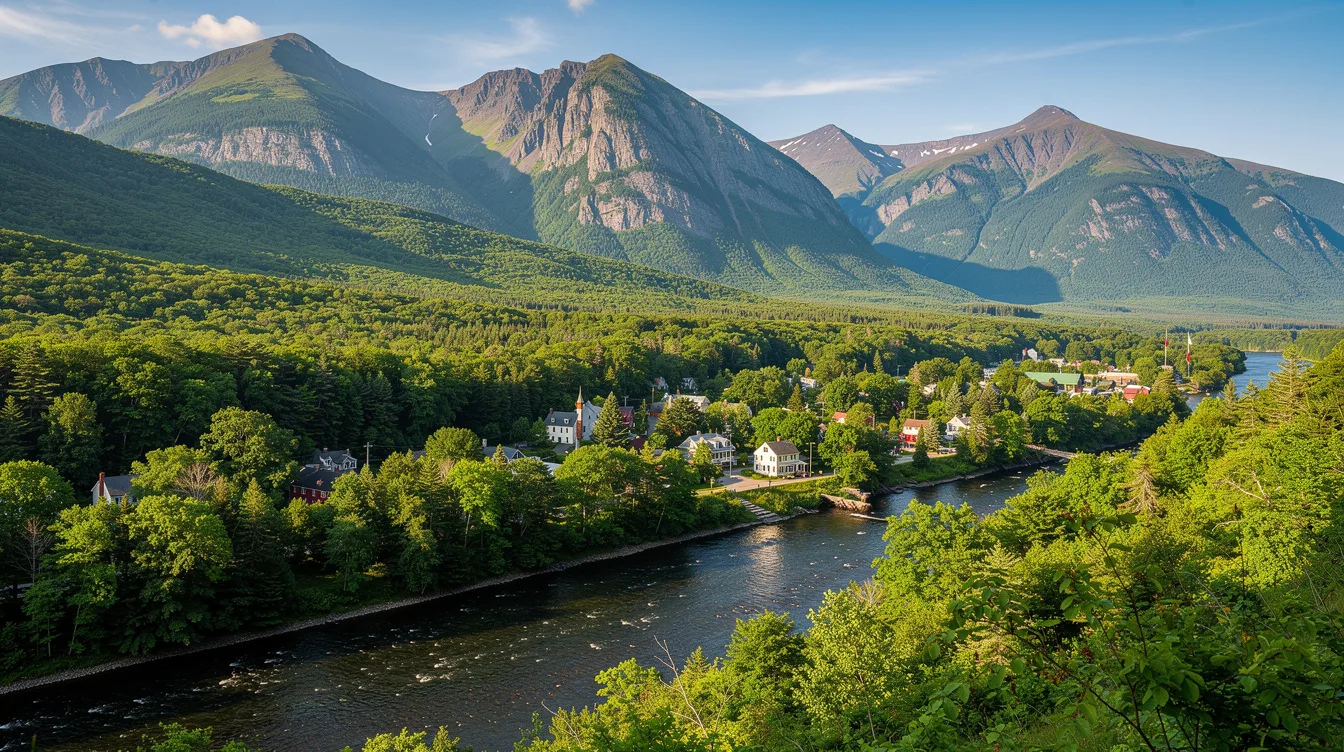
North Conway was drawing skiers by train in 1932, long before ski vacations became a familiar American ritual. That history still gives this White Mountains village an unusual pull: you come for winter, then realize the train station, cliffs, and small-town streets make a stronger case for staying awhile.
It’s a resort village, but it doesn’t feel built around a single season. And that matters if you’re the kind of traveler who wants mountain access without committing every daylight hour to a lift ticket.
A 1932 ski trip had a destination
In 1932, snow trains began carrying enthusiasts to North Conway, a place associated with the “birthplace of American skiing.” The phrase is part of its local identity, and the timing is the point: people were already arriving by rail for snow when ski travel was far less routine.
Today, the Conway Scenic Railroad runs classic excursions from the village’s Victorian station. You won’t be retracing a snow-train commute exactly, but you can still feel why rail belonged here. The depot gives the center a sense of arrival that parking lots rarely manage.
And North Conway has enough around that station to keep a non-skier interested. Independent shops, bakeries, bookstores, restaurants, and the outlet stores around Settlers Green all sit within the broader village experience. It’s commercial, yes, but not only commercial.
Cranmore keeps the ski story close
Cranmore Mountain Resort is North Conway’s own winter ski option, while Attitash Mountain Resort, Black Mountain, and Wildcat Mountain are nearby choices. That concentration is why the village becomes a nighttime base for skiers. You can spend the day in the mountains, then return to actual streets and dinner options.
But winter isn’t the only reason to look up. Cranmore also has summer activities, including chairlift rides and a mountain coaster, so the same mountain-town setup works after the snow is gone.
If you’re visiting with mixed interests, this is North Conway’s advantage. One person can pursue snow sports or mountain activities while another takes the railroad, browses a bookstore, or simply lingers over coffee. The compromise feels less like a compromise here.
Cathedral Ledge earns the short detour
Cathedral Ledge rises above Echo Lake and North Conway from the west. It’s popular with climbers, and an automobile road reaches the summit. That access changes the proposition: you don’t have to be a climber to get a wide view over the Saco River Valley.
And the ledge has the kind of abrupt scale that makes the valley below seem calmer. Echo Lake State Park lies beneath it, with water, rock, and forest sharing the frame. It’s an easy place to understand at a glance.
Can you reach the view without a long hike?
Yes. Cathedral Ledge has an automobile road to the summit, so you can reach the overlook without treating the visit as an all-day hike. The trade-off is obvious: this is not a solitary backcountry experience, especially when the weather is good.
Beyond the ledge, the White Mountain National Forest lies to the west and north. North Conway is a practical base for hiking, climbing, scenic viewpoints, and time around Mount Washington Valley, though the village itself stays the useful center of gravity.
Fall makes the village harder to leave
Late September through early October brings visitors for autumn foliage on the surrounding mountains and forests. Late September to early October is the window that matters, and it’s busy for a reason: the roads, rail line, and high viewpoints all put color within easy reach.
The Kancamagus Scenic Byway begins nearby and crosses the White Mountain National Forest toward Lincoln. It’s especially popular in fall, which means you should expect company. But the payoff is a drive built around looking out the window, not racing toward the next stop.
Summer has its own appeal, with hiking, swimming, scenic drives, and family activities. Spring is quieter and can bring lower lodging demand. North Conway doesn’t force one correct itinerary, although winter and foliage season give it its clearest personality.
Getting there is part of the calculation
North Conway sits in eastern New Hampshire near the Maine border. Portland is the nearer major airport, so it’s often the more sensible arrival point if you’re flying in.
U.S. Route 302 runs through the area, placing the village at the edge of the White Mountains. The population was 2,116 in 2020, which explains the scale: there are services, but no big-city anonymity.
By the time the train leaves the Victorian station and the light drops behind Cathedral Ledge, North Conway feels less like a ski stop than a mountain town that learned early how to welcome people in.