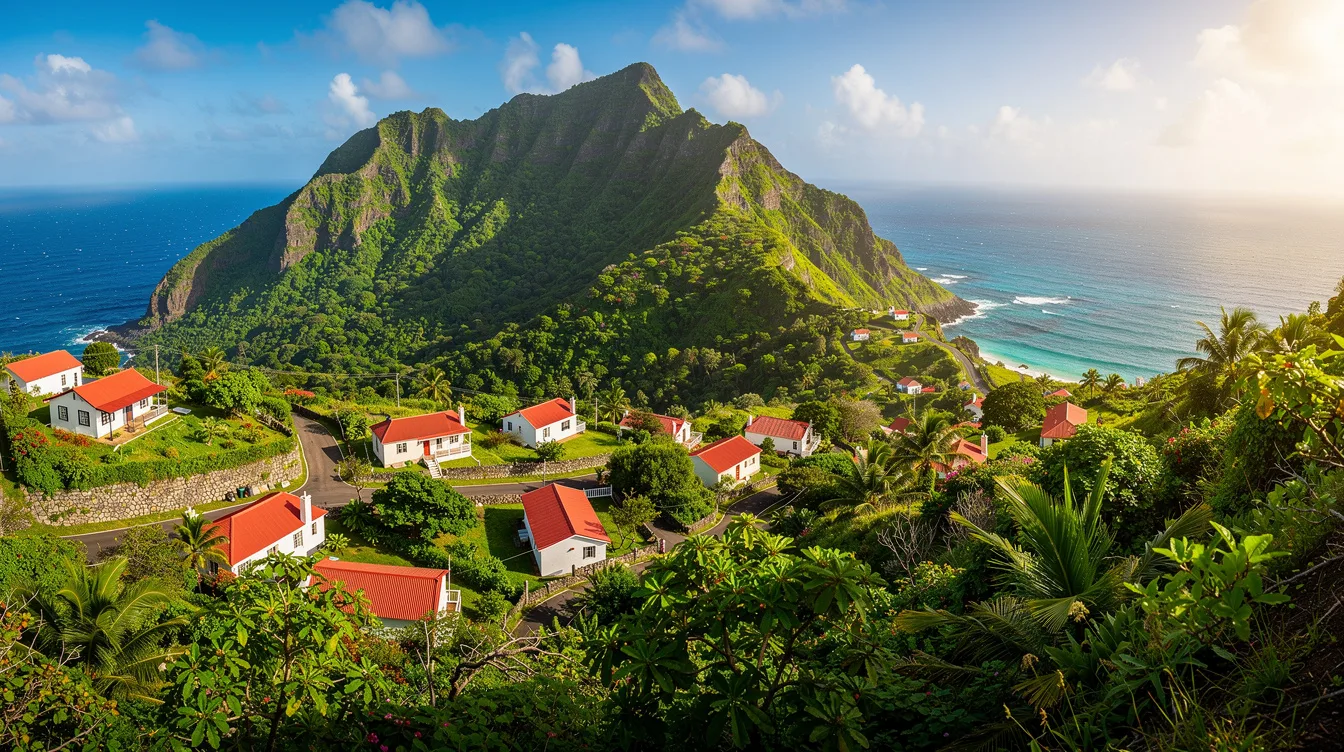
Saba has no broad resort beach and little patience for crowd-chasing travel. That’s precisely why this steep Caribbean island feels different. Its central peak, Mount Scenery, is the highest point in the Kingdom of the Netherlands, a fact that catches many Dutch travelers off guard.
You reach this small volcanic island through Sint Maarten, then swap the usual Caribbean ease for a small plane or ferry. But that slight inconvenience filters the mood. The shoreline is rugged, the terrain rises quickly, and mass tourism never really gets a foothold.
The Netherlands’ highest point is in the Caribbean
At about 13 km², Saba is one of the three Caribbean Netherlands islands, alongside Bonaire and Sint Eustatius. Yet its scale is misleading. The island climbs sharply toward Mount Scenery, so even an ordinary walk can feel like a mountain outing.
And that is the promise worth coming for: the Netherlands’ loftiest point isn’t in Europe at all. It’s here in the northeastern Caribbean, above a place where cloud forest hiking matters more than sun loungers. You get a Caribbean trip with a distinctly uphill personality.
Mount Scenery is described as dormant or potentially active, and the volcanic ground explains Saba’s dramatic shape. The slopes are steep, so the island’s appeal lies in trails, reef water, and the feeling of being far from the standard resort circuit.
But don’t expect a carefree beach itinerary. Saba is quieter and less beach-oriented than many neighboring islands because its coast is mountainous and rugged. If wide sand and all-day pool service are your priorities, this isn’t the right match.
The Bottom feels like the island’s practical center
The Bottom is Saba’s capital and main seat, an apt name for a settlement on an island built around elevation. It gives you a place to orient yourself before heading into the hills or toward the water.
English is the principal everyday language, though Dutch is official. And the currency is the US dollar, which removes one small travel friction for American visitors. The island operates on UTC−4, useful to know when you are coordinating flights or ferry connections.
Saba has roughly 2,000 residents, and you feel that modest scale quickly. The streets and slopes don’t suggest an island engineered for crowds. They suggest a place where visitors need to adapt their pace to the terrain.
But “remote” doesn’t mean disconnected from the Netherlands. Since October 10, 2010, after the Netherlands Antilles dissolved, Saba has been a public body and special municipality of the Netherlands. It is not part of a Dutch province, and it sits outside the EU’s standard territory and Schengen.
Getting there is part of the filter
Most visitors arrive via Sint Maarten, using a small regional flight or ferry. That routing is more involved than flying directly into a large Caribbean airport, so you should plan your connections carefully rather than treat Saba as a casual add-on.
And the airport is part of the story. Juancho E. Yrausquin Airport is known for its exceptionally short commercial runway, a detail that makes arrival feel more intimate than grand.
You are not landing at a resort gateway. You are arriving on a mountain island.
The ferry offers another route, but the same advice applies: build your itinerary around transport rather than assuming endless departures. Because access is limited to these smaller links, Saba retains the quiet that many larger Caribbean destinations have traded away.
Can you go to Saba for the water?
Yes, if you want reefs and diving rather than a beach-heavy vacation. Saba Marine Park and the island’s underwater pinnacles are major draws, and the protected marine setting gives the sea a larger role than the limited shoreline might suggest.
But the experience asks something of you. You come here to dive, hike, and accept a smaller set of choices. That trade-off is the point, especially if crowded beaches and busy waterfront strips have started to blur together.
A Caribbean island for travelers who prefer altitude
Saba’s strongest quality is that it doesn’t imitate the rest of the region. You can hike toward cloud forest, then turn your attention underwater. The island is compact, but the volcanic rise makes it feel physically larger than its footprint.
And it is low-key without being blank. The mountain gives the island purpose, while the reefs give it a second world below the surface. You’ll find less conventional beach time, but more reason to look up and out.
For travelers who want the Caribbean without the usual resort script, Saba makes a convincing argument. By the time the small plane or ferry carries you away, the island’s steep green slopes are the last thing you see.