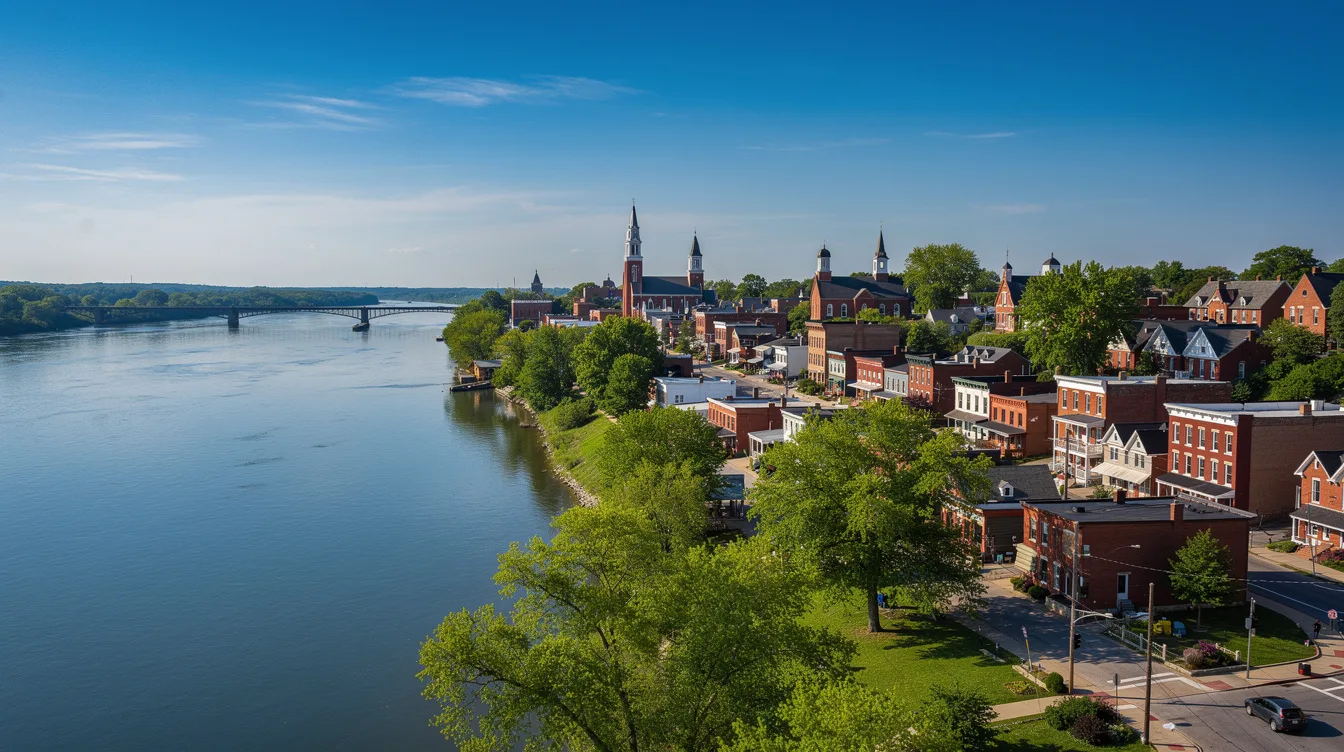
Madison, Indiana, holds the largest contiguous National Historic Landmark District in the United States. That claim sounds like a plaque-worthy technicality until you arrive on the north bank of the Ohio River and realize how much of the town still speaks in 19th-century brick, stone, and wood.
Founded in 1809, Madison grew into a major river port and an early railroad terminus. You don’t need a museum script to feel that past here, because the historic fabric extends along and near Main Street instead of sitting behind a rope.
The historic district is the whole point
America’s largest contiguous historic district gives Madison an advantage many old towns lack: the story doesn’t break after one block. You can move through a working small city while its 19th-century architecture keeps the visual thread intact.
And that continuity changes the visit. A single preserved house can feel formal, but a district this extensive makes you notice the accumulated details: masonry, tall facades, river-facing streets, and the sense that the town developed as one connected place.
But don’t come expecting a theme park version of history. Madison is a city of about 12,000 residents, and that scale is part of its appeal, though visitors who want nonstop attractions may find the pace deliberately quiet.
Main Street carries the argument
Main Street and the surrounding area are where Madison’s architecture makes its strongest case. The buildings are the draw, so give yourself time to look up rather than treating the district as a quick stop between larger destinations.
And you should resist the urge to rush through with a checklist. The best part is the repetition of real urban texture, one historic frontage after another, which makes the district feel substantial instead of ceremonial.
Madison’s river-port history explains that density. Trade on the Ohio River helped the town grow, and its role as an early railroad terminus brought another layer of importance before modern travel routes changed how Americans moved through the region.
The Ohio River keeps Madison grounded
The city sits on the north bank of the Ohio River, opposite Milton, Kentucky. That location gives the old town a practical logic: this was a place connected to river traffic, not a collection of old buildings preserved in isolation.
But the riverfront setting is more than background scenery. Stand near the water and the broad current shifts the mood, adding open sky and the low, steady presence of the river to streets otherwise defined by close-set historic architecture.
For travelers coming from Louisville, Madison is about 46 miles northeast. That makes it an easy change of pace from the city, especially if you prefer a place where the destination is the walk itself rather than a packed itinerary.
There is more than architecture nearby
Clifty Falls State Park adds the outdoors component that historic-district visits often miss. The park is known for hiking, waterfalls, and views over the Ohio River valley, so you can trade brick streets for a more rugged setting without leaving the area.
And that contrast is Madison’s strongest practical argument. You can spend part of the day following the town’s built history, then head toward falls and valley overlooks when you need less pavement and more room around you.
The trade-off is simple: don’t reduce the park to an afterthought. If hiking and waterfalls matter to you, leave enough time for them, because the historic district alone can easily absorb an unhurried visit.
What historic sites should you look for?
Look for the 1844 mansion and the Shrewsbury-Windle House among Madison’s notable historic sites. They provide a more focused encounter with the city’s past, while the surrounding district supplies the wider context that makes those places matter.
But the larger lesson is outside their walls. Madison works because individual sites are embedded in a cityscape that still reads as a river town shaped by commerce, transportation, and long-term settlement.
Go for the scale, not a single photo
Madison is best for travelers who enjoy place more than spectacle. You’ll get the clearest sense of it by walking slowly, noticing how the historic district holds together, and letting the Ohio River explain why this small Indiana city developed where it did.
And that is why the superlative feels earned rather than promotional. By the river, old facades catch the changing light, while Madison remains a real town first and a historic district second.