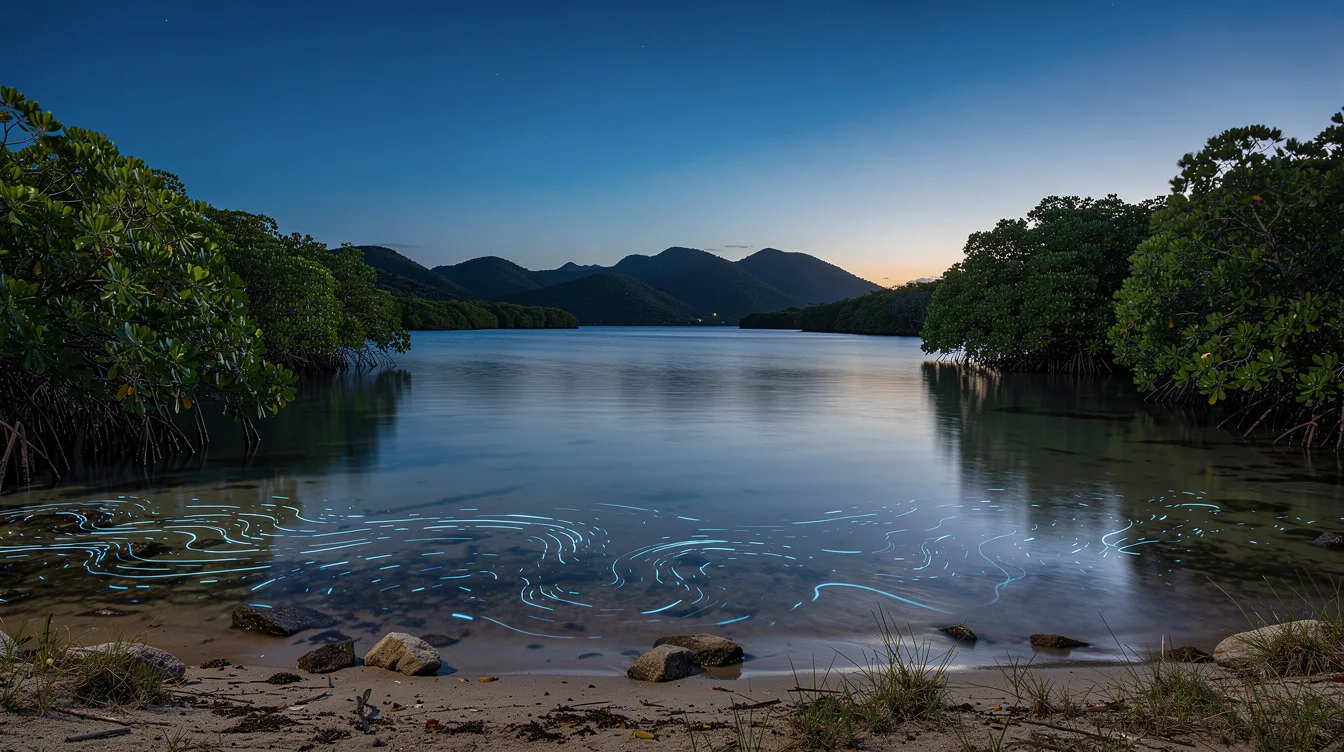
Vieques sits just 8.1 miles east of Puerto Rico’s main island, yet the crossing changes the mood fast. You leave Ceiba behind, take a ferry that generally runs 30 to 45 minutes, and arrive somewhere quieter, warmer, and more exposed to the sea.
And after dark, the island’s central promise comes into focus. Mosquito Bay is often presented as the world’s brightest bioluminescent bay, where water can shine when it’s disturbed. It’s the kind of night outing that makes dinner plans feel secondary.
Mosquito Bay earns the late-night trip
You come to Vieques for the bay, but don’t expect a daytime spectacle. The point is darkness. Once night settles, the surface becomes part of the experience, and every small movement can make the water seem lit from beneath.
But this isn’t an island built around one attraction. The bay gives Vieques its after-dark drama, while the days belong to beaches, refuge land, and roads where wild horses can appear without much warning.
The short crossing is what makes the contrast work. Vieques feels removed, but it isn’t difficult to reach from Puerto Rico. A short flight from San Juan is another option, so you can trade city traffic for salt air without committing to a long travel day.
And plan ahead if you’re taking the ferry. The notes recommend early reservations on weekends and holidays, which is sensible when many travelers are making the same quick escape.
Esperanza has the island’s social side
Esperanza, on the south side, is the livelier part of Vieques for restaurants and access to several beaches. You’ll find more movement here, more tables filling around dinner, and more reason to stay out after the sun drops.
It’s lively, but it doesn’t erase the island’s slower pace. You can spend an evening around Esperanza, then wake up to a road that feels almost empty except for hoofbeats, wind, and the occasional passing car.
For a different rhythm, head toward Isabel Segunda, the main town in the north and the island’s historic and administrative center. It gives you a clearer sense that Vieques is a municipality where people live, not simply a beach stop.
And that matters. If you treat Vieques as a one-night excursion, you may see the glowing bay but miss the island’s best quality: how quickly the hours loosen once you stop trying to fill them.
A refuge with a difficult past
A large part of the island belongs to the Vieques National Wildlife Refuge, much of it formed from former U.S. Navy land. The Navy left in 2003 after decades of military use, and that history still shapes what is open and what remains closed.
But don’t assume every stretch of coast is available. Some former Navy areas remain closed because of contamination or unexploded ordnance cleanup. It’s a real limitation, and respecting it is part of traveling here responsibly.
The accessible eastern beaches include Caracas, La Chiva, Pata Prieta, Plata, Red Beach, and Blue Beach. On the west, Punta Arenas was once called Green Beach by the Navy. Their white sand and blue water draw the attention, but the refuge context changes how you read the view.
You can feel the island’s scale while moving between them. Vieques is about 20 miles long and roughly 4.5 miles wide, so it’s manageable, though not so small that you should expect everything to sit around one corner.
Why Vieques works best without a packed plan
The island has beaches, wild horses, a refuge, and a bay that glows after dark. Still, its strongest argument is less tidy. Vieques asks you to leave room for a slow ferry, an unplanned stop, or a night when the water becomes the only thing worth watching.
And that is why it feels different from a quick Puerto Rico add-on. By the time you return from Mosquito Bay, the road is dark, the air is soft, and the island has gone quiet again.