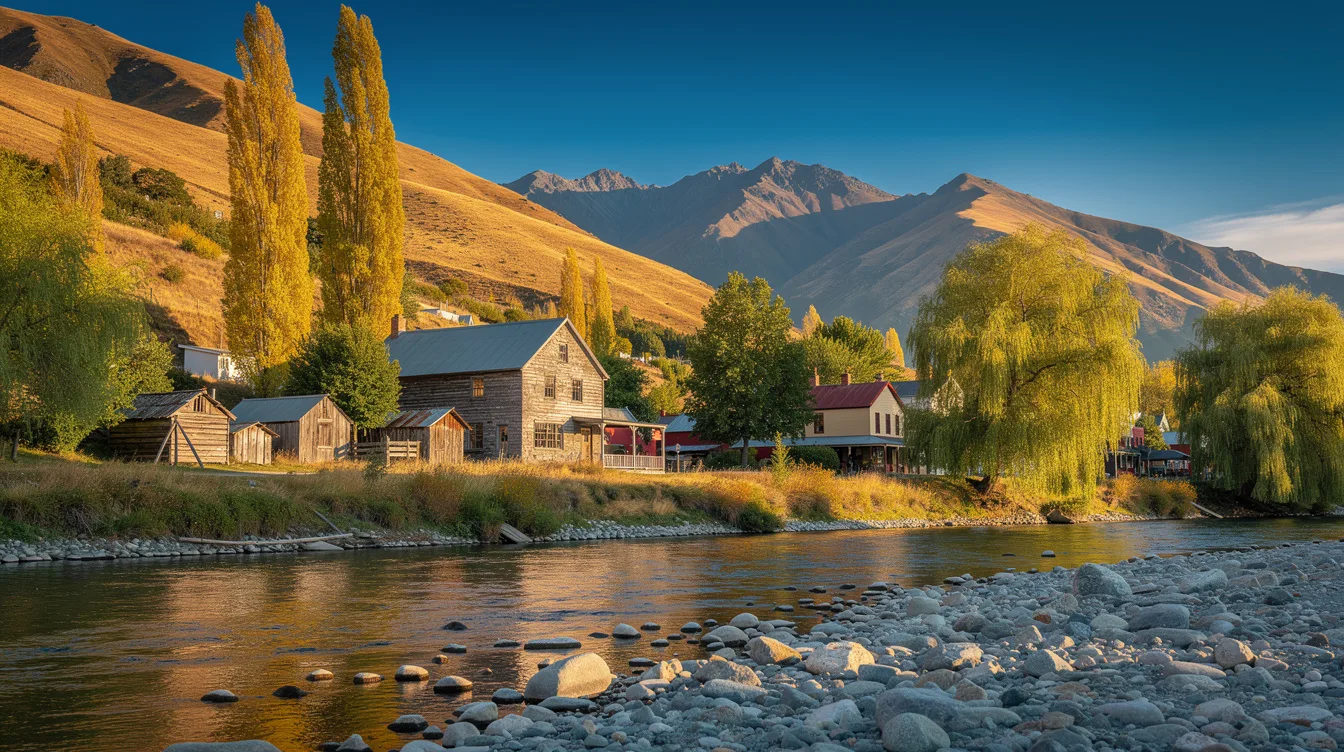
Arrowtown once swelled past 7,000 residents during the 1862 Otago gold rush. Today, this small town in New Zealand’s South Island still holds onto the mining-era buildings that make the boom feel close enough to touch.
It sits 12.1 miles east of Queenstown, beside the Arrow River. That short distance matters: you can leave Queenstown’s busy center behind, then arrive somewhere quieter with old storefronts and stone cottages under mountain light.
A gold-rush town that kept its evidence
Gold was found in the Arrow River in August 1862, and a township of 800 miners quickly appeared. Arrowtown then grew into the center of a wider gold-mining district, so its past is more than a plaque outside a café.
But the first buildings were temporary, made from calico. As mining and the population held steady, more permanent structures replaced them, which is why you can still walk streets built for people who expected to stay.
You should begin on Buckingham Street, where more than 60 early buildings remain. Restored miners’ cottages and historic shops give the town a lived-in texture, though the cafés and boutiques mean it doesn’t feel preserved under glass.
And that’s Arrowtown’s best tension. It is polished enough for an easy afternoon, but the surviving buildings keep the harder story of a mining settlement in view.
The Chinese Settlement changes the walk
The Arrowtown Chinese Settlement sits by Bush Creek and preserves huts connected to Chinese gold miners. Chinese settlers first arrived in Arrowtown in the 1870s and were forced to live in huts along the creek banks.
That detail should slow you down. The settlement isn’t a decorative detour from Buckingham Street, it is part of the town’s mining history and a necessary correction to any easy gold-rush nostalgia.
You can visit restored miners’ houses and Ah Lum’s store there. The creekside setting feels quiet, but the story it holds is not soft: opportunity came with exclusion, and the buildings make that contrast visible.
And because the site is close to the river, it connects the human story to the source of the rush. The water that drew prospectors also shaped where people were allowed to live.
Follow the Arrow River, where the rush began
The Arrow River was a key gold-bearing waterway, and trails along it are now a major reason to come. Walk or bike beside it after Buckingham Street, and you’ll understand why Arrowtown feels more dimensional than a quick heritage stop.
The river carries the town beyond its facades. You get moving water, open paths, and the sense that the mining story happened in a valley rather than inside a museum case.
But don’t expect wilderness isolation. Arrowtown has cafés, restaurants, golf, nearby ski areas, and a compact center, so you can make a day of history and still stop for lunch without much planning.
For more context, the Lakes District Museum covers local gold mining and early settlers inside historic buildings. Go before your river walk if you like details, because the streets read differently once you know what you’re looking at.
Queenstown access, without Queenstown’s pace
Arrowtown is about 20 minutes from Queenstown by car, reached via routes through Arthurs Point, Lake Hayes, or Arrow Junction. The blue Orbus #2 also links Queenstown and Arrowtown through Arthurs Point, which gives you an alternative to driving.
You can use it as a calmer base than central Queenstown, especially if heritage walks and cycling matter more than being in the middle of the action. But it isn’t a substitute for every Queenstown experience, and that’s precisely why the pairing works.
The town’s main street sits at 1,345 feet above sea level. Arrowtown has four distinct seasons, so its appeal changes with the weather rather than staying fixed in one postcard version of itself.
And winter has a real caveat. Cold nights can bring poor air quality from domestic wood burning and local temperature inversions, even though early-afternoon air quality has been reported as excellent.
April is when Arrowtown leans into color
The annual Arrowtown Autumn Festival takes place every April. Red and gold foliage brings a natural reason to visit then, while the festival adds a street parade, gold-panning championships, performers, vintage cars, and market stalls.
You’ll find more activity, but not the pace of central Queenstown. April makes sense if you want the town’s heritage buildings framed by autumn color and don’t mind sharing Buckingham Street with festival crowds.
Outside festival time, Arrowtown asks less of you. Walk the river, step through the Chinese Settlement, then linger over the old cottages without treating the town as a box to check.
By late afternoon, the Arrow River keeps moving past the old miners’ buildings, and Buckingham Street settles back into its everyday rhythm.