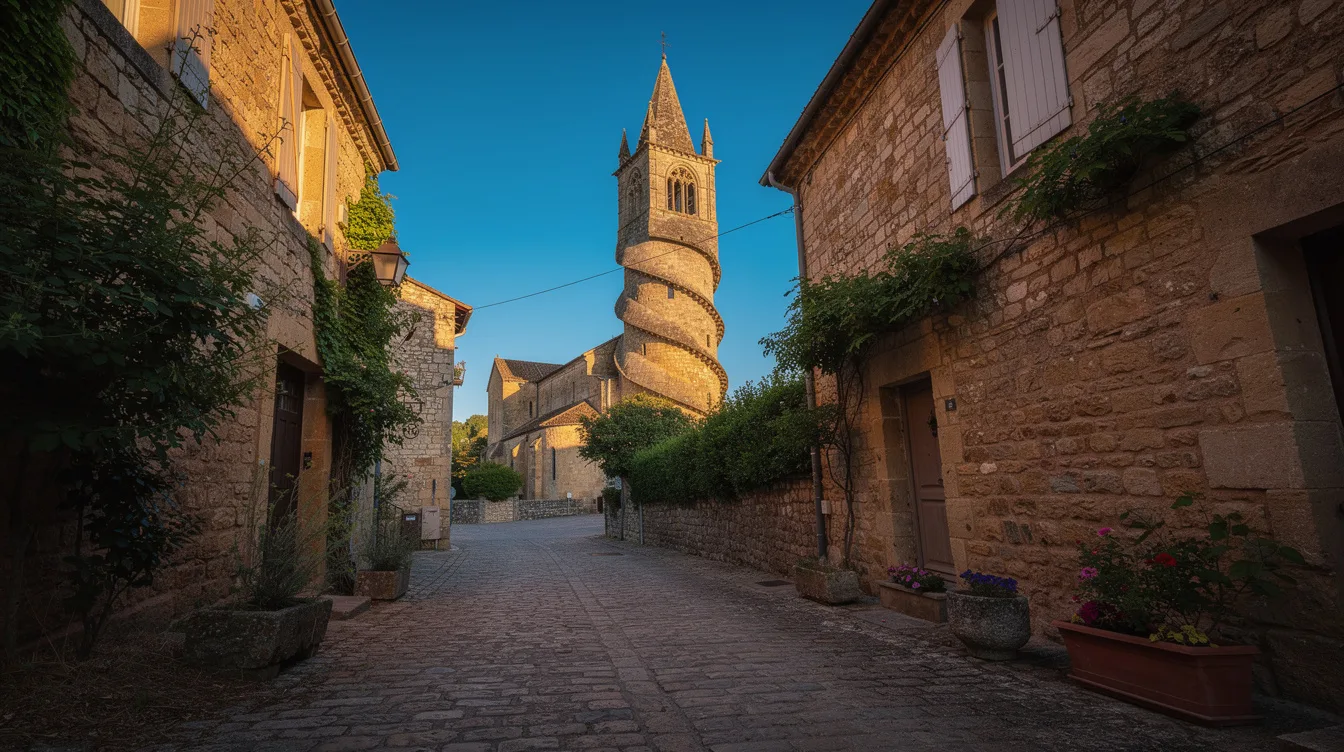
Saint-Côme-d’Olt has a bell tower that seems to lean into the sky, and that odd silhouette is the village’s best answer to a traveler’s first question. The church of Saint-Côme-et-Saint-Damien has a twisted Flamboyant Gothic tower built in the 16th century.
But the supplied record doesn’t explain exactly why its spire twists. It identifies the tower and its period, not a builder’s intention or a structural secret. That restraint matters.
You can admire the curve without being sold a convenient legend.
The tower gives the village its strange, clear signature
Set in the Lot Valley in northern Aveyron, near Espalion and at the foot of Aubrac, Saint-Côme-d’Olt is the sort of stop that changes shape as you approach it. The church tower rises above old roofs, so you notice its spiral before the village fully comes into view.
And that is the point of coming: the twisted bell tower gives a compact medieval village an instantly recognizable profile. It’s theatrical, but not showy. The stone seems to turn slowly above the tighter lines of the church below.
You’ll find the tower at the church of Saint-Côme-et-Saint-Damien, where Flamboyant Gothic detail meets a form that refuses to sit still. Look up from different streets. The twist changes with your angle, which makes a short walk feel less predictable.
But don’t expect a museum-style explanation posted on every corner. The stronger pleasure is visual: pale stone, narrow lanes, and a spire that looks almost wind-shaped against the open southern French light.
Walk the old circle, then look upward again
Saint-Côme-d’Olt is listed among Les Plus Beaux Villages de France, a designation that can attract crowds but also makes sense here. Its medieval streets hold their shape, with three former fortified gates and a circular route following the old ditches and ramparts.
Start with the tour de ville and let the curve do the work. Because the route follows the former defenses, you get a better sense of the village as a whole than you would by simply chasing one photogenic doorway.
And keep an eye on the roofs. Some houses have carène roofs, shaped like overturned boat hulls, an architectural detail associated with the Lot Valley. They give the lanes a softened, rounded skyline beneath the tower’s sharper spiral.
The streets also hold Renaissance houses, though the village is not frozen in one period. That contrast is part of its appeal. The tower is Gothic, the homes carry later details, and the old defensive outline still directs your feet.
You can also pass the Chapel of the Penitents, once a hospice for pilgrims, and the Château de Castelnau, now the town hall. Neither needs much ceremony. They make more sense as pieces of a lived-in village than as isolated sights.
The Way of St. James keeps the lanes moving
GR 65 runs through Saint-Côme-d’Olt as part of the French Via Podiensis route toward Santiago de Compostela. Pilgrims arrive from Saint-Chély-d’Aubrac, then continue toward Espalion and its Church of Perse.
That connection gives the village a useful tension. It feels old and contained, yet walkers are always passing through. You may hear boots on stone or see a pack set down near a doorway, then the lane goes quiet again.
But you don’t need to be walking the long route to understand the appeal. The Lot Valley setting makes this an easy pause when you’re exploring Aubrac or nearby Espalion. The riverbank and the Calvaire viewpoint offer a change from close stone walls.
The notes also identify the Lot’s banks as a place for a stroll or a swimming pause. Bring your own judgment about conditions. What matters here is the shift in mood: from enclosed lanes to water and open air.
Give Saint-Côme-d’Olt time, not a rushed stop
Plan 1.5 to 3 hours in the village, with more time if you combine it with Espalion, Estaing, or a walk toward Aubrac. That’s enough to circle the old defenses, see the church, and linger by the Lot without turning the visit into a checklist.
Spring and fall are the best fit for an unhurried walk. Summer has its own advantage, because guided visits are usually organized in July and August. It may be busier then, but a guide can help give the stone streets some context.
And if you stop for food, look for aligot, Aubrac beef, and products from Aubrac. The village doesn’t need a grand finale. By late afternoon, the tower still twists above the roofs, while the Lot carries on beside the old walls.