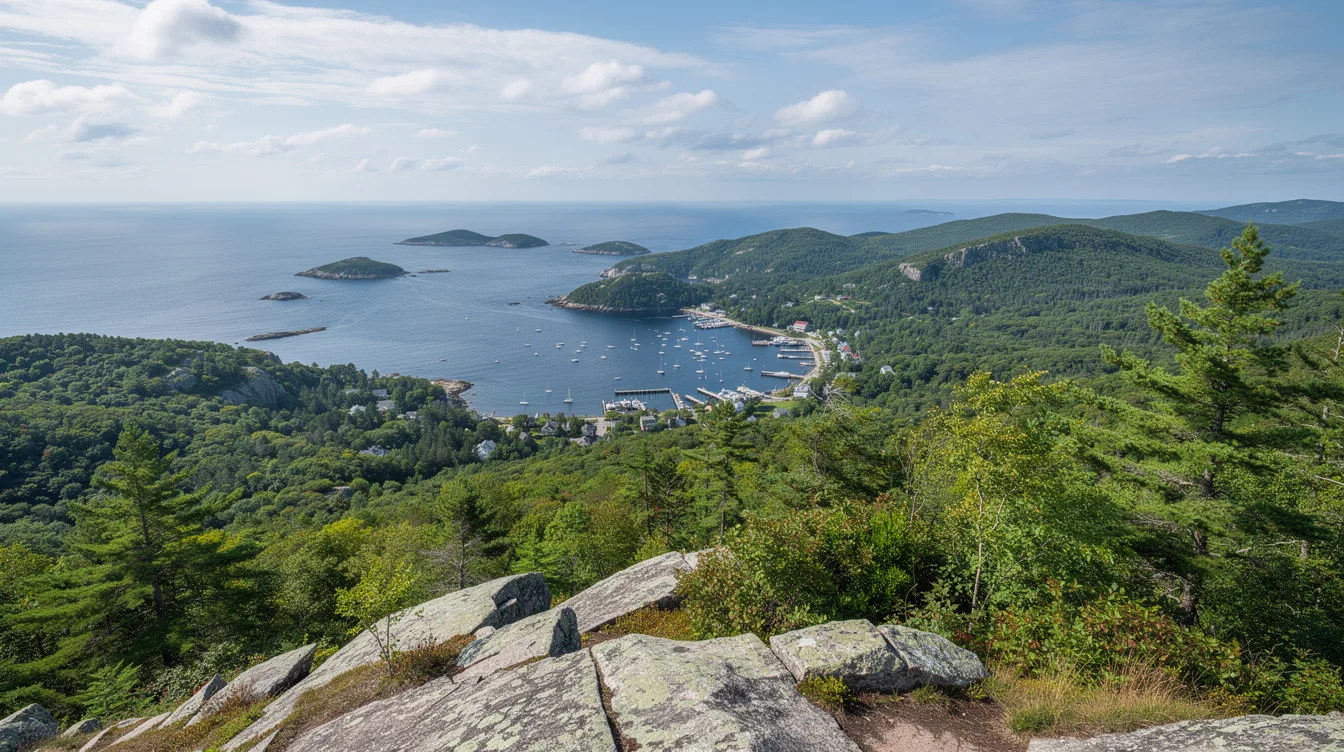
Camden, Maine makes its case quickly: mountains rise beside the Atlantic on Penobscot Bay, a pairing that’s rare along this coast. You can feel the town’s pull in summer, when the harbor and hills share the same view.
It was incorporated in 1791, and its population was 5,232 in the 2020 census. But Camden doesn’t feel defined by a number. Water takes up roughly 8.4 square miles of its total area, so the bay is never far from the conversation.
Where the Camden Hills meet Penobscot Bay
The central pleasure here is the collision of Camden Hills State Park and the sea. The hills rise right beside Penobscot Bay, which means you don’t have to choose between a mountain view and a harbor walk. You get both in one compact stretch.
And that geography changes the mood. The harbor feels active, but the slopes keep it from becoming just another coastal main street. You’ll see open water beyond town, then lift your eyes and find the hills waiting behind it.
The park covers 5,710 acres next to town. That’s a lot of ground for a place whose summer center is often the waterfront, and it gives you an easy escape when the streets begin to fill.
Mount Battie is the view worth timing
The auto road at Mount Battie is popular from roughly May through October. It’s the obvious move, and for good reason: the road puts the bay, harbor, and surrounding hills into one wide frame without asking you to spend the day on a trail.
But summer popularity is real. Camden’s population more than triples as visitors and seasonal residents arrive, so you shouldn’t expect a solitary lookout in the middle of a bright afternoon. Go for the view, not the illusion of having it to yourself.
Can you see the bay without a long hike?
Yes. The Mount Battie auto road is the practical answer, especially if you want the hills-and-ocean contrast without committing to a longer outing. You’ll still want patience during the busy season, because this is one of the town’s most familiar routes.
And the payoff is unusually direct. The broad water below catches the light, the harbor sits close by, and the ridges explain why Camden feels different from a flat coastal stop.
1936 still shapes the harbor
Camden’s harbor is the town’s centerpiece, and the windjammer fleet gives it a clear identity. These traditional sailing schooners date back to 1936, linking the waterfront to a long-running local travel tradition rather than a newly built marina mood.
You don’t need a schedule packed with attractions here. Walk near the harbor and look for the schooners, then let the water set the pace. The sound is softer than a city waterfront, though summer crowds can make the edges feel busy.
That’s the useful contrast in Camden: it is a longtime destination for wealthy Northeastern summer visitors, comparable in the notes to Bar Harbor and Nantucket, but its hills give the place a more immediate sense of enclosure. The bay stays in view, yet the town doesn’t feel entirely exposed.
How to make the 80-mile approach work
Camden sits in Knox County on U.S. Route 1, about 80 miles northeast of Portland. If you’re coming from Portland, the distance makes it a reasonable coastal continuation, not a quick neighborhood detour.
Give the trip enough room in the day.
But you have options beyond Portland. Knox County Regional Airport in Owls Head and Rockland is the nearest commercial airport, while Portland International Jetport and Bangor International Airport are larger alternatives that require a longer drive.
The town lies just north of Rockland, so its location works best when you treat the harbor and hills as the point. You can arrive with a plan, but Camden is better when you leave a little time for looking up.
Why summer is Camden’s most revealing season
Summer in Camden is full, not quiet. Seasonal residents and visitors change the scale of the town, which brings more energy around the harbor and more reason to plan the Mount Battie road with care.
And yet that fullness makes the place’s essential contrast clearer. Boats gather on Penobscot Bay while the Camden Hills remain fixed above them, dark against the late light. By the time you turn back toward town, the salt air and the harbor are still doing most of the talking.