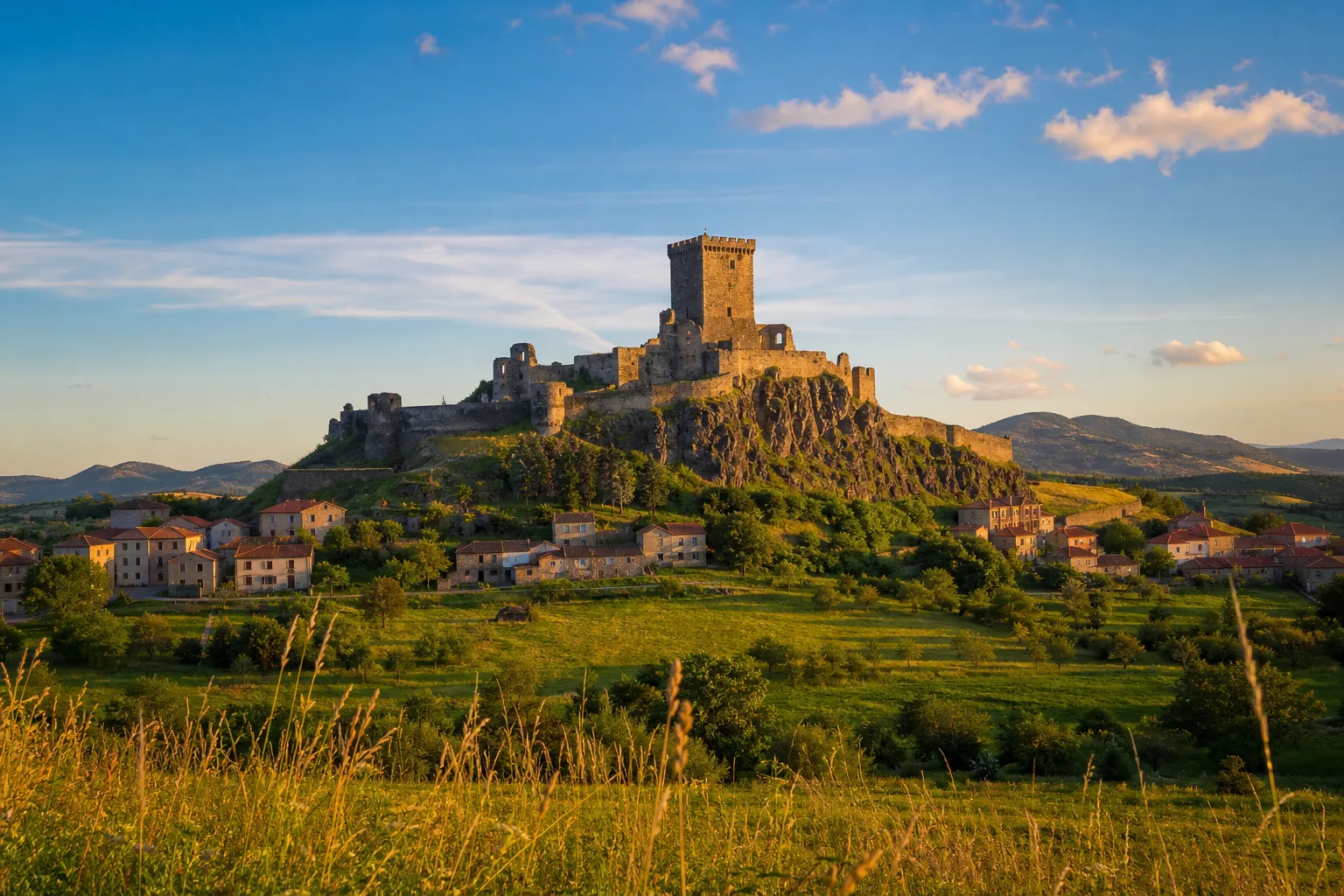
Polignac rises above the Haute-Loire on a basalt volcanic chimney, and its square keep reaches 105 feet. That is the whole draw: stone, height, and a fortress that refuses to blend into the village below.
You’re only 3.1 miles northwest of Le Puy-en-Velay, yet the approach feels deliberately separate. The dark basalt gives the place a hard outline, especially when the sky turns pale behind the walls.
A fortress built on basalt, not scenery
The Forteresse de Polignac occupies a basalt dyke above the Velay valley. Because the rock already lifts it above its surroundings, the medieval builders did not need subtlety, and neither does the fortress now.
And this is not a castle for people who want a soft pastoral detour. Its appeal is blunt: a high perch, thick stone, and a square tower that makes you look up before you have entered.
The central keep stands 32 meters tall. From below, that vertical line explains why Polignac still has such force, even for travelers who have seen plenty of French fortifications.
But the setting matters as much as the tower. Basalt has a darker, rougher presence than pale limestone, so the fortress feels stern rather than decorative.
Why the 105-foot keep earns the stop
The title promise is visible immediately: Polignac’s square keep rises 105 feet from its fortified site. You do not need a long historical lecture to understand the old logic of the place.
And the logic was control. A high volcanic foundation and a tall keep gave the fortress command over the Velay valley, which is why the silhouette still reads so clearly from around the commune.
The fortress was the ancestral seat of the House of Polignac, a major French noble family. That history gives the stonework weight, though the physical setting remains the more persuasive argument.
There is a useful contrast here. The fortress is medieval and imposing, but Polignac itself is a living commune of about 2,800 residents, not an isolated monument with a ticket booth attached.
Polignac is close to Le Puy-en-Velay
Polignac sits in Haute-Loire in the Auvergne-Rhône-Alpes region. Its distance from Le Puy-en-Velay is about 3.1 miles, so you can add it without turning a city stay into a complicated expedition.
But proximity does not make the setting feel ordinary. The basalt rise creates its own visual break, and the fortress appears above the village with the confidence of a landmark that has never needed advertising.
The commune covers 33 square kilometers and ranges from 1,844 to 2,927 feet in elevation. That variation helps explain why the fortress site feels elevated even without adding invented drama to the view.
You should treat Polignac as a focused stop rather than a place to rush through between errands. The reward is the changing angle of the tower, not a checklist of attractions.
A useful stop for walkers and heritage travelers
The fortress lies close to the Chemin de Saint-Jacques, the Way of St. James pilgrimage route. That makes it a natural pause for hikers who want stone walls after a long stretch of road and open country.
And you do not need to be walking the route to appreciate that connection. Pilgrimage paths favor places with a strong sense of arrival, and Polignac has one before you even reach the entrance.
Practical details are unusually forgiving: the site has wheelchair and stroller accessibility, plus free year-round parking. There is also motorhome parking within a 15-minute walk.
That said, accessibility does not erase the fortress’s height or its rocky character. Bring time to look around rather than expecting a quick roadside photograph to capture why the basalt matters.
The village beyond the walls
Polignac is classified among “Les Plus Beaux Villages de France”. The label can invite lofty expectations, but here the strongest detail is still concrete: a village living beneath a fortress on volcanic rock.
And that is why the place works. It is close to Le Puy-en-Velay, but it has a more contained rhythm, with the keep remaining in view as a fixed point above the streets.
There is a related Polignac family site nearby at Lavoûte-Polignac, though the fortress is the reason to come here first. Keep your attention on the square tower and the basalt base beneath it.
By the time you step back from the walls, the keep is still 105 feet above you, dark against the light and impossible to mistake for anything else.