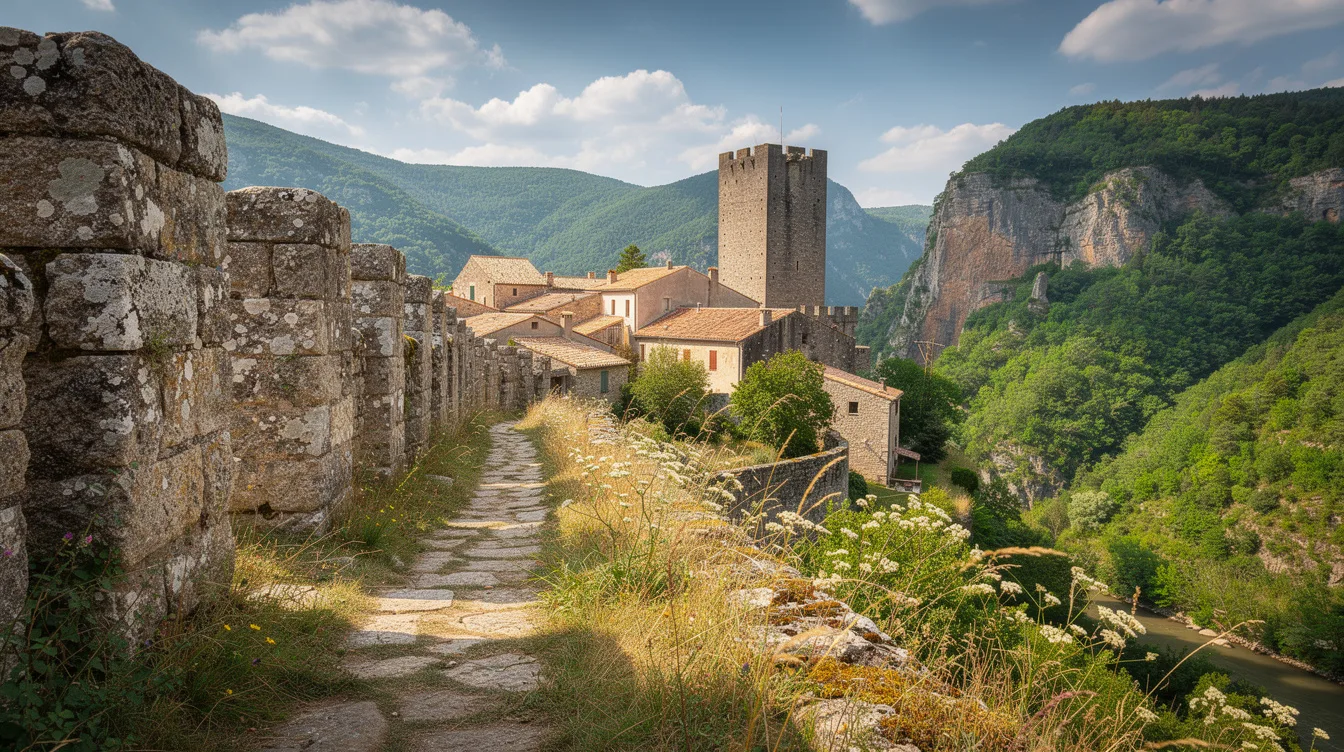
La Garde-Guérin has watched over the Chassezac gorges since the 12th century, and its position still explains everything. This fortified village sits on a high Lozère plateau, where stone lanes meet a drop that can make even seasoned road-trippers stop talking.
You come for medieval walls, of course. But the real surprise is the scale below them: 1,312-foot gorges cut through the country beneath a village with only about 20 permanent residents.
2,795 feet up, with the Chassezac far below
At about 2,795 feet above sea level, La Garde-Guérin stands between the Chassezac and Altier rivers in the southern Massif Central. The plateau catches the light hard, so the pale stone can look almost silver by midday.
And because the village overlooks gorges roughly 400 meters deep, the setting never feels merely decorative. On clear days, the view can reach toward the Mediterranean coast. It’s a big claim for such a small place, but the elevation does the work.
The village is part of Prévenchères and carries the “Plus Beaux Villages de France” designation. That brings visitors, certainly, but its streets still feel compact rather than staged.
But don’t expect a large town with endless detours. This is a small fortified settlement, and that restraint is part of its appeal. You can take your time with the worn stone and still leave room for the gorge views.
A fortified stop on the Régordane route
La Garde-Guérin was established in the 12th century to watch over the Chemin de Régordane, an important trade and pilgrimage route. That old purpose gives the place more edge than a standard heritage stop.
Its castle, now in ruins, dates from the 16th century. Most of today’s houses were rebuilt between 1595 and 1597 after damage during the French Wars of Religion, so the village has a more deliberate look than its age first suggests.
And that reconstruction matters when you walk through it. The buildings aren’t a random collection of old walls. They hold a village together around a past shaped by travel, defense, and repair.
You’ll likely notice the quiet first. Wind moves across the plateau, footsteps echo against stone, and the village’s small size keeps the experience intimate. Lively in summer, but never built for a crowd’s pace.
Can you visit without planning a full day?
Yes. La Garde-Guérin is about 5 miles north of Villefort, reached from the D906, with visitor parking at the village entrance. That makes it an easy stop if you’re traveling through Lozère by car.
But a quick look can undersell it. Give yourself time to walk slowly, then look outward from the plateau. The village is the reason you pull over; the gorge is why your afternoon plans may change.
Summer is when the village opens up
From July through August, guided village visits run every Thursday at 2:30 p. M. Without a reservation.
Summer also brings lantern-lit visits and concerts, which suit a place where evening stone holds the day’s warmth.
Outside that period, guided visits require advance booking. That’s a useful trade-off: summer has more activity, while other times of year may feel quieter around the lanes and ruined castle.
And if you want more than a stroll, the GR 72 and GR 700, also known as the Chemin de Régordane, pass through the site. A walking route also links Lac de Villefort with the village.
Is there somewhere to stay nearby?
There is a hotel-restaurant in the hamlet, so you can extend the visit without immediately returning to Villefort. It’s practical, especially if you want the village after day visitors have moved on.
Canyoning and hiking add a wilder counterpoint to the stone streets. Still, choose your plans honestly: the gorge country invites movement, while the village itself rewards stopping.
Why this tiny village stays with you
La Garde-Guérin receives about 150,000 visitors a year, making it the second-most visited site in Lozère. That number sounds large until you remember how few people actually live here year-round.
But the village doesn’t need a long checklist. You come to see how a fortified settlement could hold a plateau above the Chassezac, then understand why that position mattered for centuries.
By the time the stone cools and the road back toward Villefort calls, the gorges remain below the plateau, darkening first at their deepest edges.