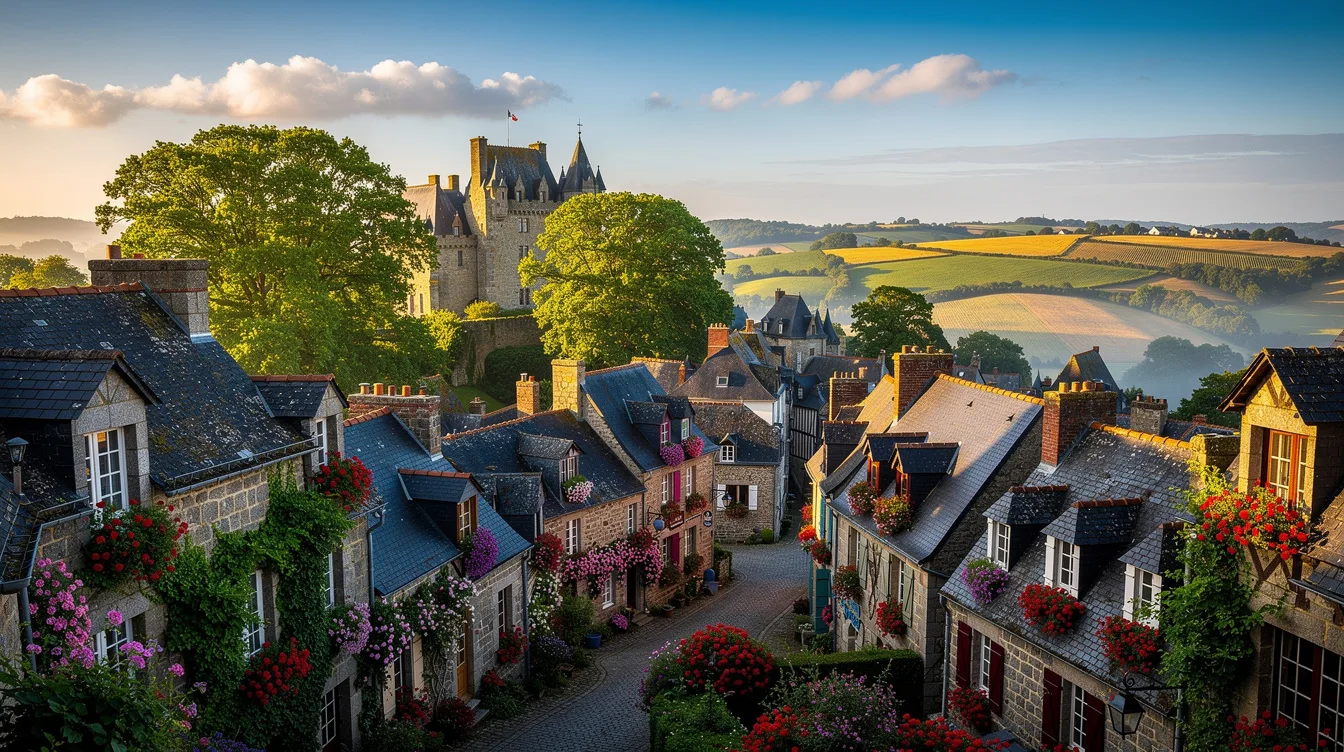
Rochefort-en-Terre was named France’s favorite village in 2016, and the title makes immediate sense once you reach its compact center. Granite facades, timbered houses, and flower boxes crowd the cobbled lanes in Morbihan, Brittany.
This is a village that knows it’s being watched. But it doesn’t feel staged in the usual way, because the old buildings rise and dip with the rocky ridge instead of lining up for a postcard.
A 12th-century village above the Gueuzon valley
Dating to the 12th century, Rochefort-en-Terre sits on a rocky ridge above the Gueuzon valley. That high perch gives the streets a tucked-away feeling, even when summer visitors fill the lanes.
You’ll find it about 21.7 miles east of Vannes, in the Morbihan department. It’s close enough for a detour, but the ridge and its narrow center make it feel removed from the faster rhythms of Brittany’s larger towns.
And the village is genuinely small, with around 647 residents recorded in 2023. That scale matters. You can wander without a plan, then circle back to the same stone corner before you realize how little ground there is.
It carries both the Petite Cité de Caractère designation and a place among Les Plus Beaux Villages de France. Those labels can invite crowds, but they also explain why the built fabric has held together so convincingly.
Flower boxes soften the granite in summer
Summer is when Rochefort-en-Terre makes its strongest case. The village has a 4-star Ville Fleurie classification, so flowers spill across windows, doorways, and street edges against dark granite.
That contrast is the point. The stone can feel severe in flat light, but blooms change the mood without sanding down the village’s age.
You should come prepared for company in the summer period. It is popular, and the narrow cobbled streets don’t create much room to disappear, especially around the most photogenic facades.
But the visual variety keeps a walk from feeling repetitive. Half-timbered homes stand beside Renaissance-style mansions, Gothic buildings, and 19th-century structures, each adding a different texture to the short route through town.
Can you get away from the busiest streets?
Yes, head toward Étang du Moulin Neuf, where the banks offer a walking loop outside the village center. It’s the sensible reset after the cobbles, especially if you want water and open space instead of another tightly framed lane.
The pond area has a different pace. You trade carved facades and flower boxes for a quieter path, with the village no longer demanding that you stop every few steps.
And there’s a practical reason to make that shift: the village’s appeal is concentrated. Its center rewards a slow first pass, but the pond helps the visit feel like more than a sequence of storefront views.
The château is the village’s old anchor
Château de Rochefort-en-Terre began as a medieval fortress and was later transformed into a manor. Much of what stands today was rebuilt in the 1800s after damage, which gives the site a layered rather than frozen-in-time character.
The gardens and grounds are free and open year-round. That’s a useful detail if you arrive outside the main summer rush, when the flower displays may not carry quite the same force.
The castle interior opens from May through September and contains paintings. But don’t build the entire day around it, because the grounds and the village streets provide the more reliable experience across the year.
Nearby, the Naïa Museum focuses on fantastical and imaginary art, linked to a local witch legend. It’s an unexpected fit for a medieval village, and that slight strangeness keeps Rochefort-en-Terre from becoming overly polished.
How to make a short visit feel worthwhile
Rochefort-en-Terre is about a 20-minute bike ride from Malansac train station. That approach suits the place better than rushing in, because the village is small enough that a hurried arrival can make the whole visit feel finished too soon.
Give yourself time for the lanes, the château grounds, and the Moulin Neuf loop. But don’t expect a large town’s menu of distractions. The pleasure here is concentrated, and that’s also its limit.
There is an old café in the village, Café Breton, identified in the research as one of Europe’s oldest. You may want a stop, but the better reason to linger is simpler: granite underfoot, flowers above, and a ridge that catches the last quiet light.