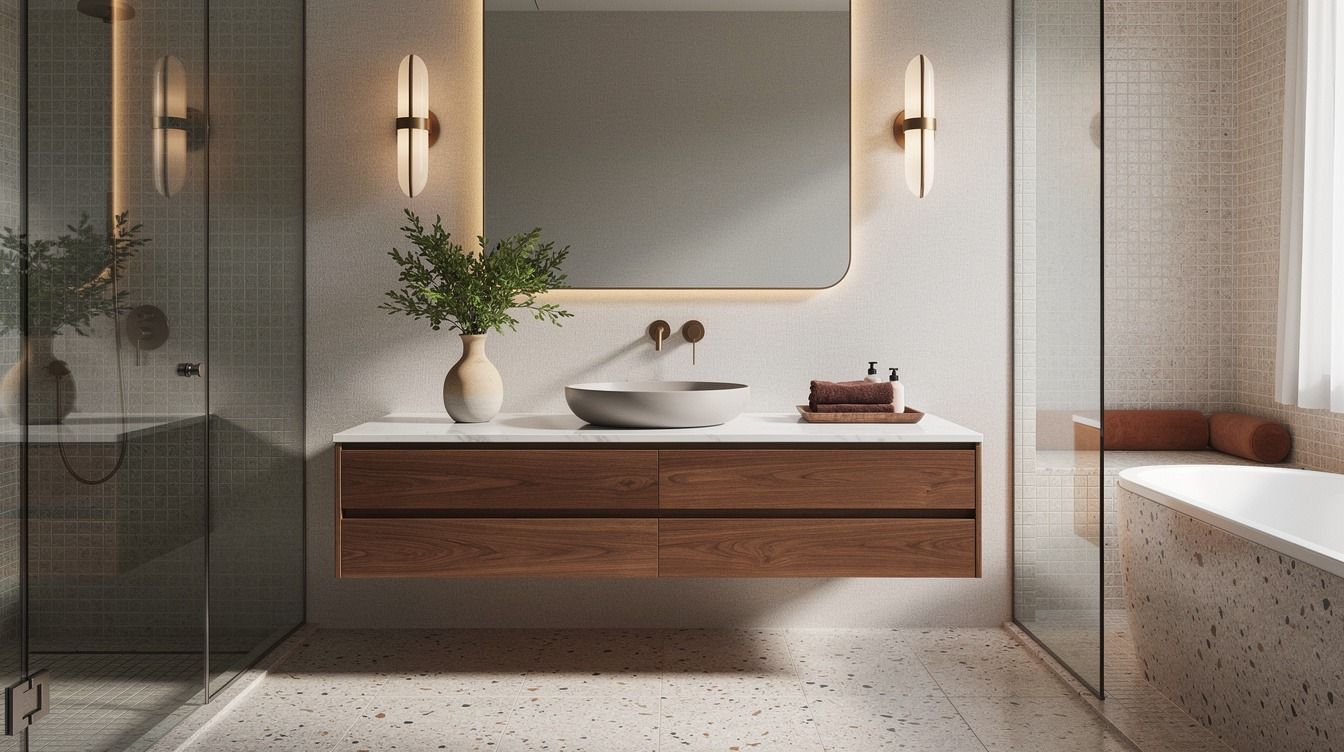
There’s a reason the mid-century bathroom keeps showing up in every design magazine you open. Warm wood, honest materials, light that flatters. The era solved bathroom design decades ago, and most of what we’ve done since is decoration on top of its homework.
I’ve renovated two bathrooms in this style now, and I’ve made enough mistakes to know which moves matter and which ones are expensive noise. So here’s everything I’d do again, in the order I’d do it.
- Anchor the Room with a Floating Walnut Vanity
- What Makes Terrazzo the Ultimate Mid-Century Floor?
- Pair Warm Walnut Against Cool Terrazzo Tile
- Farrow & Ball Studio Green Belongs on These Walls
- Swap Every Chrome Fixture for Unlacquered Brass
- Can a Freestanding Tub Really Feel Mid-Century?
- The IKEA GODMORGON Reads Shockingly Period-Perfect
- Layer Your Lighting Like George Nelson Did
- Why Does a Clerestory Window Beat a Big Picture Window?
- Mix Globe Sconces Against a Long Linear Mirror
- Run Your Shower Tile Straight to the Ceiling
- Benjamin Moore Chestertown Buff Warms Up the Water Closet
- What Makes a Built-In Bench Worth Giving Up Floor Space?
- Style the Vanity Top with Three Period Props
- Set Matte Black Hardware Against Honeyed Teak Shelving
- How Do You Heat a Retro Suite Without Ruining the Lines?
- A CB2 Infinity Mirror Earns Its Spot Over the Sink
- Carve a Makeup Nook Out of Dead Corner Space
- Is a Sunken Shower the Right Retro Move for You?
- Bring the Outdoors In with One Oversized Plant
1Anchor the Room with a Floating Walnut Vanity
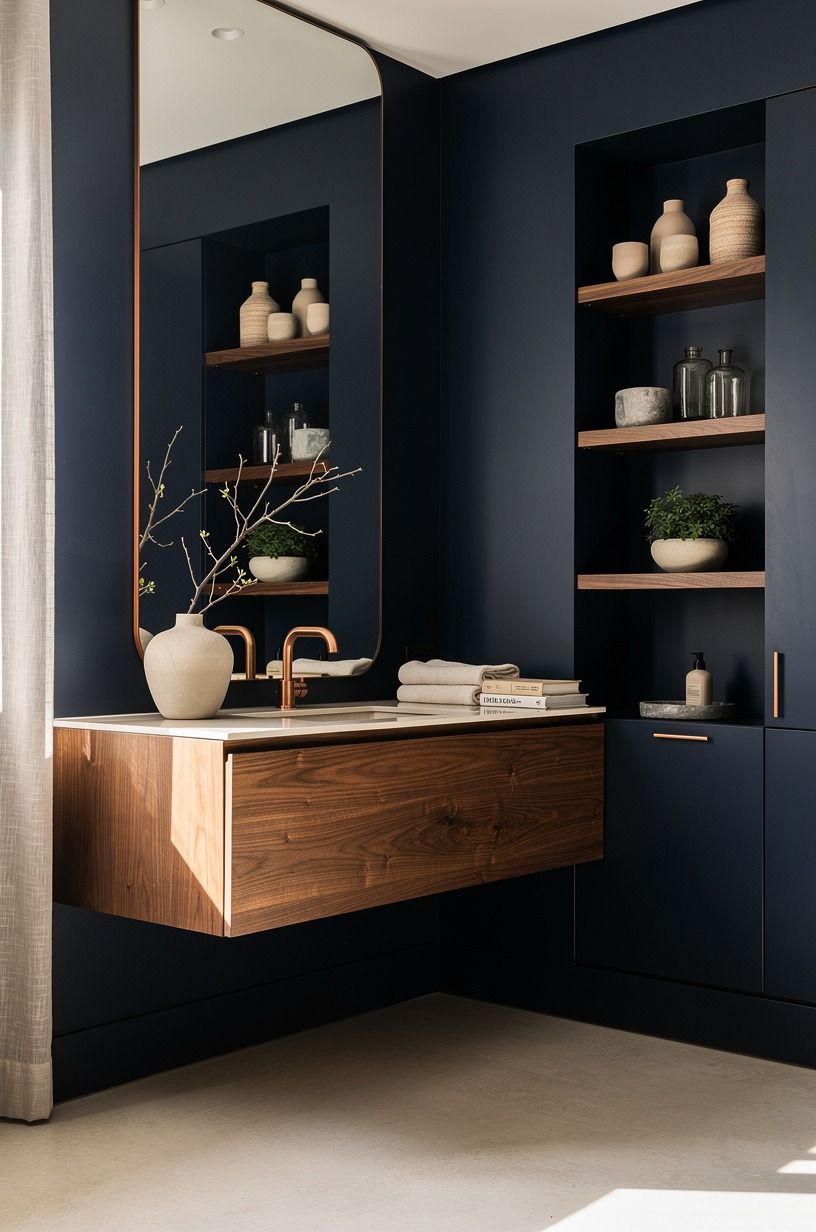
If you only copy one thing from this list, make it a floating vanity in warm walnut. Mounting the cabinet a few inches off the floor shows more tile, and more tile makes the whole room read bigger. I’ve watched this single swap transform a cramped 5×8 into something that feels twice its size.
Keep the fronts flat. No shaker trim, no fussy pulls.
The mid-century look lives in clean planes and honest wood grain, though a painted cabinet in deep midnight blue with copper hardware works beautifully if you’d rather skip stain. Soften the hard surfaces with an ivory shade in washed Belgian linen at the window. You’ll want a durable finish either way, because bathrooms are humid and raw surfaces won’t forgive you.
If your budget’s tight, look at the Article bathroom line, or retrofit a vintage credenza with a drop-in sink. I did the credenza route in our guest bath for under $400, and guests ask about it every single time. For more warm wood inspiration, my walnut vanity roundup goes deeper on sourcing.
2What Makes Terrazzo the Ultimate Mid-Century Floor?
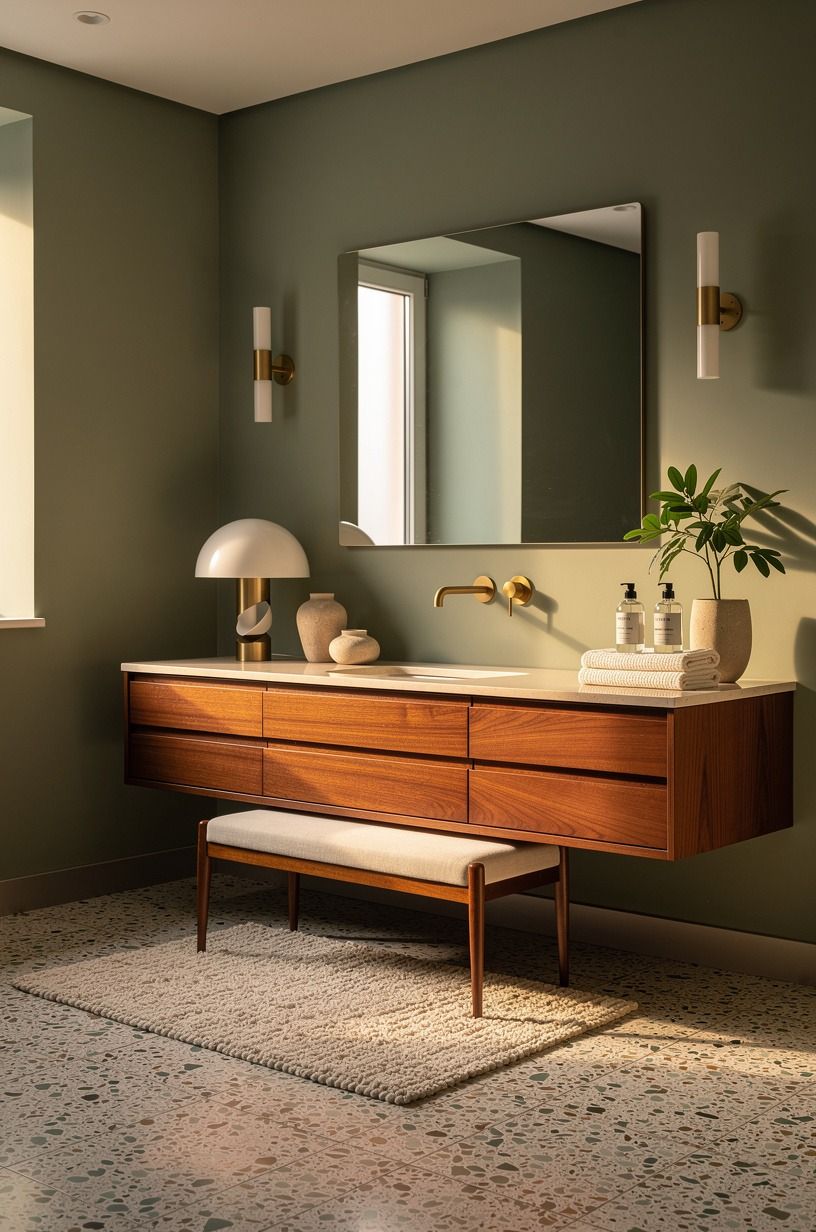
Terrazzo was everywhere in 1958, and it’s back because it never actually stopped working. The speckled composite hides water spots, hair, and dust better than any solid tile I’ve lived with. Choose terrazzo with chips in warm cream tones that echo a sage green wall and the natural wood of the vanity.
Large format tiles with tight grout lines read more authentically than busy small chips. You’ll pay more upfront than porcelain, but you’re buying a floor that outlives trends. If poured terrazzo blows the budget, porcelain lookalikes from Fireclay Tile get you eighty percent of the effect.
Soften the room with one upholstered moment, a small stool in organic bouclé does wonders against all that stone. Worried about cold feet? Pair it with radiant heat and you’ve solved the one complaint everyone has.
There’s a reason terrazzo anchors so many rooms in my mid-century modern living room ideas piece. It grounds everything you put on top of it.
3Pair Warm Walnut Against Cool Terrazzo Tile
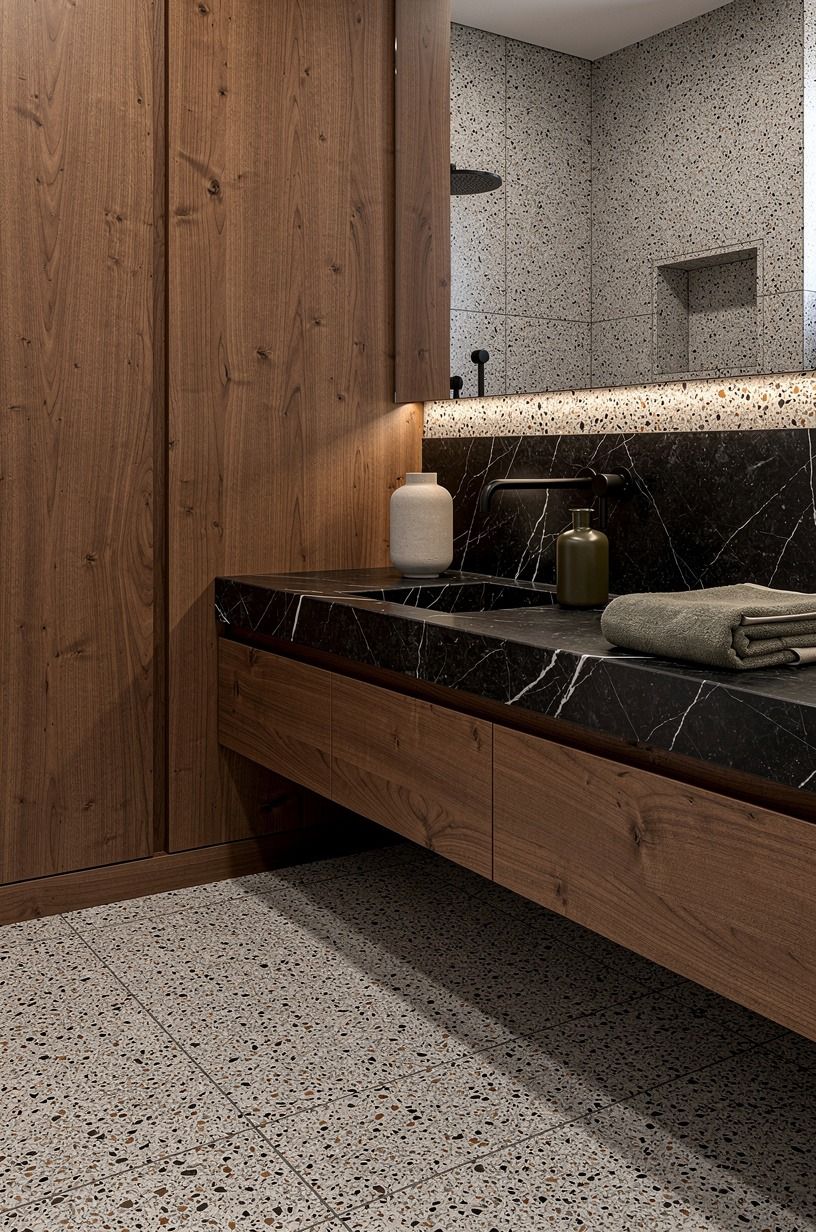
The tension that makes mid-century rooms sing is warm wood against cool stone. Walnut and terrazzo are the classic pairing, and a master bath is the easiest place to pull it off because the big surfaces are already fixed. Let the floor carry the terracotta and olive tones, let one vanity wall be the warm element, and you can’t really go wrong.
One caution from experience: don’t add a third dominant material. If you want a stone moment, commit to exactly one, a Nero Marquina counter with white veining against the terracotta and olive is striking precisely because it’s the only marble in the room.
I’ve watched people layer in patterned wall tile and colored grout on top of that, and the room collapses into noise. Two stars, supporting cast in neutrals.
That’s the formula.
4Farrow & Ball Studio Green Belongs on These Walls
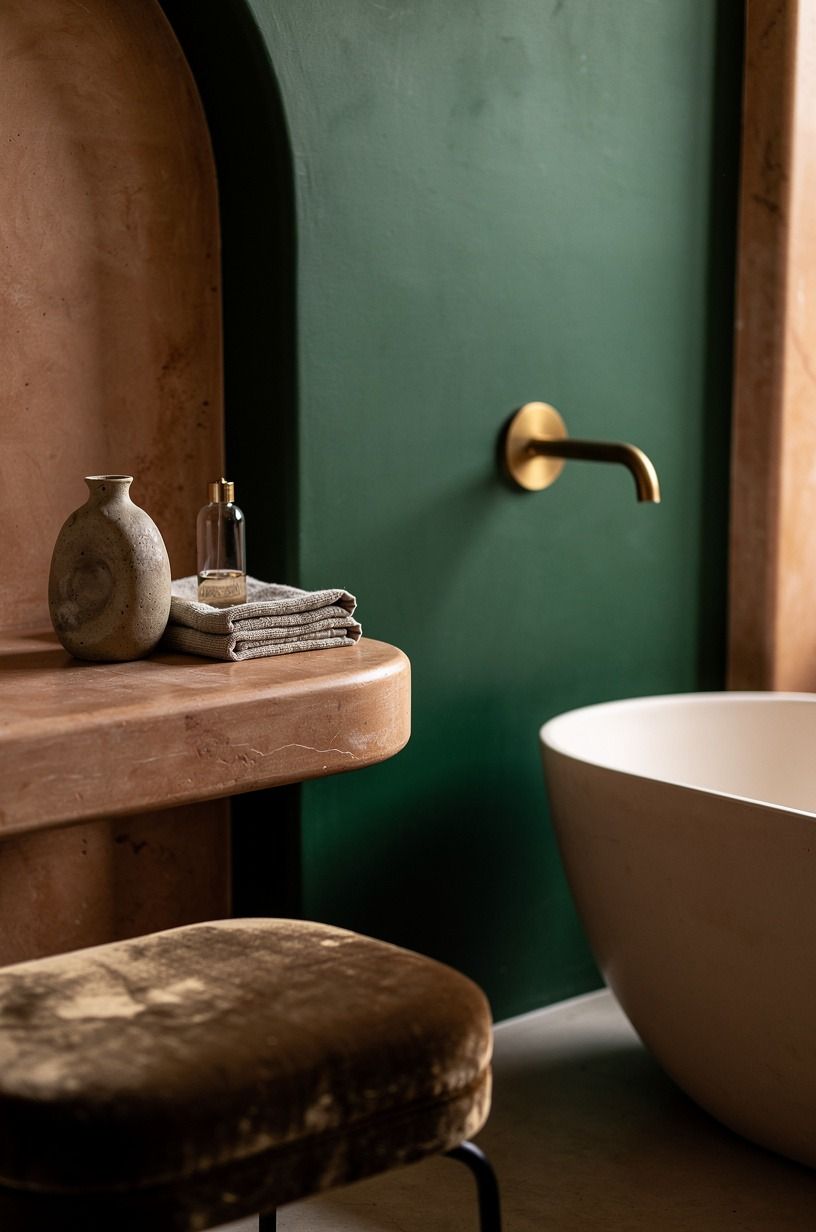
Mid-century palettes swing between earthy and optimistic, and Farrow & Ball Studio Green hits both notes at once. On bathroom walls above clay-toned tile, it reads like a forest at dusk. I’ve used it in two renovations now, and it flatters aged brass like nothing else I’ve tried.
Keep the ceiling and trim in a soft linen white so the green doesn’t swallow the room. You want contrast, and you’ll get it.
A small bench or stool in deep-pile mohair velvet brings out the earthy side of the green beautifully. If green feels too committed, Sherwin-Williams Evergreen Fog SW 9130 is the gentler, grayer cousin that still gives you the mood.
Paint is the cheapest transformation on this list, so sample before you commit. Brush two coats on poster board, move it around the room for a day, and watch it in evening light. My green bathroom ideas post has more shades worth testing.
5Swap Every Chrome Fixture for Unlacquered Brass
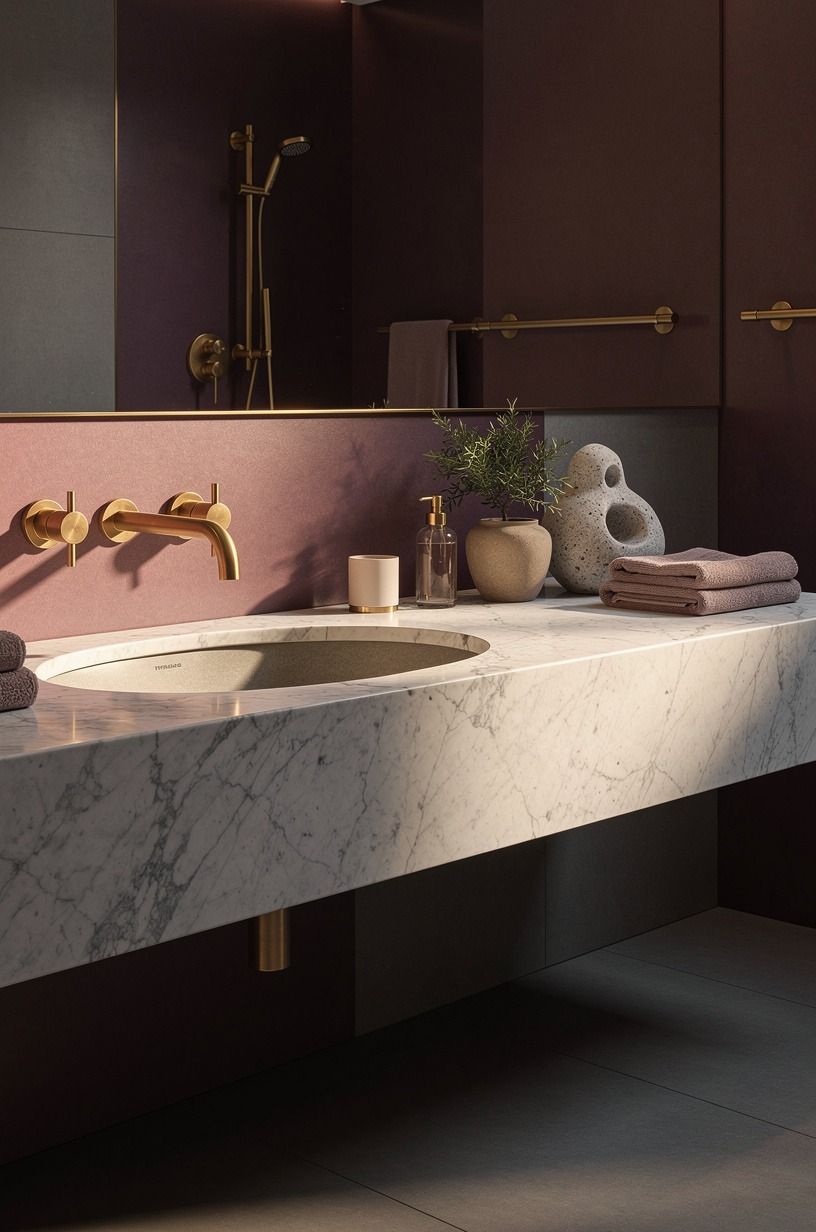
Chrome reads 2005 builder grade. Unlacquered brass reads collected, warm, and period right. The living finish develops patina where your hands touch it most, which sounds like a flaw until you see it happen.
It’s the fixture aging alongside you.
Brass looks its richest against deep, moody color. A plum-grey wall behind the vanity pulls out the rosy warmth in the metal, and a Carrara marble counter with subtle grey veining keeps the whole thing from tipping too warm. You don’t need to gut the plumbing to get there.
Swapping a faucet, shower trim, and cabinet pulls takes one Saturday afternoon. I’d start with the Delta Trinsic in champagne bronze if genuine unlacquered brass stretches the budget too far.
One rule I enforce in my own house: pick one metal per sightline. Brass faucet with brass mirror frame and brass sconces, beautiful.
Brass faucet next to chrome sconces, never. There’s more mixing guidance in my brass bathroom fixtures ideas roundup.
6Can a Freestanding Tub Really Feel Mid-Century?
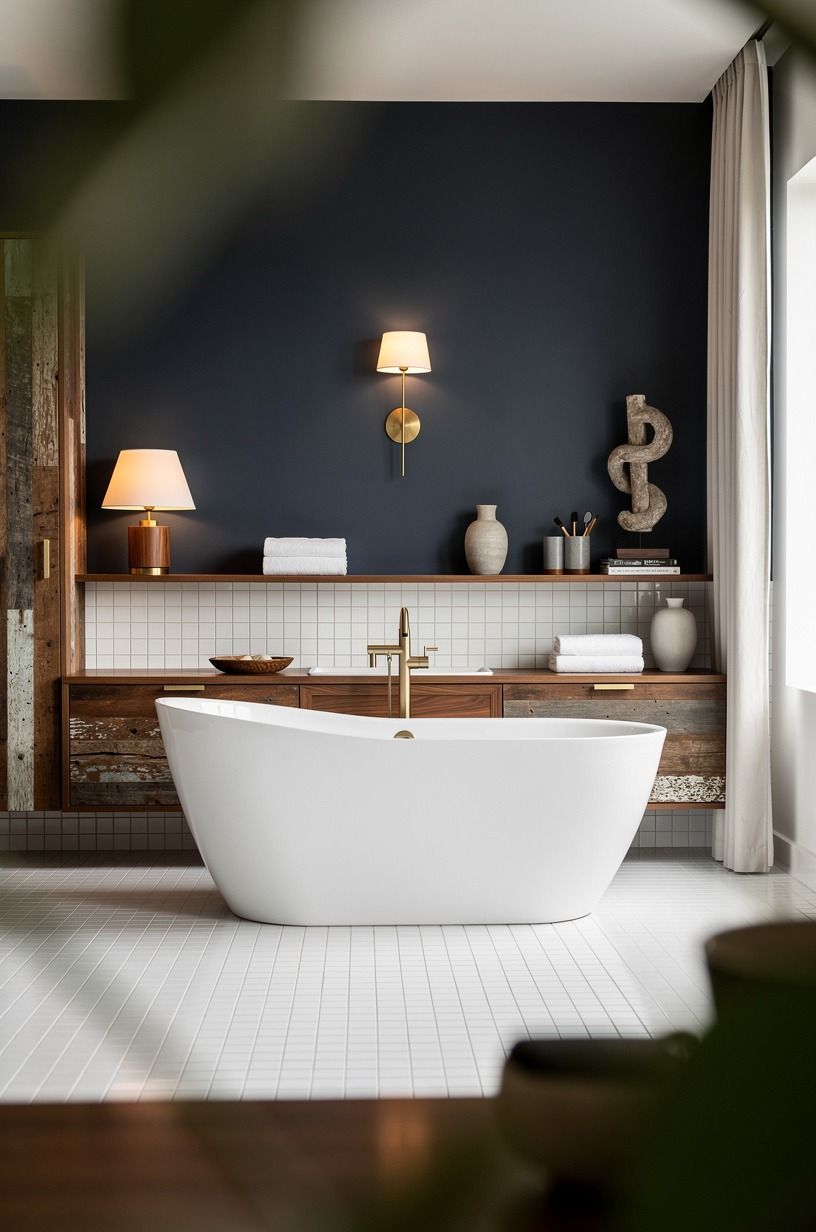
Yes, and honestly it might be the strongest move in the whole suite.
7The IKEA GODMORGON Reads Shockingly Period-Perfect
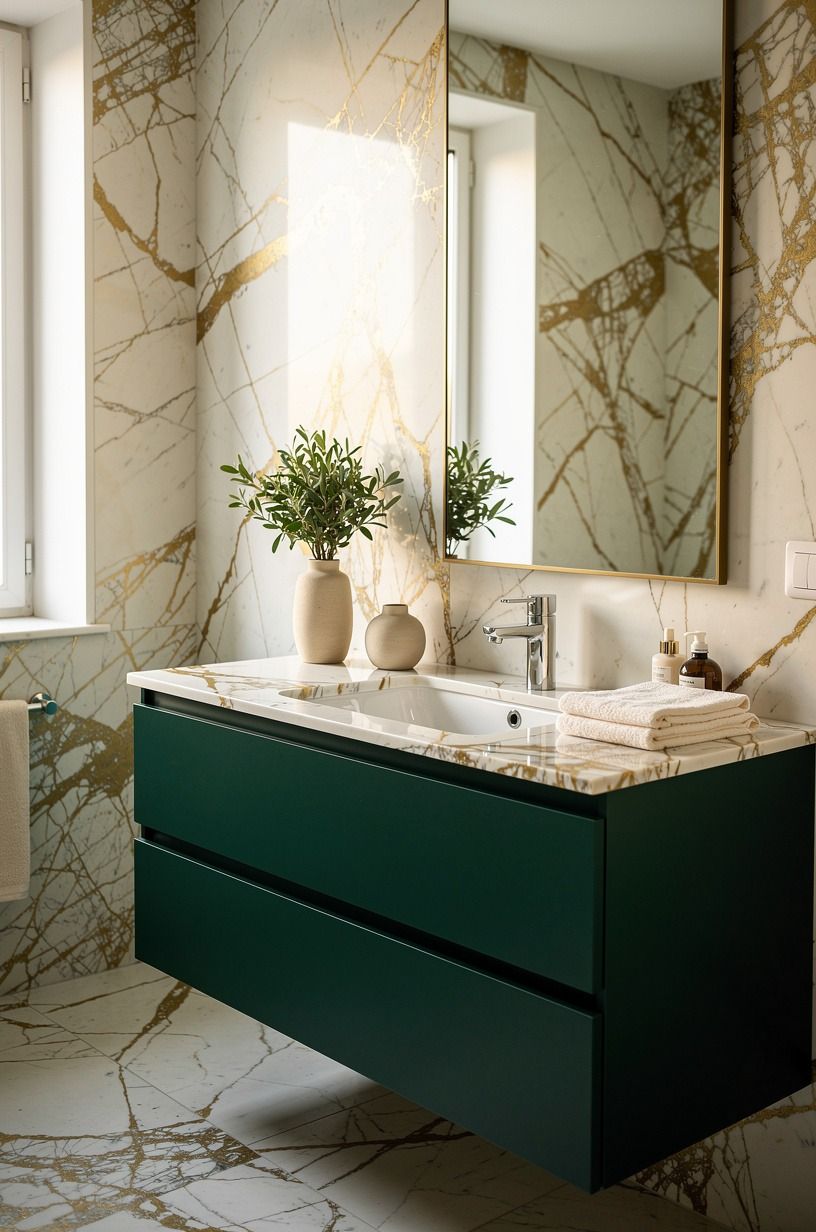
Hear me out. The IKEA GODMORGON has flat fronts, clean lines, and a floating profile that mimics vintage Danish pieces at a tenth of the price. Set it against a deep emerald wall, top it with a Calacatta-look counter, swap the stock pulls for gold knobs, and nobody will clock it as flat-pack.
I’ve recommended this to three friends on tight budgets, and all three bathrooms look fantastic. The full-extension drawers are the real win, because organized storage beats a cabinet door you have to kneel into. The sourcing logic in my mid-century modern bedroom ideas post transfers directly if you’re furnishing on a budget.
8Layer Your Lighting Like George Nelson Did
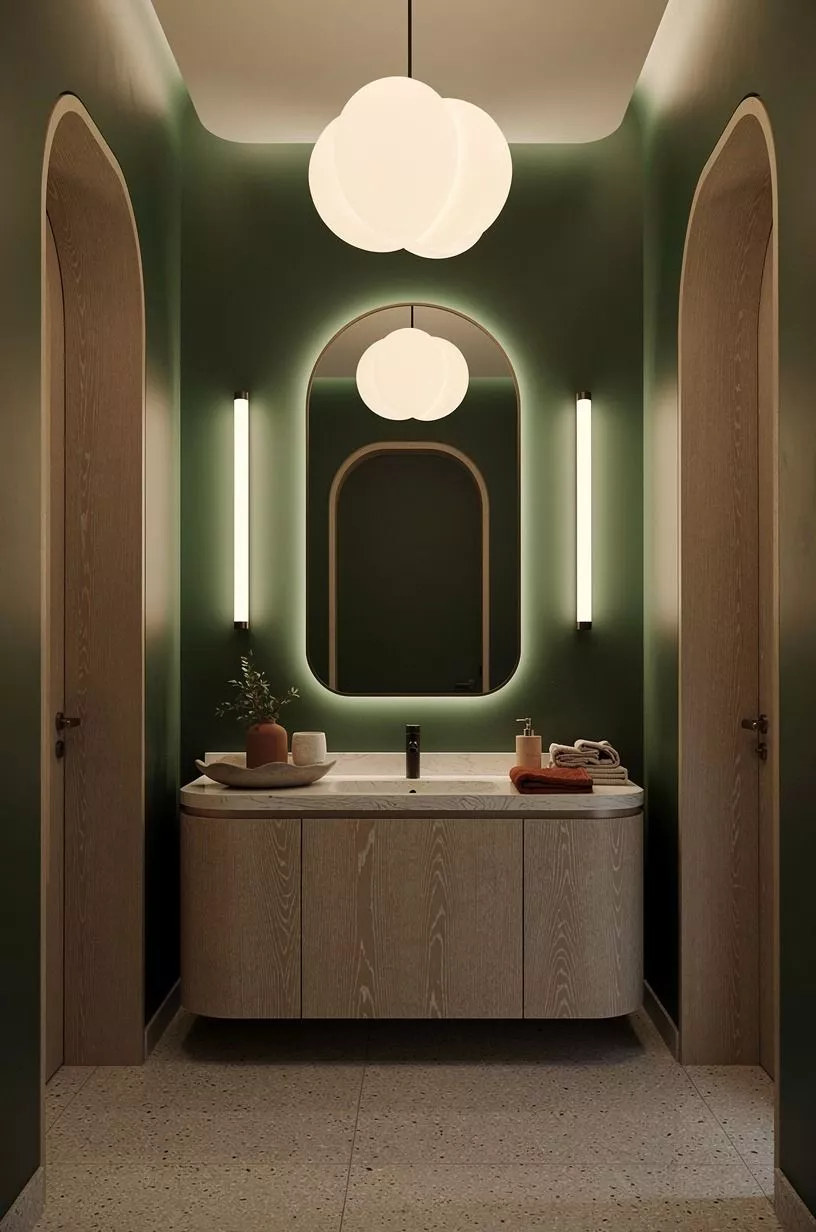
George Nelson treated light as sculpture, and your bathroom deserves the same thinking. You need three layers: ambient ceiling light, task light at the mirror, and one accent that exists purely for mood. Most bathrooms stop at layer one, and that’s why they feel like clinics.
Good light flatters good materials, so give it something worth washing over: a vanity in cerused white oak against a forest green wall, with rust-toned towels for warmth. Aim for 2700K bulbs across every fixture, because mixing color temperatures is the fastest way to make a beautiful room feel off.
Dimmers on everything too. You’ll want the bright setting at 6 a.m. and a low glow at 10 p.m., and the room should serve both.
9Why Does a Clerestory Window Beat a Big Picture Window?
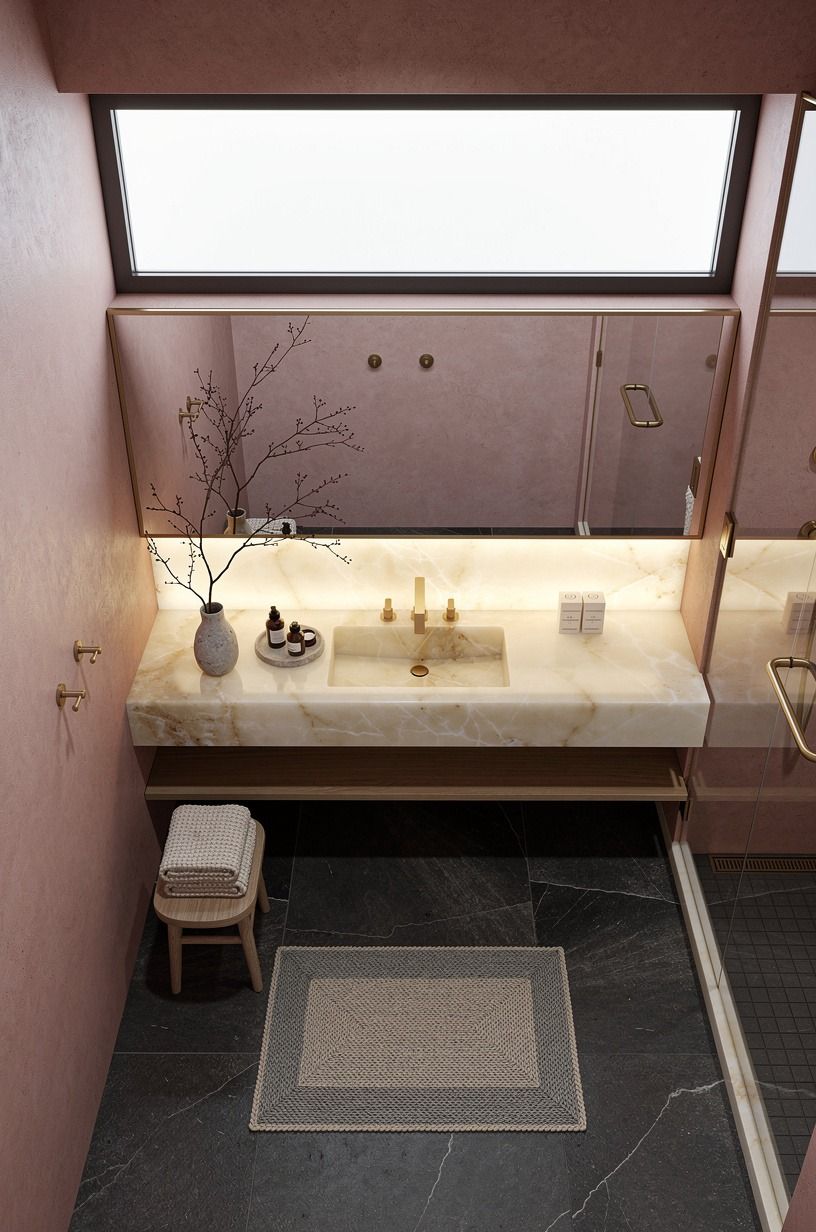
Privacy. A clerestory window sits high on the wall, pulling in daylight without exposing you to the neighbors. Mid-century architects loved them for exactly this reason, and in a bathroom they’re nearly perfect.
The high placement also frees the wall below for a vanity, bench, or storage, which a standard window eats alive. I love the band of glass against a dusty rose plaster wall with charcoal floor tile underfoot, trimmed in brass. If your sightlines are truly awkward, a backlit onyx panel in place of clear glass glows warm amber and keeps the privacy absolute.
If you’re renovating anyway, this is the moment. Framing a clerestory into an existing wall costs less than most people fear, and it changes the light quality permanently. More configurations live in my clerestory window ideas guide.
10Mix Globe Sconces Against a Long Linear Mirror
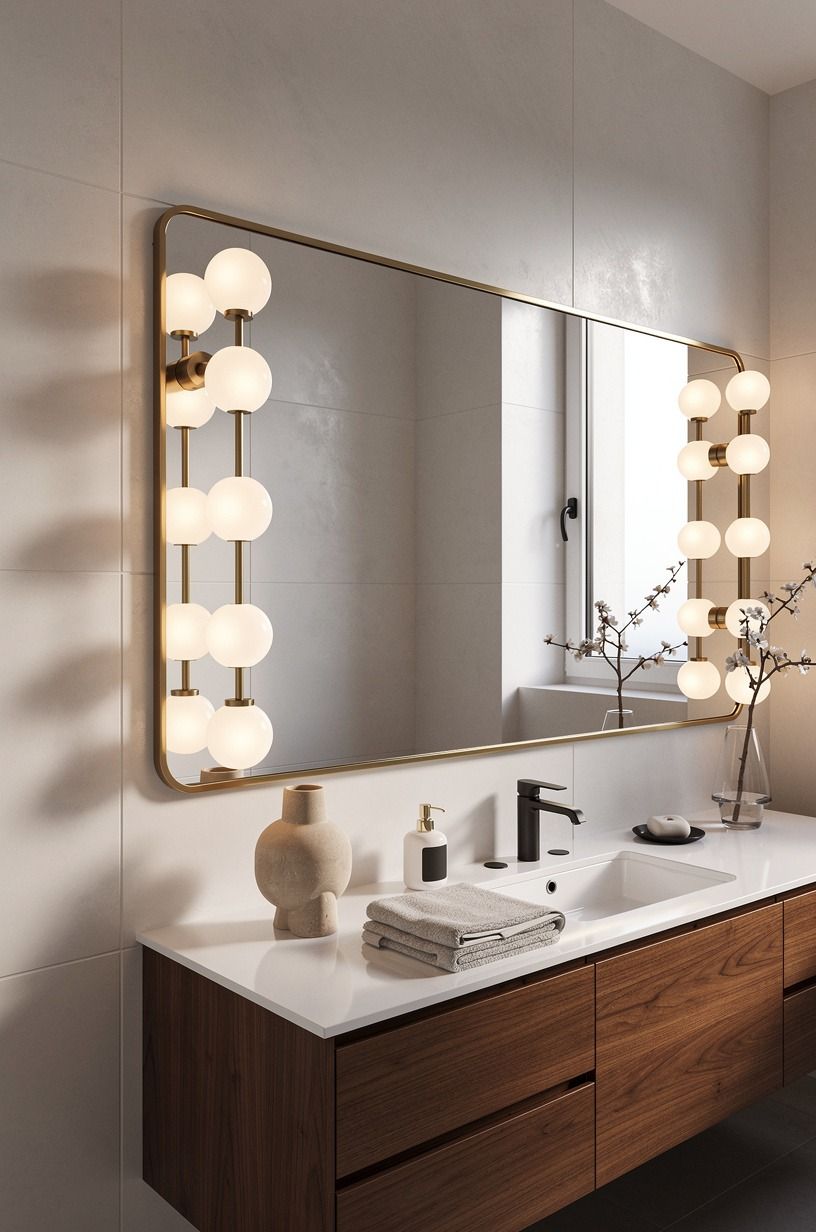
Round globes, straight mirror. That contrast is peak mid-century, and it solves a real problem: two globe sconces at face height light you evenly, with no shadows under your eyes. Mount them around 60 inches and flank the mirror instead of hanging one bar above it.
The long linear mirror stretches the wall visually, which matters in narrow suites. I’d go frameless or thin black against a camel-toned wall, nothing chunky, and let a book-matched walnut vanity carry the warmth below. Schoolhouse and Rejuvenation both make period-correct globes that fit standard junction boxes, so you won’t need to rewire.
11Run Your Shower Tile Straight to the Ceiling
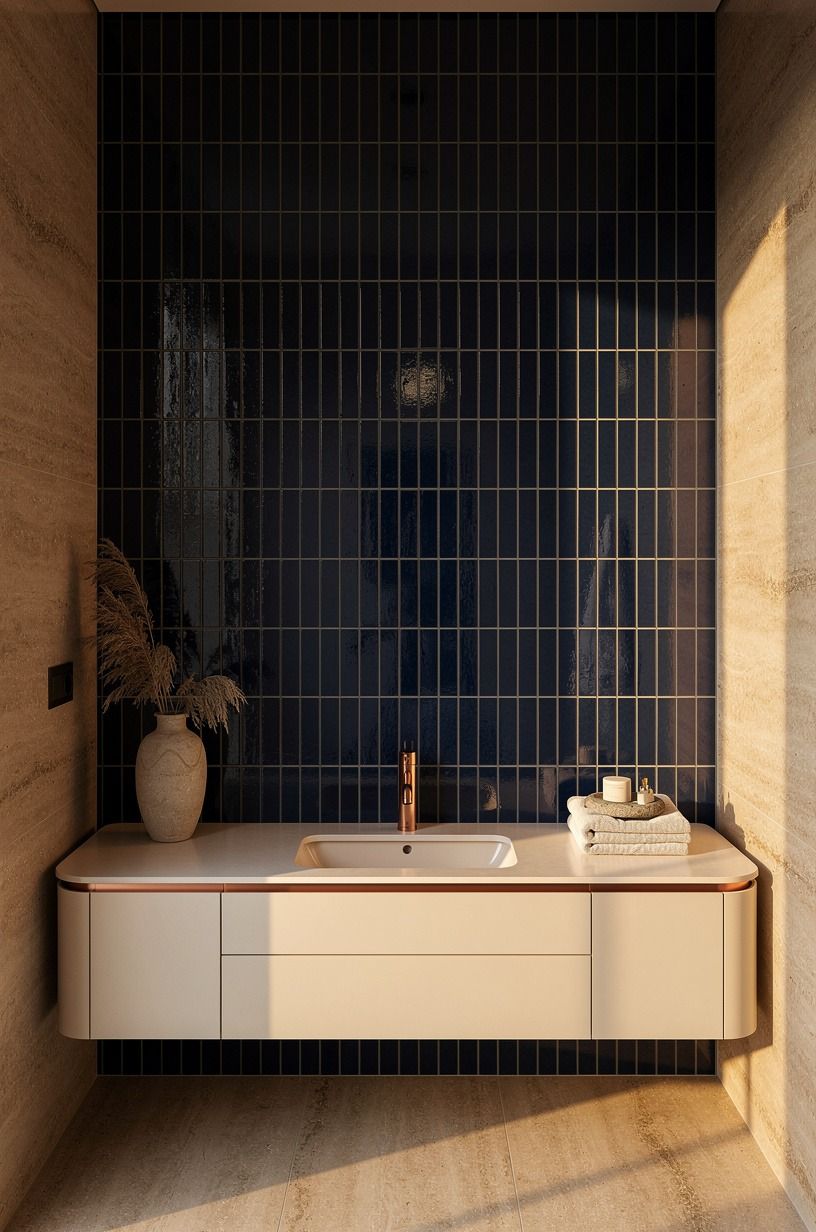
Half-height tile looks like the budget ran out, because usually it did. Taking tile to the ceiling makes the shower feel architectural, and it protects the drywall from steam. Warm travertine in soft ivory is my pick here, though a deep midnight blue handmade tile with copper fixtures is the bolder route and just as period.
Travertine has surface variation that catches light differently through the day, so the shower never reads flat. You’ll pay more per square foot than subway tile, but a shower is a small footprint. Splurge where you stare.
Keep the grout close to the tile color for a calm read, or go one shade darker if you want the grid to show. My bathroom tile to ceiling ideas post shows both directions with real rooms, including one Fireclay install I still think about.
12Benjamin Moore Chestertown Buff Warms Up the Water Closet
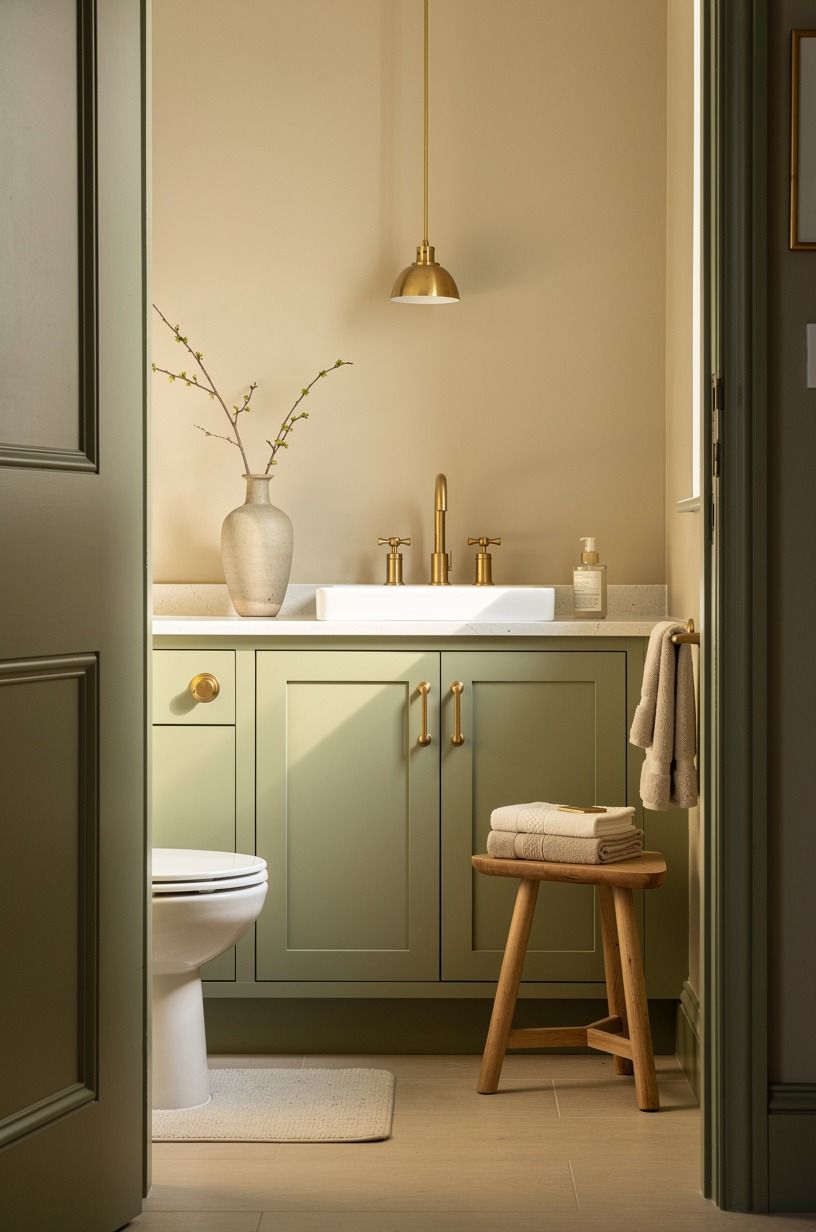
The WC is your chance to go bolder than the main room, because it’s small and the door closes. Benjamin Moore Chestertown Buff HC-9 is a golden ochre that reads like aged parchment, and it pairs beautifully with sage green tile, a warm cream ceiling, and natural wood.
Paint all four walls and the ceiling for the full jewel-box effect, then let unlacquered brass hardware age right alongside it, the patina only deepens the warmth. I’ve done this twice now, and guests comment on the tiny room more than the big one. There’s more palette thinking in my mid-century modern paint colors roundup.
13What Makes a Built-In Bench Worth Giving Up Floor Space?
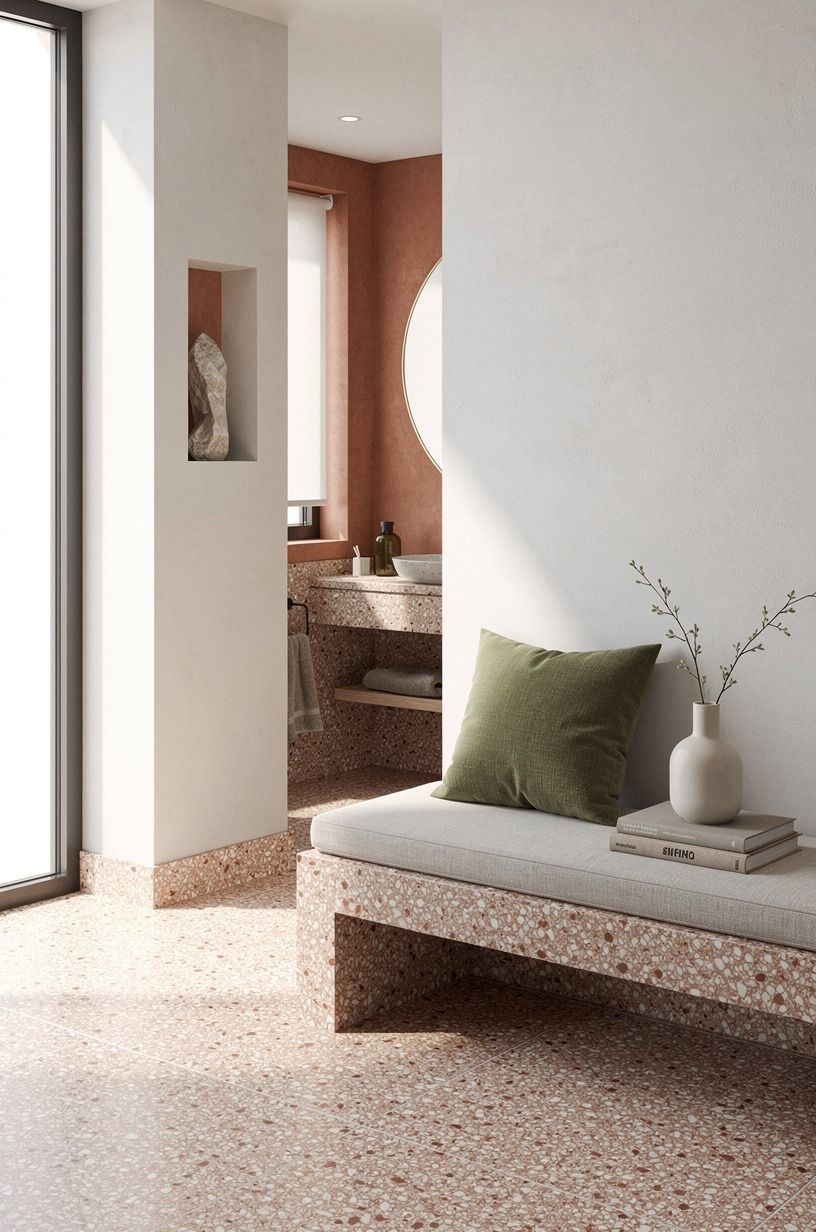
A floating bench in the shower or along a vanity wall gives you somewhere to sit, shave, or stack towels, and it reads like custom millwork. A slab in oversized-chip terrazzo over a stone base keeps the material story consistent, and terracotta and olive accents warm it right up.
The honest tradeoff is square footage. In a suite under 100 square feet, I’d skip it. Over that, it earns its footprint fast, especially in a walk-in shower where you’ll use it daily.
My built-in bathroom bench ideas post has dimensions worth stealing.
14Style the Vanity Top with Three Period Props
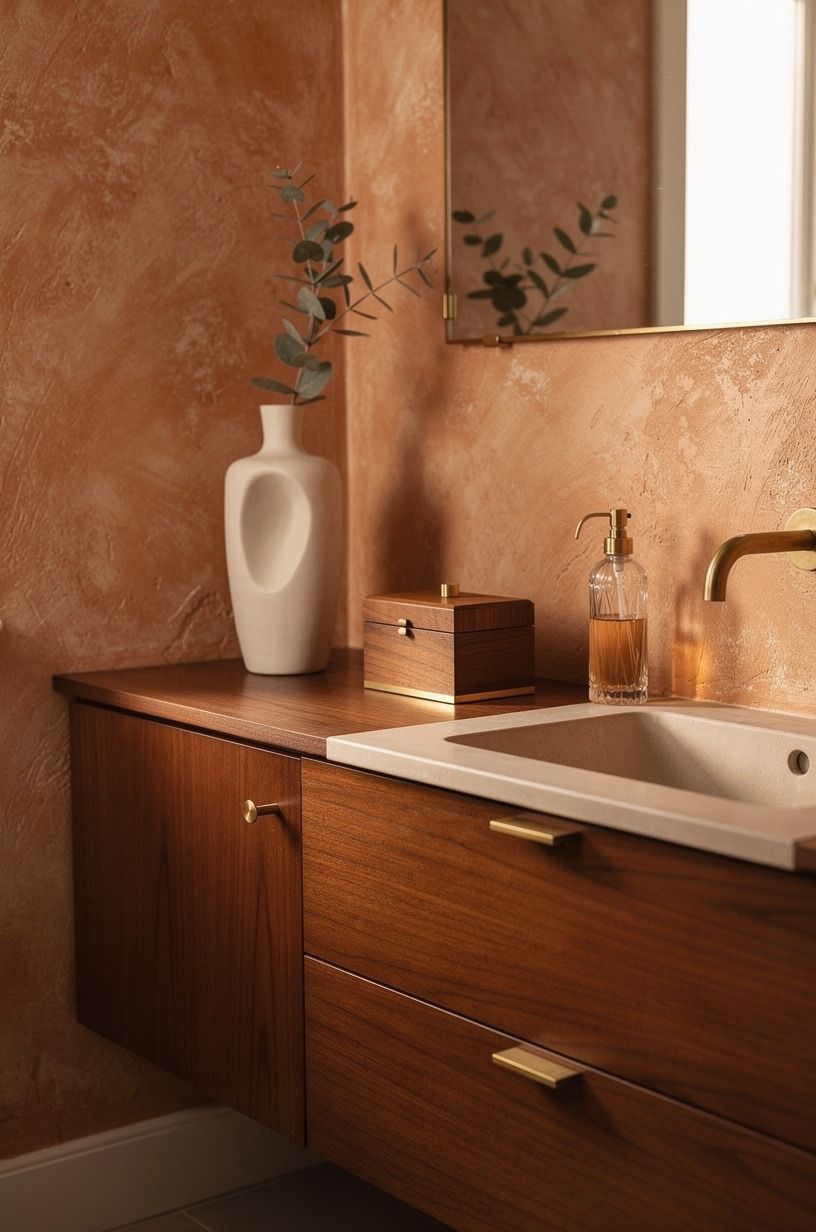
Three props, total. A ceramic tray, a low vase with one stem, and a small aged brass box for the things you actually use. That’s the whole formula.
The mid-century bathroom counter was functional first, and clutter kills the calm you’re building.
The backdrop matters as much as the props. A wall in hand-applied Venetian plaster, clay-toned and slightly uneven, makes even three small objects feel intentional.
Skip the apothecary jars full of cotton balls. Nobody’s fooled.
One Heath Ceramics bud vase does more work than a dozen styled objects. You’ll notice the difference every morning, and wiping down around three things takes ten seconds.
15Set Matte Black Hardware Against Honeyed Teak Shelving
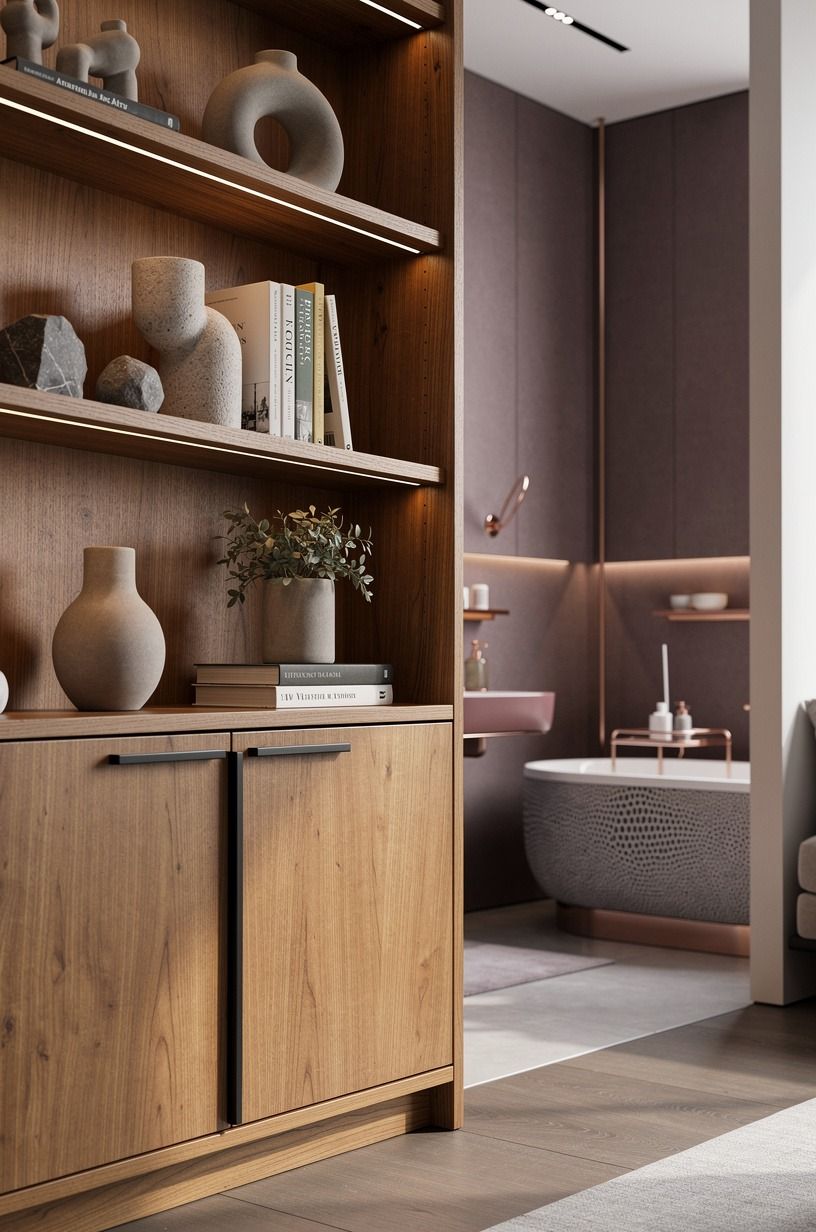
If full brass feels too warm for you, matte black hardware against honey teak shelving gives the room a graphic edge that still reads period. The Eames house used exactly this contrast, and it hasn’t dated in seventy years.
Teak handles bathroom humidity better than most woods, which is why boat builders have trusted it for a century. Two shelves against a deep plum-grey wall, loosely styled with one shagreen-covered box, beat a wall of closed cabinets in a room that needs air.
Keep the black accents small: pulls, a towel hook, maybe the mirror frame. Black faucet plus black shower frame plus black brackets tips the room into farmhouse territory fast. My mid-century modern kitchen ideas post handles the same balancing act.
16How Do You Heat a Retro Suite Without Ruining the Lines?
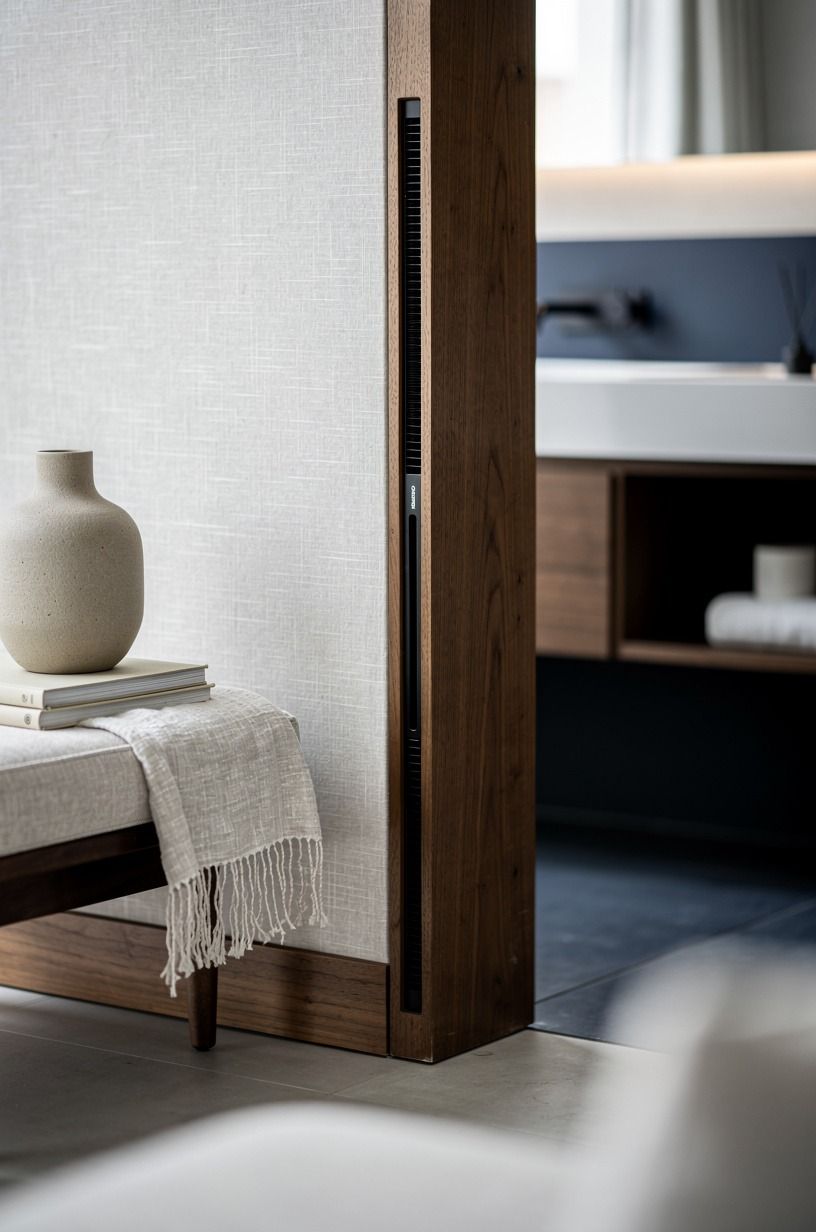
Radiant floor heat, full stop. It’s invisible, it keeps a navy-and-white tile floor warm underfoot, and it eliminates the radiator or vent that would otherwise break up your clean walls. Electric mats under tile cost less than you’d guess and go down before the floor does.
With no radiator to work around, the window can stay simple: a shade in washed Belgian linen is all it needs against the walnut vanity. If radiant isn’t in the cards, a slim Runtal panel radiator in matte white disappears against the wall better than any baseboard unit.
You lose a little wall space but keep the lines. I break down the cost math in my radiant floor heating guide.
17A CB2 Infinity Mirror Earns Its Spot Over the Sink
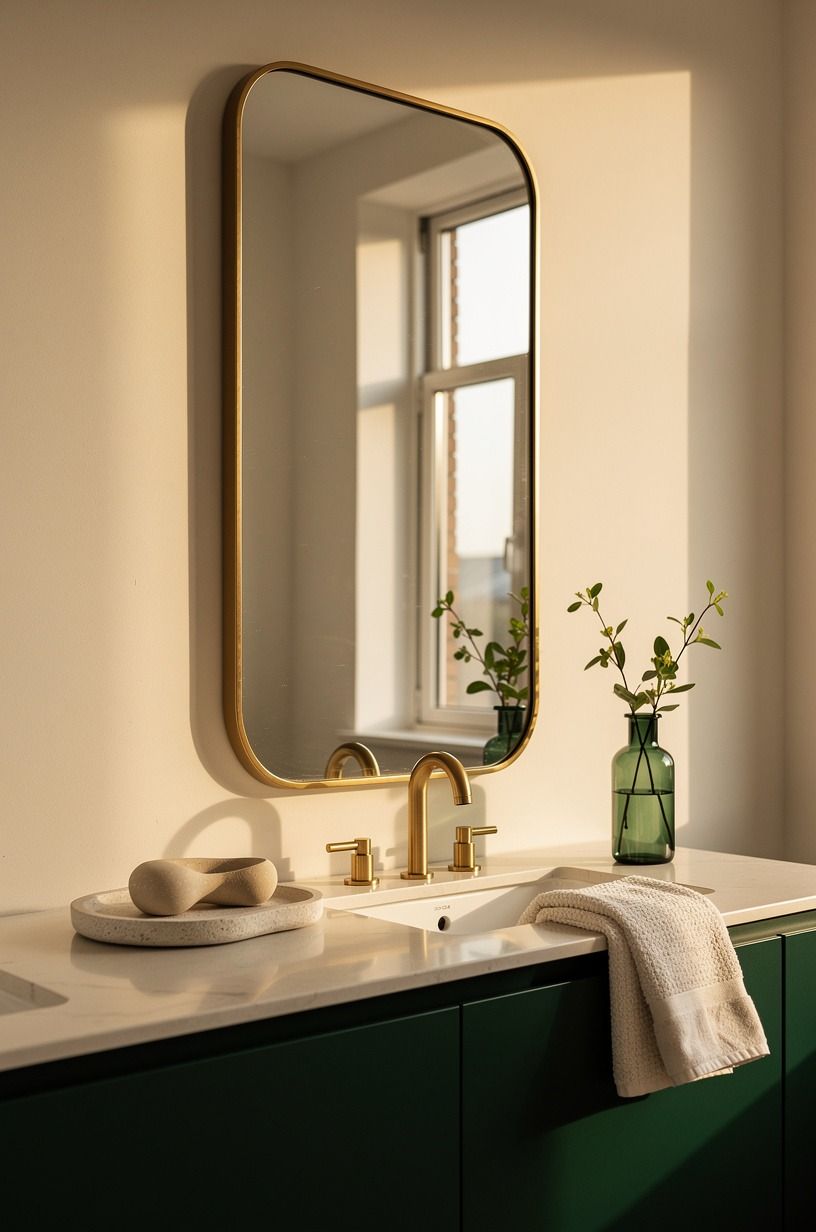
The round CB2 Infinity mirror in brushed brass has stayed in production for years because it simply works. Hung against a deep emerald wall above a cream-tiled vanity, between two globe sconces, it completes the mid-century triangle of circle, wood, and warm metal.
Round mirrors soften rooms full of rectangles, and bathrooms are nothing but rectangles. A stool in organic bouclé tucked beneath the vanity doubles the softening.
If you’ve already got round sconces, though, consider a pill-shaped mirror instead so you’re not doubling shapes. My statement mirror ideas post maps the pairings.
18Carve a Makeup Nook Out of Dead Corner Space
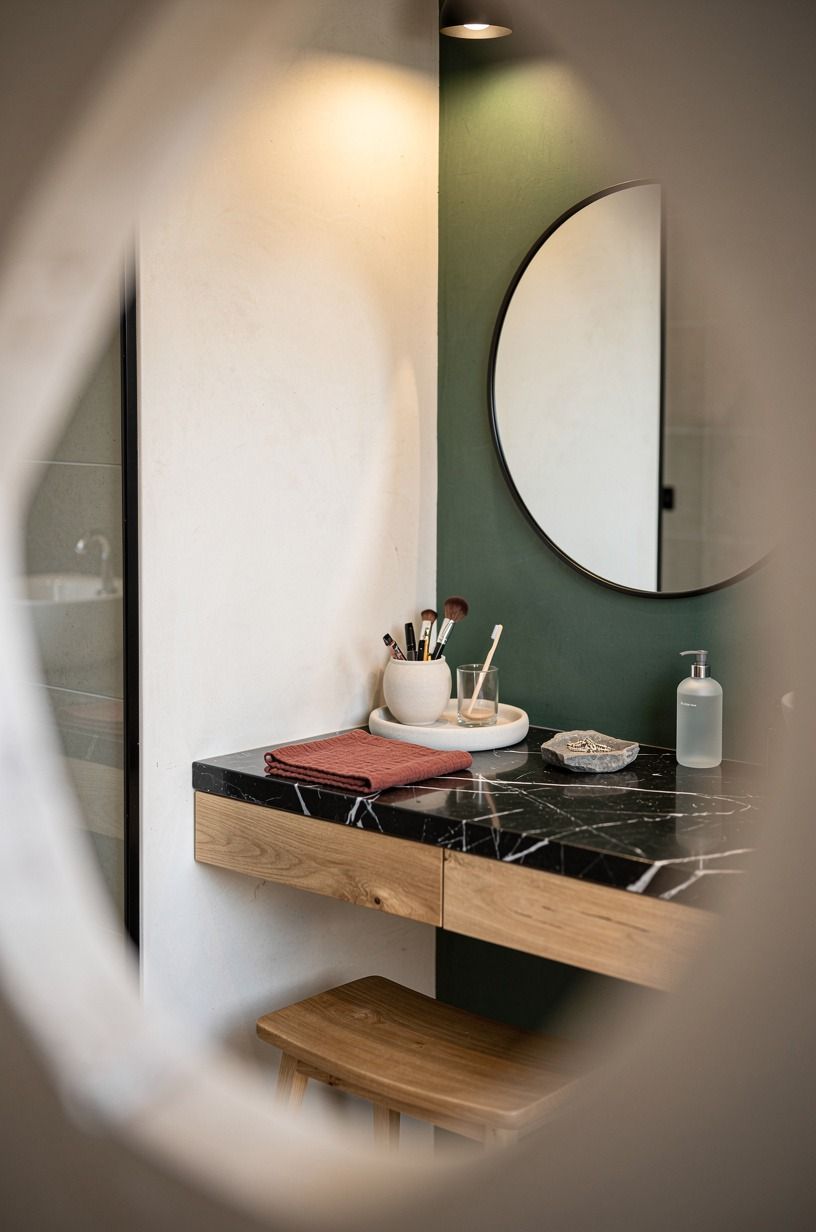
Most master suites have a corner that collects nothing. A knee-height counter, a stool, a mirror, and one sconce turn it into a makeup nook that feels like a 1960s hotel suite. A Nero Marquina black marble counter against a forest green wall is the version I’d build tomorrow.
Carry the white veining of the marble into one rust-toned stool and an oak-framed mirror, and the corner reads as planned from day one. You’ll want a drawer here, because surface clutter in a pretty corner is still clutter.
The Article Seno side table doubles nicely as a compact vanity surface if built-ins aren’t feasible. More layouts live in my makeup vanity ideas post.
19Is a Sunken Shower the Right Retro Move for You?
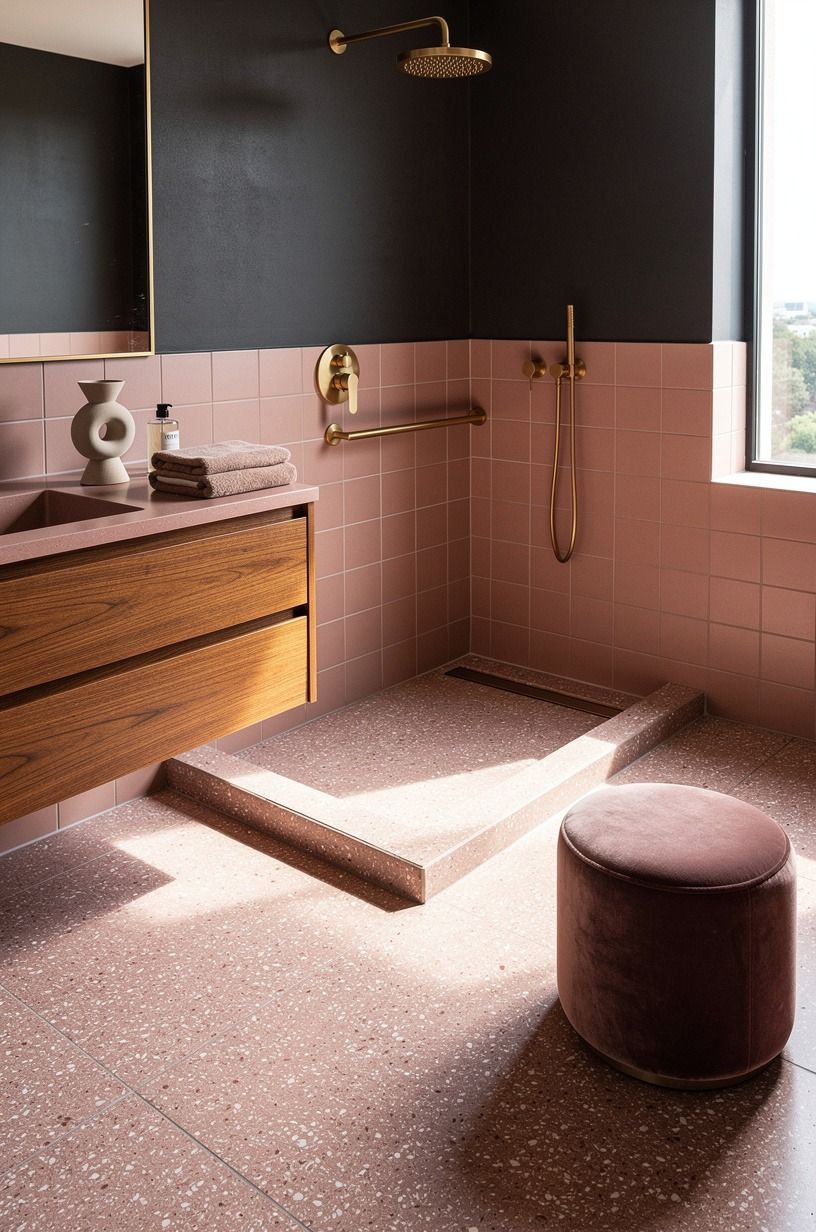
The curbless shower is authentically mid-century and genuinely practical.
20Bring the Outdoors In with One Oversized Plant
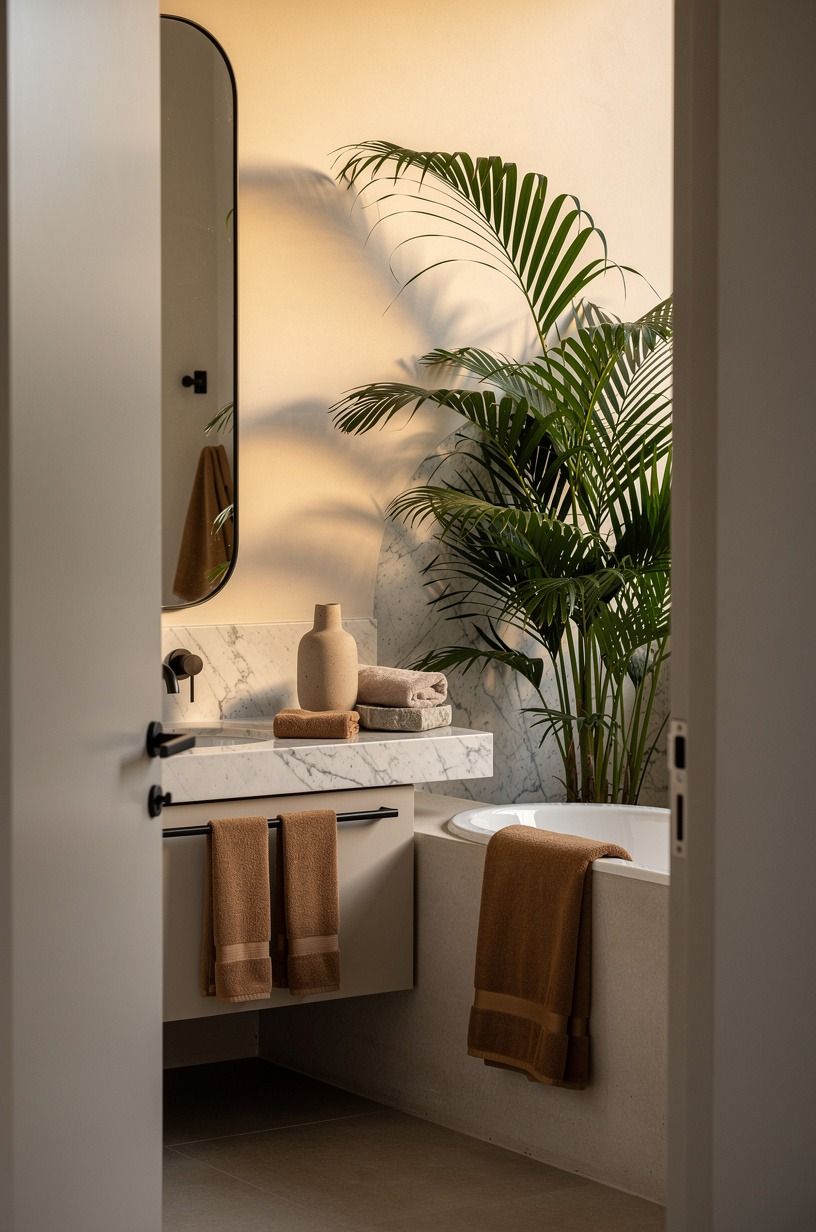
One big plant. That’s the whole move.
A tall bird of paradise beside the tub gives the suite the indoor-outdoor connection the entire era chased. Mid-century rooms were designed around views and greenery, and a bathroom with good light can hold both.
Set the tub against warm white walls with a Carrara marble surround in subtle grey veining, then let one camel towel and one black accent keep the palette tight around all that green. Humidity is a gift here.
Plants that sulk in your living room will thrive beside a shower. Water less than you think, wipe the leaves monthly, and you’re done. My bathroom plants guide ranks the survivors if your light is weak.
Why This Era Keeps Winning in Bathrooms
I get asked why mid-century works so well in bathrooms specifically, when other vintage styles fall apart the moment you add plumbing. I think it’s because the style was built on function.
Flat-front cabinets are easier to clean than shaker profiles. Floating furniture frees the floor. Nothing in a mid-century room is decorative without earning its keep, and a bathroom punishes anything that doesn’t earn its keep.
There’s also the material honesty. Walnut is walnut, brass is brass, terrazzo is exactly what it claims to be.
Bathrooms are small enough that fake materials read instantly, and this era never faked anything. You feel the difference even if you can’t name it.
The part nobody mentions: this style photographs beautifully but lives even better. The warm metal patinas instead of corroding. The wood deepens with age.
Ten years in, a mid-century bathroom looks more itself than the day you finished it, and I can’t say that about any other renovation trend I’ve watched come and go.
If you’re carrying this palette through the rest of the house, my mid-century modern living room ideas post keeps the same material story going. Consistency across rooms is what makes a house feel designed instead of decorated, and walnut is the thread that ties it all together.
A Few Things Worth Answering
What colors define a mid-century modern bathroom?
I always start with warm wood tones as the base, then add one saturated wall color like Farrow & Ball Studio Green or a muted ochre. Cream, warm white, and terrazzo gray fill the gaps. Two colors plus wood is genuinely all you need.
Can you mix brass and matte black in one bathroom?
You can, but I’d keep them in separate sightlines. Brass at the vanity, matte black on the shelving wall works because your eye never compares them directly. Same countertop, never.
My brass fixtures roundup shows combinations that hold up.
Is terrazzo practical for a wet bathroom floor?
It’s one of the most practical floors I’ve lived with. Sealed terrazzo shrugs off water, hides spots, and outlasts almost everything. Just specify a honed or matte finish rather than polished, because polished terrazzo gets slick when wet.
How do I get this look on a tight budget?
Paint first, then hardware, then lighting. Those three changes cost a few hundred dollars and carry most of the style. The IKEA GODMORGON vanity covers the big furniture piece, and my mid-century paint colors post has exact shades.
What’s the single best splurge in a master suite?
Radiant floor heat, no contest. It costs less than a fancy tub, it’s invisible, and you’ll appreciate it every single morning from October through March. Fixtures can be upgraded later.
The floor can’t.
If I Had to Pick One, It Would Be the Vanity
Everything on this list helps, but the floating walnut vanity does the heaviest lifting. It sets the wood tone, frees the floor, and tells every other choice what to do.
Start there, let the room build around it, and you’ll end up somewhere you’ll still love in a decade. I’d bet my own renovation budget on it.