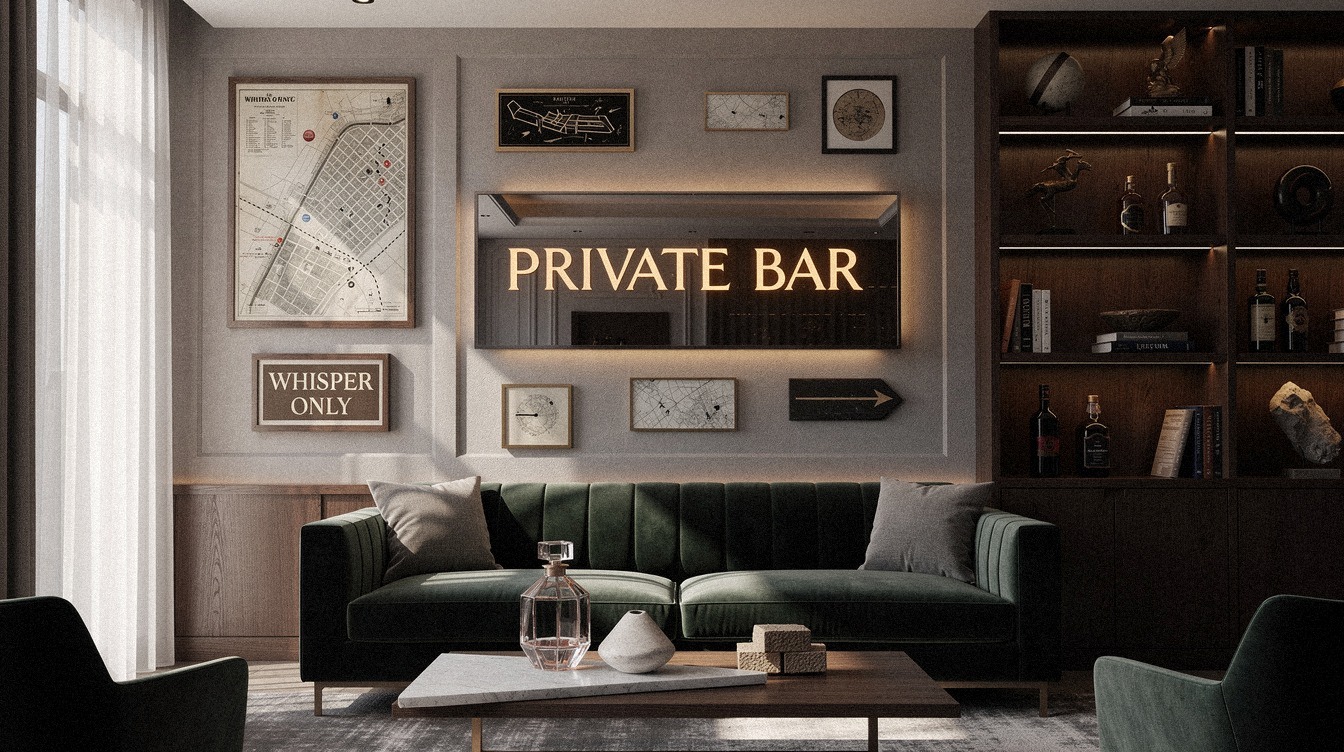
How to style speakeasy wall signs that feel secretive starts with restraint: one anchor sign, low light, and a few pieces that hint instead of shout. I learned that after overfilling a living room wall with novelty bar art and watching the whole setup go flat. You want the room to feel discovered, not decorated. Done right, this kind of wall story usually fits the Budget tier of about $300-$1,200, not a full rebuild.
Before You Start: The One-Glow Rule and what this usually costs?
Before you hang anything, decide whether your wall is doing one job or two. If your sign wall sits behind the sofa, you need it to anchor seating and not fight the upholstery. If it sits over a console, you need a focal point that can hold a lamp, a tray, and one framed piece without feeling top-heavy.
I like to sketch the wall first, then mark where your eye should land within 5 seconds.
If you’re building out the whole room later, these spending tiers keep you from pouring money into the wrong layer first. For more room mood references, look at dark moody speakeasy lounge inspiration before you shop.
A few pieces do most of the work. One smoked mirror sign. One framed map.
One tray with decanters. If your sofa is the standard 35-40 in deep, keep the wall story visually lighter than the seat mass or the room starts to feel back-heavy.
- Start with a smoked mirror bar sign
- Anchor the sofa wall with brass lettering
- Layer vintage liquor ads in dark frames
- Hang a speakeasy map above the console
- Build a backlit password sign niche
- Mount a neon cocktail quote low
- Frame house rules on aged parchment
- Cluster tin plaques around the bar cart
- Paint a secret door mural behind art
- Add brass arrows toward the hidden bar
- Finish with a velvet rope wall hook
- Line a passage with framed vintage menus
- Hang a single oversized key as wall sculpture
- Build a low ledge for a password-of-the-week blackboard
- Try a small gallery of antique bottle labels
- Hang a single oval portrait in a heavy frame
- Add a pair of slim sconces as punctuation
- Style a small wooden crate as a hidden-bar reveal
- Drape a long piece of moody fabric as a backdrop
- Cluster three small mirrors instead of one
- Top a console with one dramatic decanter
1Start with a smoked mirror bar sign
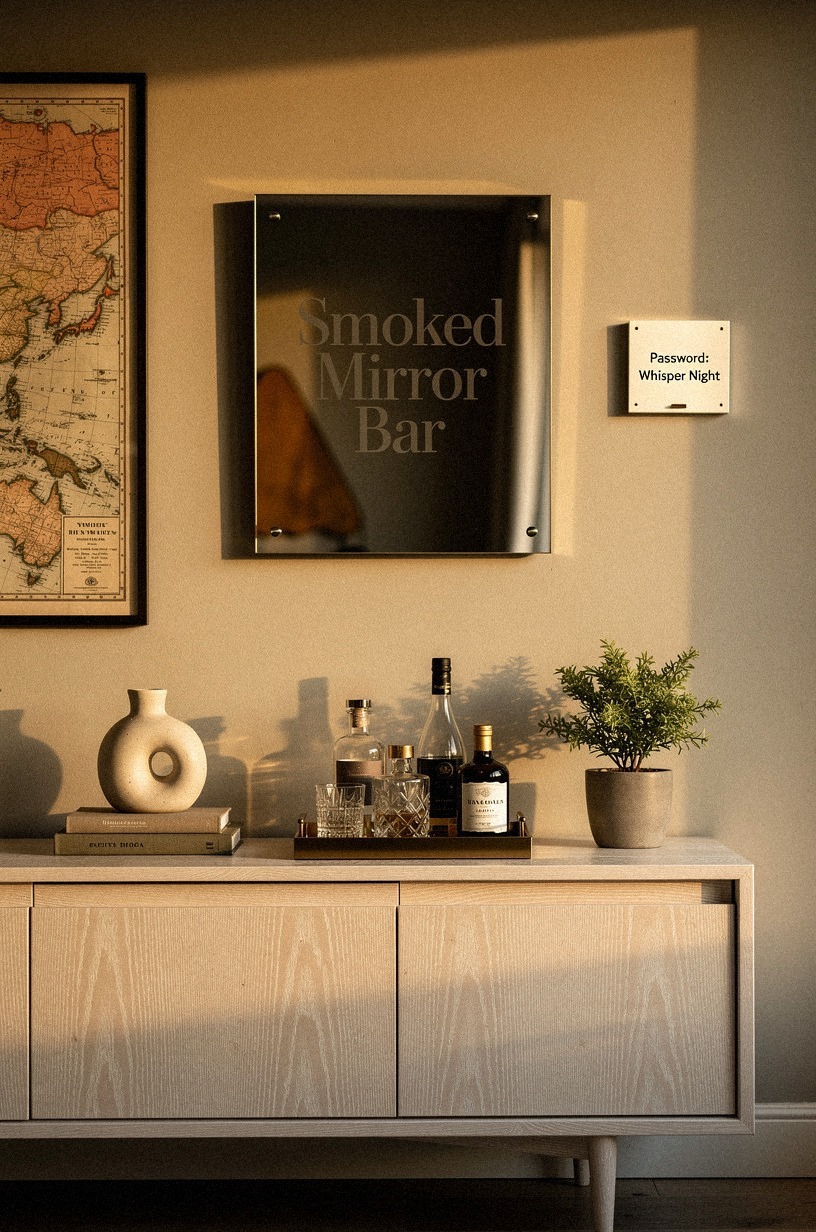
Put the smoked mirror bar sign at the center first, then let every other piece answer it. If you’re working over a console, hang it so the reflection catches lamplight and the top line of the frame sits comfortably above your sightline when you walk in. I like this higher than people expect, because a low sign reads like shop decor and you don’t want that.
Under it, keep the vignette tight. A walnut console with a framed map leaned or hung nearby, a slim bar tray, and one decanter silhouette are enough to sell the mood. You can borrow the layering pace from these vintage speakeasy lounge walls if you want a more old-world read.
And here’s the part that worked in my own tests: let the mirror be slightly imperfect. A little smoke, a little age, less polish.
If you go glossy and bright, the sign turns retail fast. You want a hush, not a showroom.
2Anchor the sofa wall with brass lettering
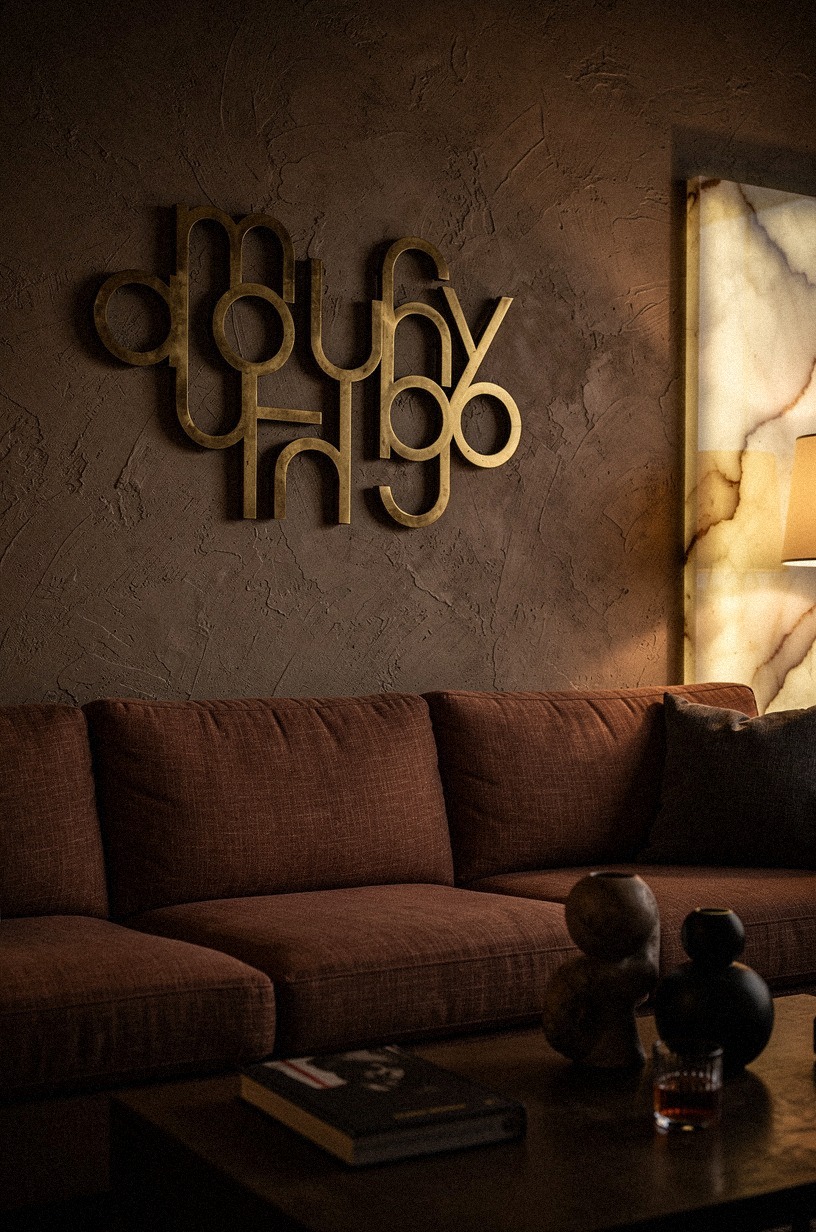
If the sofa wall is your main backdrop, use brass lettering as the anchor and not as a scatter of tiny words. One phrase in unlacquered brass reads richer than five plaques fighting each other. Keep it wide enough to hold the wall but not so wide that it outruns the sofa below.
Most living room sofas land around 35-40 in deep, and that depth matters because you see the brass from a seated angle more than a standing one. I prefer letters that stretch across roughly the visual middle third of the wall, especially over an Article Sven profile or another low, masculine sofa shape. If you’re leaning modern, this updated speakeasy approach shows the cleaner version.
But skip shiny script fonts. They go wedding-sign fast. Blockier brass with a little patina gives your eye something firm to land on when you step into the room, and the sofa finally feels like it belongs to the wall instead of floating in front of it.
3Layer vintage liquor ads in dark frames
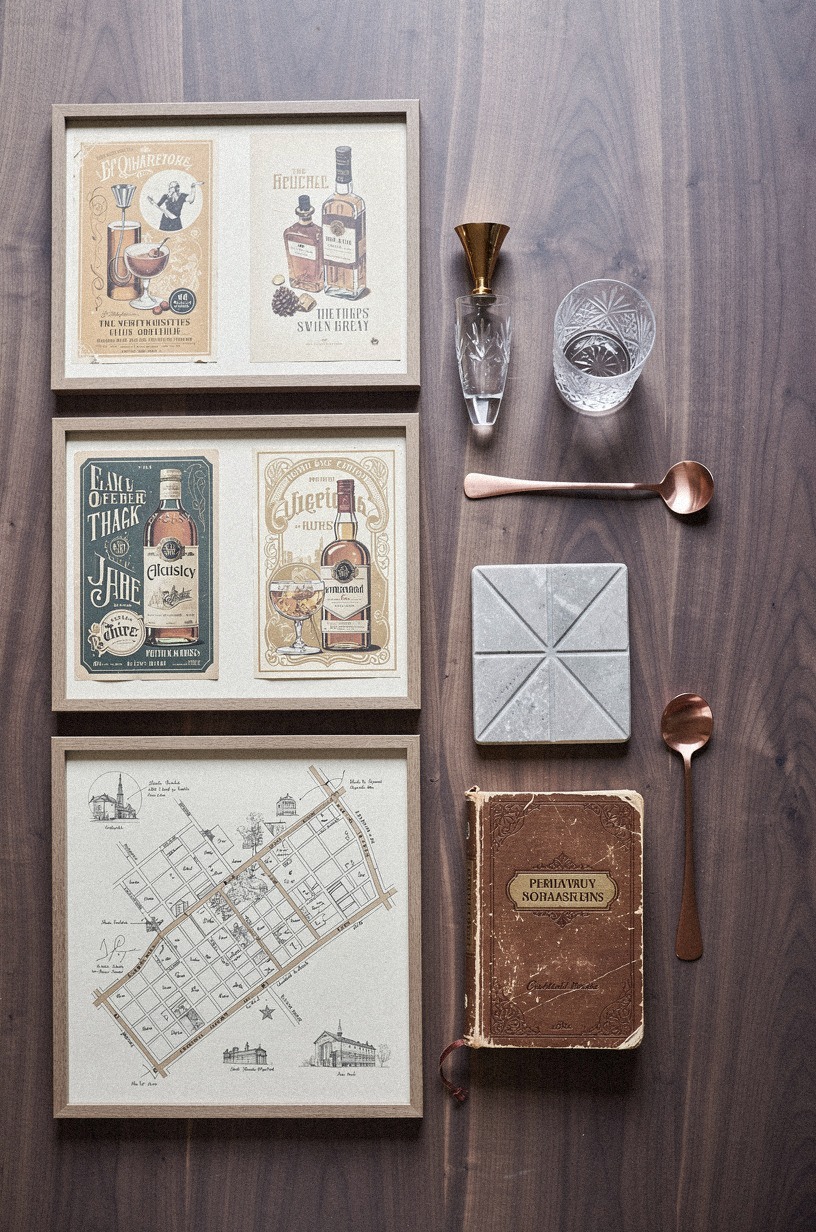
Now bring in the supporting pieces. Vintage liquor ads look best when you treat them like paper ephemera, not collector trophies. Three dark frames with varied margins will do more for you than a perfect matched set, because the tiny irregularities make the tabletop styling feel lived with.
I like these beside aged bronze objects, a folded map sketch, and one small bar tool on the table below. Thin black or tobacco-stained frames work better than bright gold here, especially if your wall color is Benjamin Moore Revere Pewter HC-172 and you need contrast without glare. For a little more Roaring Twenties energy, pull a few cues from Art Deco speakeasy rooms.
You don’t need rare originals. Reproductions on matte stock are fine if the frames look convincing and the glass doesn’t flash blue.
Much better. The goal is that overhead view where paper, metal, and wood all feel like they’ve been together a while.
4Hang a speakeasy map above the console
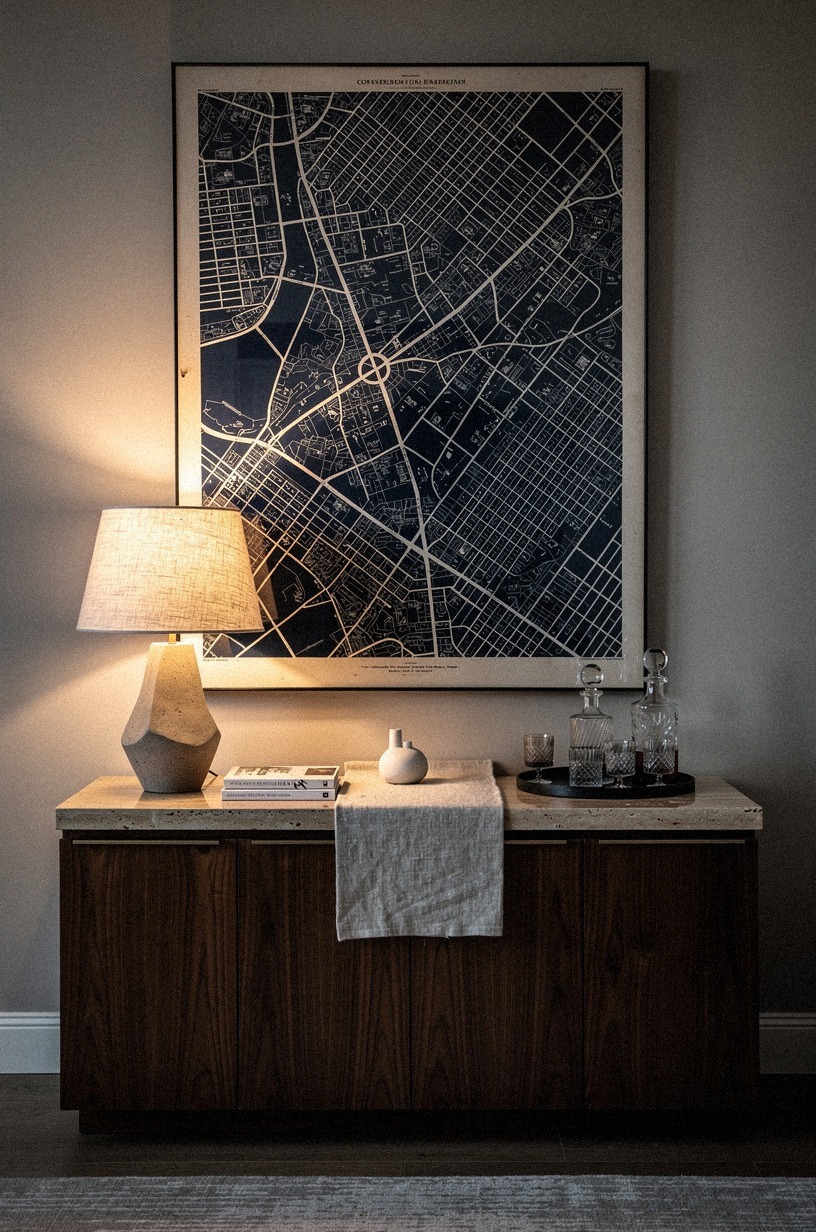
A framed map is the move that makes the whole wall feel intentional. When you hang it above the console, let it act as the quiet hero and keep the lamp, tray, and bottle shapes lower and simpler. If the map is busy, everything below it should calm down.
This is where I use what I call the One-Glow Rule: one lamp, one reflective object, one dark wood base. A linen shade on the lamp softens the edges, while a walnut cabinet or even an IKEA TONSTAD console gives the vignette enough weight to feel grounded. If you want to see how luxury rooms handle that balance, study these more polished speakeasy corners.
And don’t oversize the frame. Slightly narrower than the console usually looks smarter than edge to edge. You want the map to read like a clue you found, not a mural that swallowed the whole wall.
5Build a backlit password sign niche
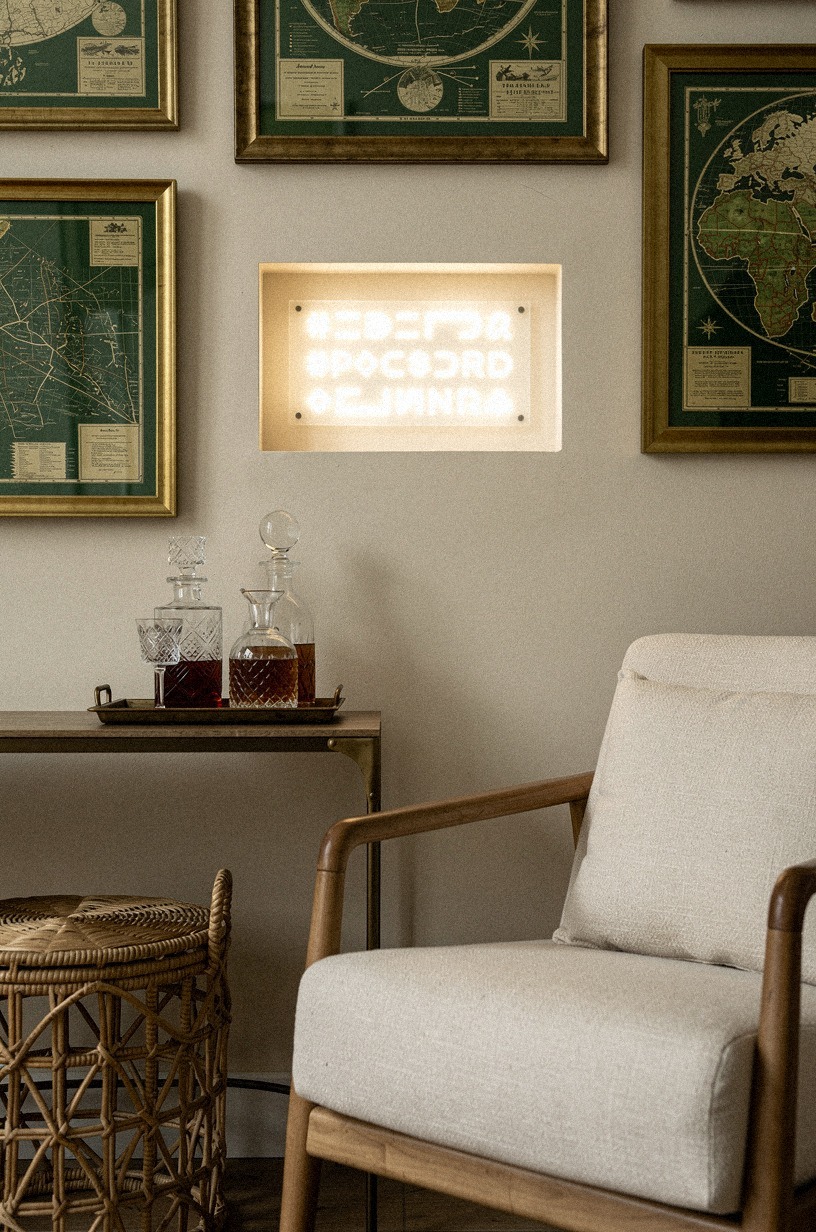
A backlit niche works because it turns the sign into an object, not just a message. If you’ve got an inset shelf or even a shallow boxed recess, line the back with a dark paint like Farrow & Ball Hague Blue No. 30 so the light stays moody instead of chalky. Warm bulbs only.
Cold LEDs kill this look in seconds.
Keep the sign itself small in frame and let the room around it breathe. A lounge chair nearby, a framed map off to the side, and a tray below are enough context for your eye to understand the story. I wouldn’t fill the niche with bottles unless you want it to drift into sports-bar territory, and you probably don’t.
For walls that need more depth, pair this idea with one of the darker palettes in these moody speakeasy rooms. The niche should feel like a discovery you notice on the second look.
That’s the win! Every time a guest walks past it twice before spotting the glow, you know the room is working.
6Mount a neon cocktail quote low
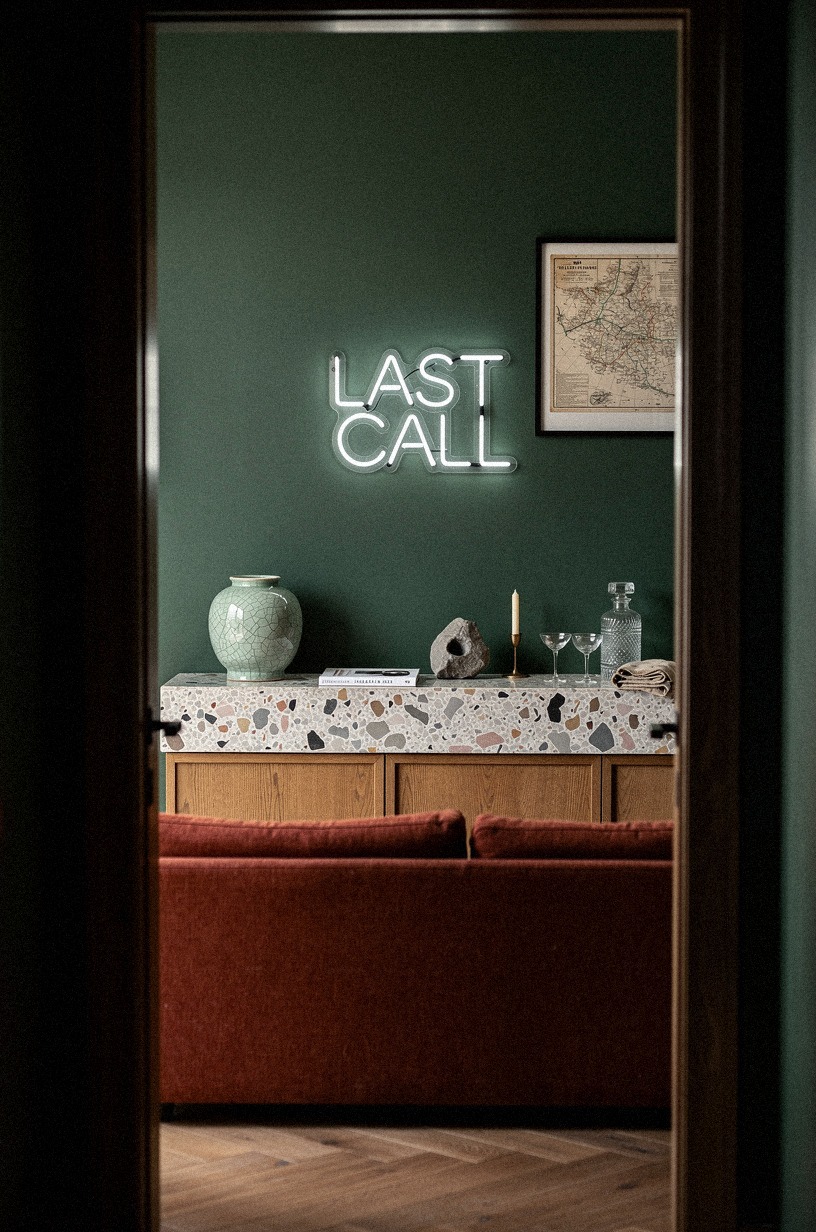
Low neon works when it feels like spillover from the bar area, not the headline of the room. Mount the quote lower than you think, close enough to the hidden bar zone that you catch it through the doorway with the sofa edge and framed map visible beyond. That layered sightline is what gives the room its after-hours pulse.
I prefer warmer tubing against Sherwin-Williams Evergreen Fog SW 9130 or another muted wall tone, because cool white neon can turn harsh the minute daylight leaves. If you’re mixing old and new, study how 1920s speakeasy styling handles glow without going diner.
But keep the wording short. Two or three words, max. If the line is long, the room starts reading the quote before it notices the doorway, the bar, or the map, and that’s backwards for the mood you’re trying to build.
7Frame house rules on aged parchment
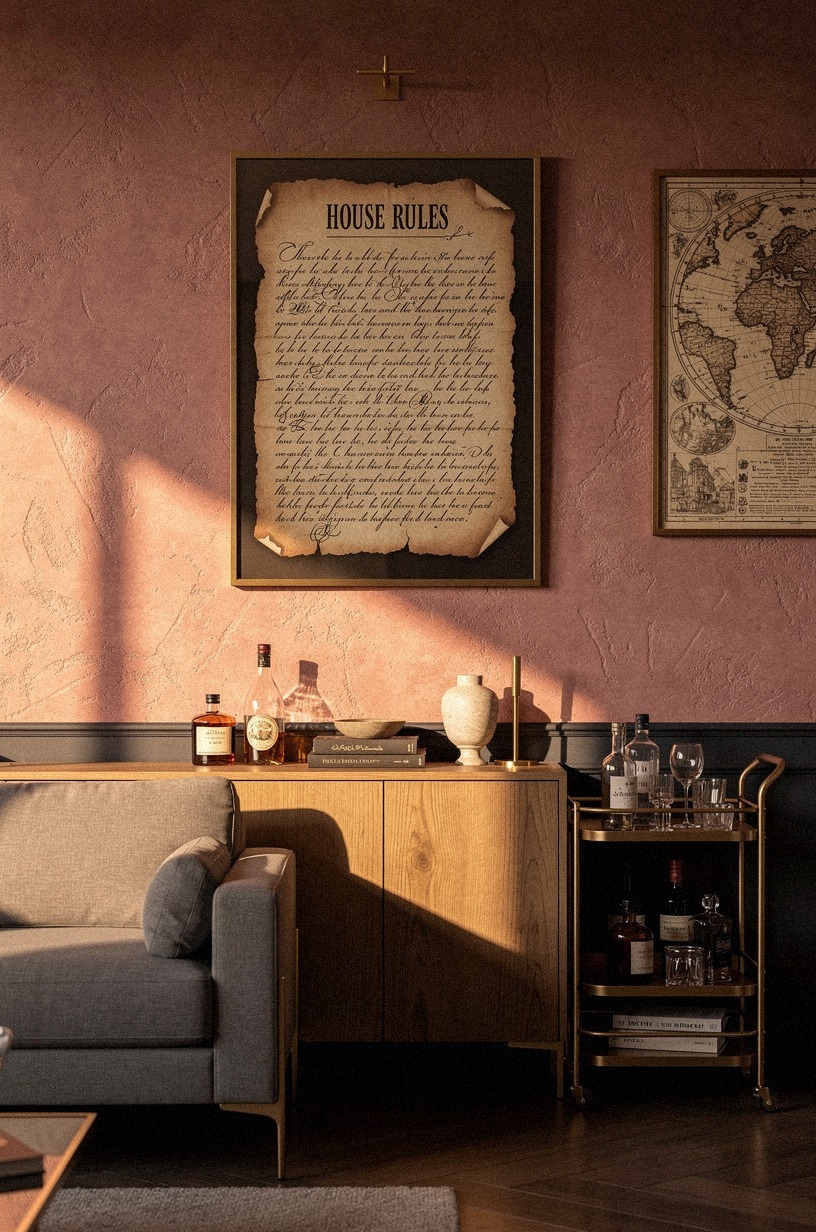
This step is where you can have a little fun, but it still needs discipline. House rules on aged parchment look convincing when the page tone is tobacco, the frame is dark, and the placement connects visually to the sofa, console, and bar cart across the room. If you can see the whole corner at once, the frame should read as one note in the arrangement, not the punch line.
Use cream paper with browned edges instead of fake scorch marks. Real talk: burnt-looking paper almost always looks craft-store cheap. I like a slim black oak frame here, especially if your rug is an 8×10 or 9×12 and the room already has enough softness below eye level.
For more layered period references, I still come back to old-world speakeasy decor.
And write fewer rules than you think. Three lines land. Nine lines feel like a restaurant waiting area menu.
8Cluster tin plaques around the bar cart
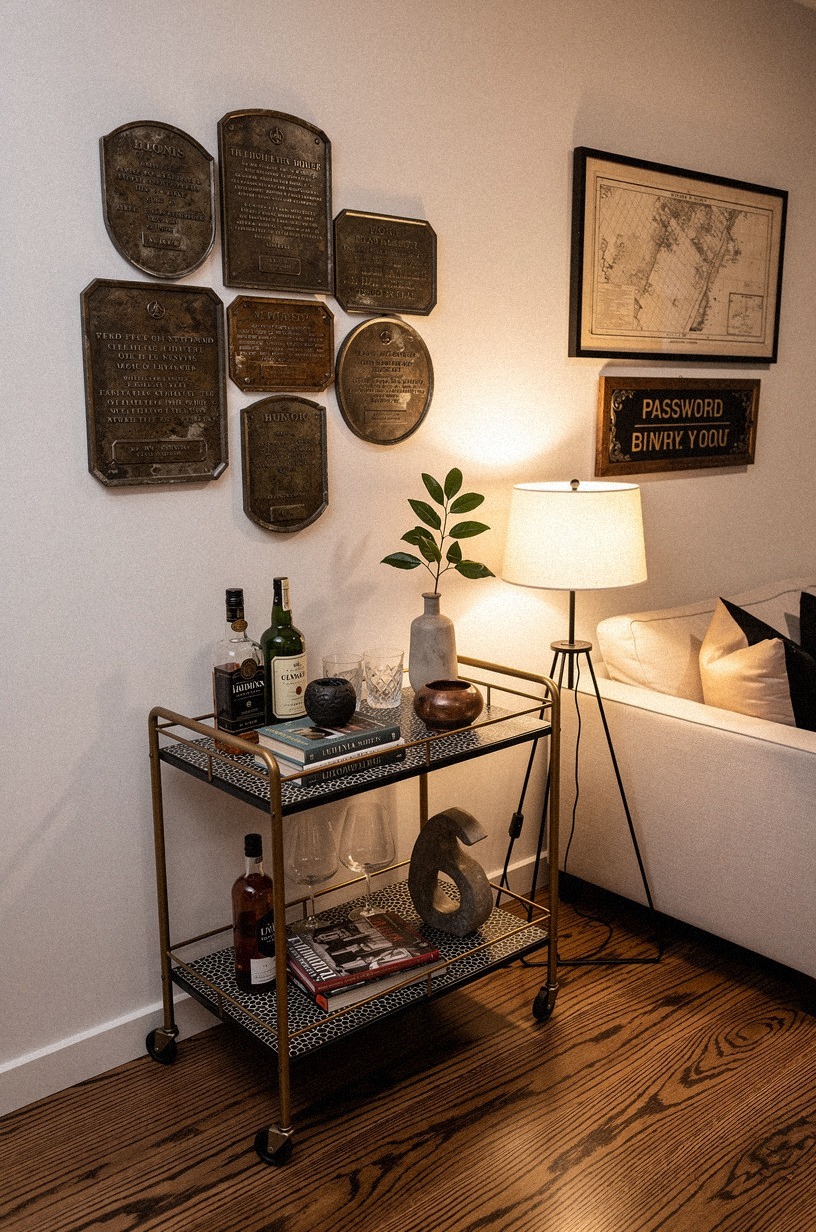
Tin plaques need a supporting actor, and that actor is the bar cart. Start with the cart parked where you can see a framed map and one other sign nearby, then cluster the plaques around that corner instead of spraying them across the whole room. When you keep the grouping local, the metal looks collected rather than random.
A Target Threshold cart or a secondhand brass-frame cart works fine here, because the plaques are doing the charm-heavy work. I mix one larger plaque with two smaller ones, then leave at least one patch of plain wall around them so your eye gets a rest. If you want a cleaner version, this modern speakeasy wall mix shows how to keep nostalgia from turning noisy.
Would I do six plaques in a tiny living room? No, and that’s the mistake people keep making. Three usually beats six because the cart, the bottles, and the lamp already bring enough detail into that corner.
9Paint a secret door mural behind art
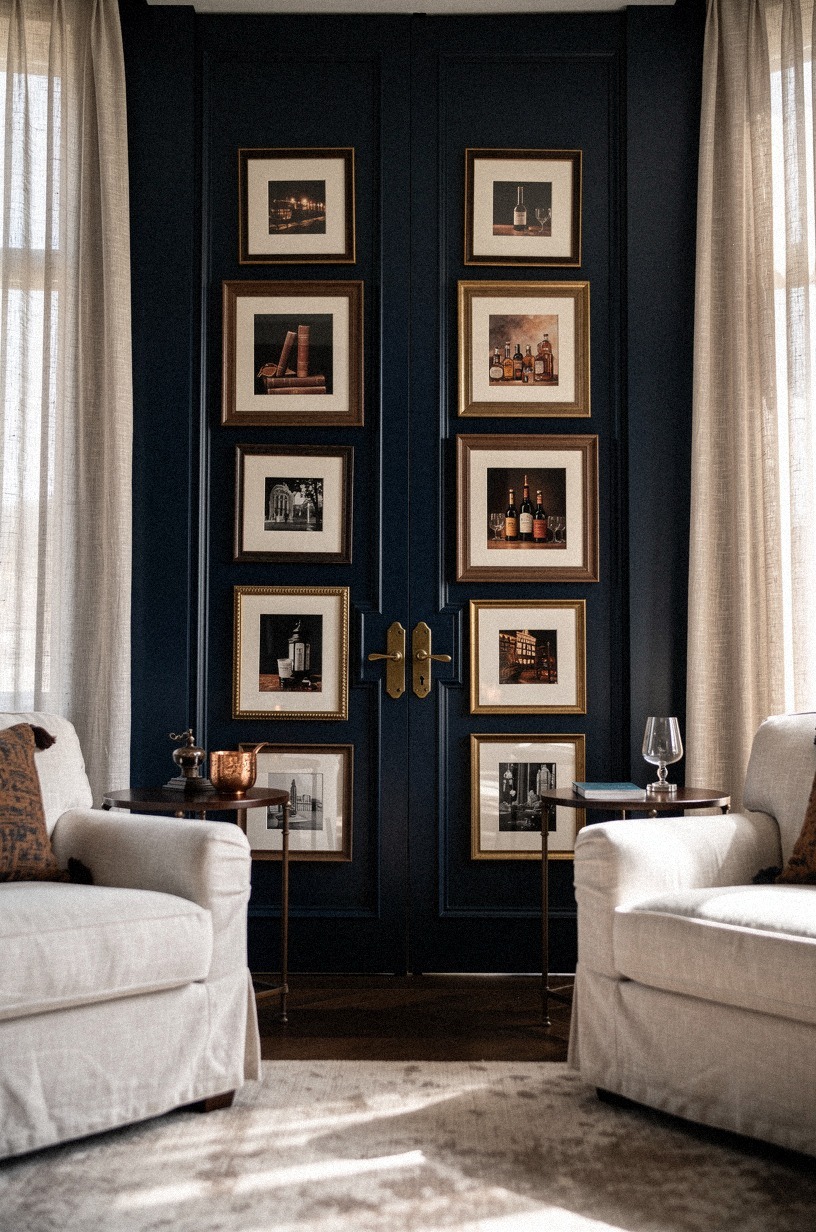
This is the highest-commitment step, so save it for after the simpler moves are in place. A concealed door mural behind framed art works when the seams disappear into the paint treatment and the art looks like it belonged there before the panel ever opened. If the panel lines stay obvious, the illusion is gone.
I like a deeper wall color such as Farrow & Ball Hague Blue No. 30 or even a softened charcoal wash, because shadow hides the joinery better than pale paint ever will. Use frames with enough depth to cast a little line of shadow, then keep the clue elements subtle: a map edge, a narrow shelf, one old key shape. For a more glamorous version of concealed drama, there are good cues in luxury speakeasy hideaway ideas.
But don’t paint a big mural scene unless you’re ready to commit hard. A mural with too much illustration starts feeling theatrical, and the best version of this idea is quieter than that.
10Add brass arrows toward the hidden bar
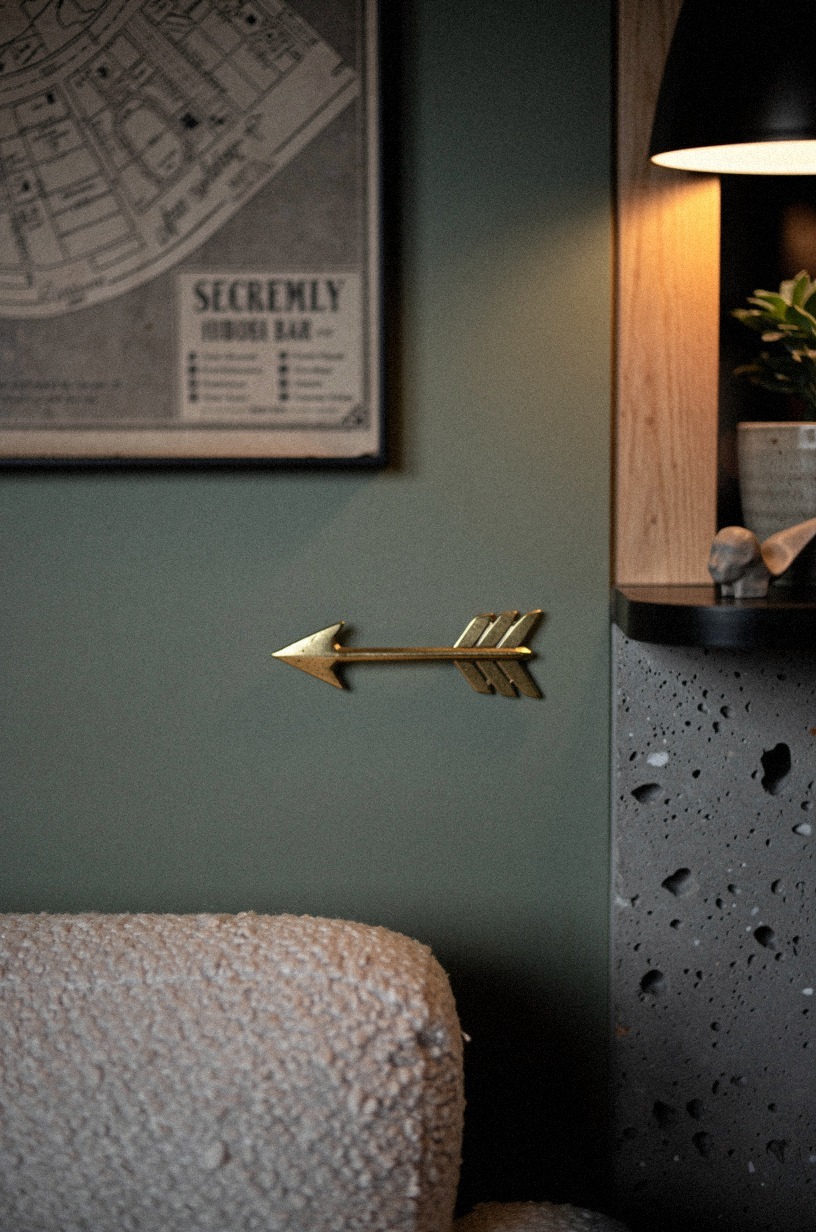
Use brass arrows like punctuation. One small marker beside the wall, angled toward the bar, does more for the story than a whole row of novelty signs. When you see it close up next to a sliver of map frame and counter edge, the room suddenly feels plotted.
This is where the Three-Clue Method works every time: one arrow, one map fragment, one bar surface. That’s enough for your brain to connect the dots without turning the wall into a themed set. I like brushed aged brass over polished brass here, because you want the metal to glow softly, not shout under lamplight.
And keep the arrow small. Think detail, not billboard.
If you’ve already got strong brass lettering on another wall, this little marker should whisper from the side and let the bigger sign stay in charge. If you want more period-style direction cues, this 1920s speakeasy roundup is worth a look.
11Finish with a velvet rope wall hook
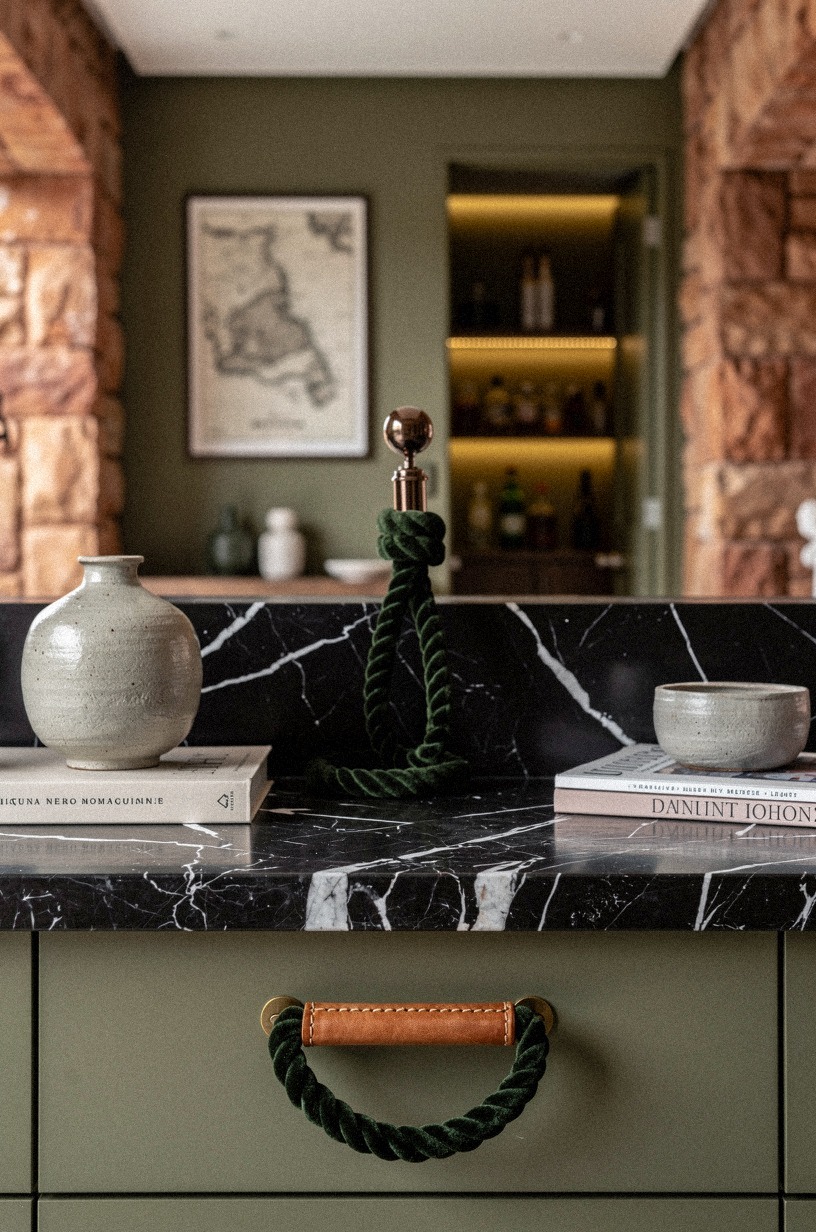
The wall hook is the finishing move because it gives the entry vignette a tactile ending.
12Line a passage with framed vintage menus
Got a hallway that leads toward the bar? Frame three or four vintage cocktail menus in a tight, single-line row, all in blackened brass frames with a 1.5-inch matte.
They cost almost nothing on eBay, and the hallway suddenly reads like an arrival, not a pass-through. The trick is the height: hang them at 58 in centerline so the eye catches them as you walk, not on the way out.
Pair them with a single aged bronze picture light overhead, warm 2700K, and you don’t need anything else. The menus become the message, and the wall does the storytelling while your feet keep moving. For more layering inspiration, bar cart styling with a sense of occasion covers a similar trick on a smaller surface.
13Hang a single oversized key as wall sculpture
I know this sounds like a gift-shop move, but a single oversized brass key, like 18-24 inches long, hung vertically on a dark wall, doesn’t read cute.
14Build a low ledge for a password-of-the-week blackboard
A small framed chalkboard at seating height, maybe 18×24 inches, lets you write the weekly “password” in soft white chalk. The reveal becomes a tiny ritual, and the room gets a moment of play without losing its grown-up edge. Mount it on the side wall of the bar cart, where guests can see it but the room still anchors elsewhere.
Use a real chalk, not a chalk pen. The dusty texture is half the look.
And rotate the phrase every Friday, two words, never more. A simple ikea HEMNES frame, painted Farrow & Ball Off-Black No. 57, gets you the look for under $40 and disappears into the wall between phrases.
15Try a small gallery of antique bottle labels
Bottle labels, the paper kind peeled from old liquor bottles, framed tight in a 2×2 grid. Each label is maybe 3×4 inches, all in tobacco-stained mat boards, all in matched narrow black walnut frames. The grouping reads like a museum case, not a fridge door.
It’s a small, almost quiet move, and that’s why it works. I keep mine in a hallway that leads to the bar area, and people ask about the labels every single time! A reproduction set runs about $30 for six, and the framing can be done in a single afternoon.
The detail that makes or breaks it: mat them all the same color. Visual consistency is the whole point.
16Hang a single oval portrait in a heavy frame
A single oval portrait, mostly dark, in a chunky antique gold frame.
17Add a pair of slim sconces as punctuation
Slim brass sconces flanking the sofa, the map, or the portrait you just hung. They aren’t lighting the room, they are punctuating the wall. Pick a 14-inch swing-arm sconce in unlacquered brass, mount them at 66 in off the floor, and tip the bulbs up so the light grazes the wall instead of spilling into the room.
The sconces cost between $80 and $220 each depending on whether you go Schoolhouse Electric or a Rejuvenation reproduction, and they’re the kind of detail that quietly does the work of a $5,000 buildout. Add a dimmer, set them at 30% after 9pm, and watch the room go from “nicely decorated” to “where did this place come from.” Worth every single dollar!
18Style a small wooden crate as a hidden-bar reveal
A small pine crate, the kind wine comes in, mounted on the wall with iron brackets and used as the “reveal” for a hidden bar.
19Drape a long piece of moody fabric as a backdrop
A single length of mohair velvet in oxblood or forest green, hung from a ceiling-mounted brass rod, makes the wall feel like a curtain in a private club. The fabric should pool 1-2 inches on the floor, never break above it. Use a heavyweight 18 oz cotton velvet if you want the drape to be substantial, not theatrical.
The trick is the rod. Get a 1-inch unlacquered brass rod, mount it 6 inches from the ceiling, and let the fabric hang in soft folds rather than pulled tight.
You don’t need a window behind it, the rod IS the room, and the wall suddenly looks like a backdrop to a moment, not a surface to fill. For a similar effect with a little more whimsy, vintage speakeasy lounge walls show how soft fabric softens hard surfaces.
20Cluster three small mirrors instead of one
Three small mirrors, each maybe 10×14 inches, hung in a tight column on the wall that catches the most lamplight. The mirrors bounce the warm glow back into the room and triple the sense of moody depth. Each frame in a different antique metal finish, one brass, one bronze, one blackened steel, so the cluster reads collected, not matched.
I’ve done this twice. Both rooms felt bigger and moodier.
The mirrors should hang vertically, about 4 inches apart, on the wall opposite the bar corner. You want the reflection to catch the bottles and the lamp, not the door, because the point is layering, not surveillance.
Each mirror runs $30-$60 on Etsy, and the cluster takes about 45 minutes to install.
21Top a console with one dramatic decanter
One decanter, oversized, in cut crystal with a faceted stopper.
Why the One-Sign Rule beats the themed-bar wall
I’ve gone back and forth on speakeasy walls more than once, and the version that wins is never the one with the most references. It’s the one with the clearest hierarchy.
You need one sign that claims the room, one supporting story piece, and then a few quiet objects that keep the whole thing from feeling empty. That’s it.
The second you start adding every clever quote, every faux-vintage plaque, and every bottle print you can find, the room stops feeling private and starts feeling merch-driven.
The best decision framework is simpler than people expect. First, decide whether your wall’s job is anchoring a sofa or leading you to a bar corner. Second, pick the material that will carry the mood: smoked mirror if you want reflection, brass if you want weight, parchment if you want age, neon if you want late-night glow.
Third, kill the loser. If you’ve got both shiny brass script and bright neon fighting on the same wall, one of them needs to go.
I almost always cut the shinier piece first because it reads younger and cheaper.
And here’s where budget matters more than taste. A room in the $300-$1,200 range can still feel rich if the palette stays controlled and the materials have texture.
A room in the $2,500-$8,000 range buys you better lighting, a better rug, and a sofa that doesn’t flatten the whole mood. But the wall idea itself isn’t what costs big money.
Custom millwork does. That’s why I’d spend on the room shell last, not first.
You can use the same thinking in other rooms too. A kitchen wall sign needs less patina and more restraint, which is why I like borrowing scale ideas from kitchen wall styling that stays grown-up.
A bathroom version needs almost no signage at all, just one clue, and bathroom wall decor with a tighter footprint proves the point. More isn’t moodier.
Better chosen is moodier.
A Few Things Worth Answering
What is the best Speakeasy Wall Decor & Signage Ideas (Passwords, Maps & More) for a small living room?
A smoked mirror sign over a console is the best place to start because it gives you depth without bulk. In a small room, pair it with an IKEA TONSTAD piece, one framed map, and skip the extra plaques.
One focal wall reads bigger than several busy corners. If you want the cleaner version, this modern speakeasy guide keeps the scale tight.
Where can I buy Speakeasy Wall Decor & Signage Ideas (Passwords, Maps & More) pieces on a budget?
Target, Wayfair, and IKEA are the easiest places to start, especially for frames, carts, and basic consoles. For the older-looking pieces, Facebook Marketplace and local thrift shops usually give you better patina for less money. I would buy new lighting and secondhand frames if you want balance.
How much does a Speakeasy Wall Decor & Signage Ideas (Passwords, Maps & More) makeover cost?
Most living room versions cost about $300 to $1,200 if you’re repainting, adding art, and styling around what you own. Mid-range rooms jump to $2,500-$8,000 when a new sofa, rug, and layered lighting come in. The free move is editing down what you already have.
Can I create a Speakeasy Wall Decor & Signage Ideas (Passwords, Maps & More) on a budget?
Yes, and you can get a lot done with editing before spending. Start by regrouping frames, lowering warm lamps, and moving one tray to the console. Then buy only the anchor piece you still need, usually the sign or the map, not both at once.
Is a Speakeasy Wall Decor & Signage Ideas (Passwords, Maps & More) worth it in a small space?
Yes, a small space can make this look stronger because tight rooms hold atmosphere better. Keep the sign on one wall, keep your rug at 8×10 or 9×12 with the front legs on it, and let the bar corner stay secondary. Compression helps the mood here.
Is Speakeasy Wall Decor & Signage Ideas (Passwords, Maps & More) a good idea for a rental?
Yes, as long as you lean on reversible layers. Removable hooks, leaned frames on a console, battery lights in a niche, and a bar cart do most of the work without asking you to patch much later. I would save painted murals for a place you own.
Where I’d Start First, the One-Sign Rule
If I had to pick one step, I’d start with the smoked mirror bar sign. It fixes scale fast, and every other piece can borrow its mood from that reflection. Pin this approach for later and build the rest once the wall has a center.