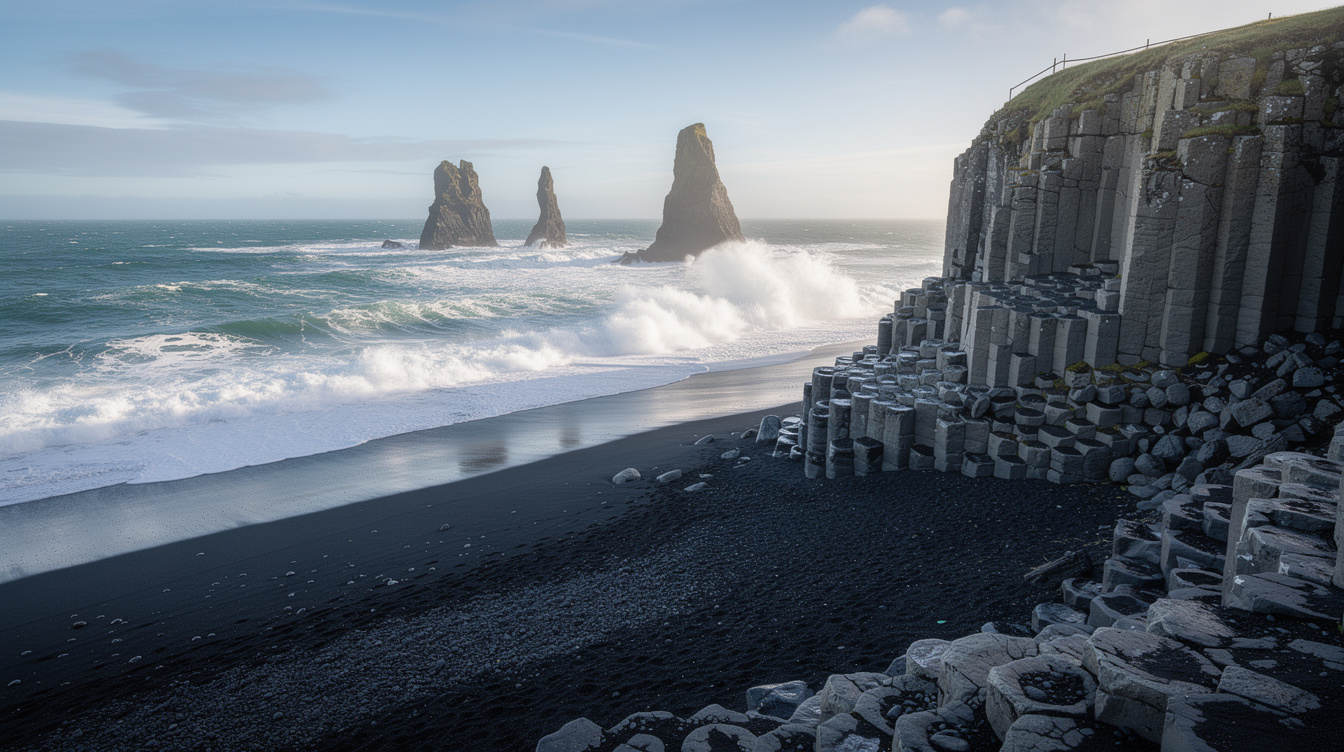
The photograph that sold you on Reynisfjara Beach shows black sand, basalt columns stacked like organ pipes, and the Reynisdrangar sea stacks rising out of white surf. It’s a real photograph. The beach looks exactly like that. What the photograph cannot show is the wave that ran 25 feet up dry black sand in under four seconds and pulled visitors into the North Atlantic before anyone processed what happened.
Both elements are real. Understanding why one produces the other is the only practical preparation for this place.
The geology that built this beach explains the waves
Reynisfjara sits on Iceland’s south coast, roughly 115 miles southeast of Reykjavik via Route 1, near the village of Vík í Mýrdal, population around 300. The black sand is pulverized basalt lava, which stays noticeably colder underfoot than quartz sand even in July. The Reynisdrangar sea stacks offshore rise to approximately 216 feet. The Hálsanef basalt cave directly on the beach is worth examining from the entrance. Standing inside it for any length of time is not.
The critical geographic fact: Reynisfjara faces due south into the North Atlantic with no land mass between it and Antarctica. That’s several thousand miles of open ocean fetch arriving directly at a flat, steeply sloped shore.
Because the beach has no protective reef or tidal shelf, wave energy hits the sand unbroken. Hanalei Bay works on a similar principle, where the physical structure of the coast determines what the water does, not what the weather looks like from the parking lot.
The wave problem, explained without dramatization
Most surf beaches have readable patterns: sets arrive in groups, the frequency is consistent, the waterline is predictable. Reynisfjara doesn’t work that way. The beach receives irregular wave trains from multiple North Atlantic storm systems simultaneously, and those energies combine unpredictably. A wave that appears to be retreating can be immediately followed by one running significantly further up the sand.
Icelandic authorities and local emergency services have responded to multiple incidents here involving visitors swept into the ocean. Several have been fatal. A warning system with audio alarms and flashing lights was installed at the parking area, though it can’t predict individual waves. Official signage recommends staying at least 30 feet from the waterline.
But the most dangerous position on the entire beach isn’t at the waterline. It’s at the base of the Hálsanef cave, where the rock face blocks retreat and amplifies wave run-up against solid basalt. Local guides who’ve worked this stretch for years say the same thing: the cave draws people in, and the cave is where the incidents cluster.
When to go, and what you actually get
June through early August gives you the widest weather window. July air temperatures at Vík average 50 to 55°F, which sounds mild until the 15 to 25 mph coastal wind arrives, and it always does. That wind moves fine black sand into your teeth and camera lens within 20 minutes. Bring a windproof layer regardless of what the forecast shows.
Puffins nest on the Reynisdrangar stacks and in the cliffs east of Vík through approximately early August, visible from the beach with binoculars. And the daylight near the summer solstice stretches to 22 hours, which means you can visit at 8am and share the parking lot with four other cars instead of forty. High-latitude light in that window does things to black sand that afternoon light simply doesn’t.
October through February trades puffins and warmth for aurora probability and near-empty conditions. Wave energy is statistically higher in winter. The sneaker wave risk is present every single month, but the crowds that ignore the signs are largely gone.
The hour the bus tours miss
Organized tours from Reykjavik arrive between 10:30am and 1pm and spend about 45 minutes on the beach. At 8am in summer, the low northeastern light hits the black sand and it reflects faintly, like wet graphite. The basalt columns in that light look assembled rather than natural. The gap between what photographs show and what early-morning presence delivers is the same lesson every dramatically photogenic beach eventually teaches.
The sea is still the same sea at 8am. The waves are still the same waves. But the beach at that hour belongs to you in a way it never does at noon.
Your questions about Reynisfjara answered
How do you get there from Reykjavik?
Drive Route 1 east approximately 115 miles to the Reynisfjara turnoff, just west of Vík. The drive takes roughly two hours in summer. Rental cars at Keflavik Airport (KEF) run $60 to $120 per day in peak season. Organized south coast day tours typically cost $80 to $130 per person and add Seljalandsfoss and Skógafoss to the itinerary. The N1 station in Vík, 2 miles east, is your best fuel and food stop.
What’s the best time of year to visit?
June through early August for puffins, long daylight, and manageable weather. October through February for aurora potential and solitude, with the same logic that applies to any volcanic coast: geology doesn’t care what month you arrive, but the light and the crowds do.
Is there an entrance fee?
Parking costs approximately $7 USD in ISK equivalent. The beach itself has no admission charge. But the wave warning signs at the lot are free, and they’re the most valuable thing at the site.
At 9pm in July, the sun is still well above the horizon and the Reynisdrangar stacks cast long shadows across black sand that holds the cold of the North Atlantic in its surface no matter how long you stand in it. The waves come when they come.