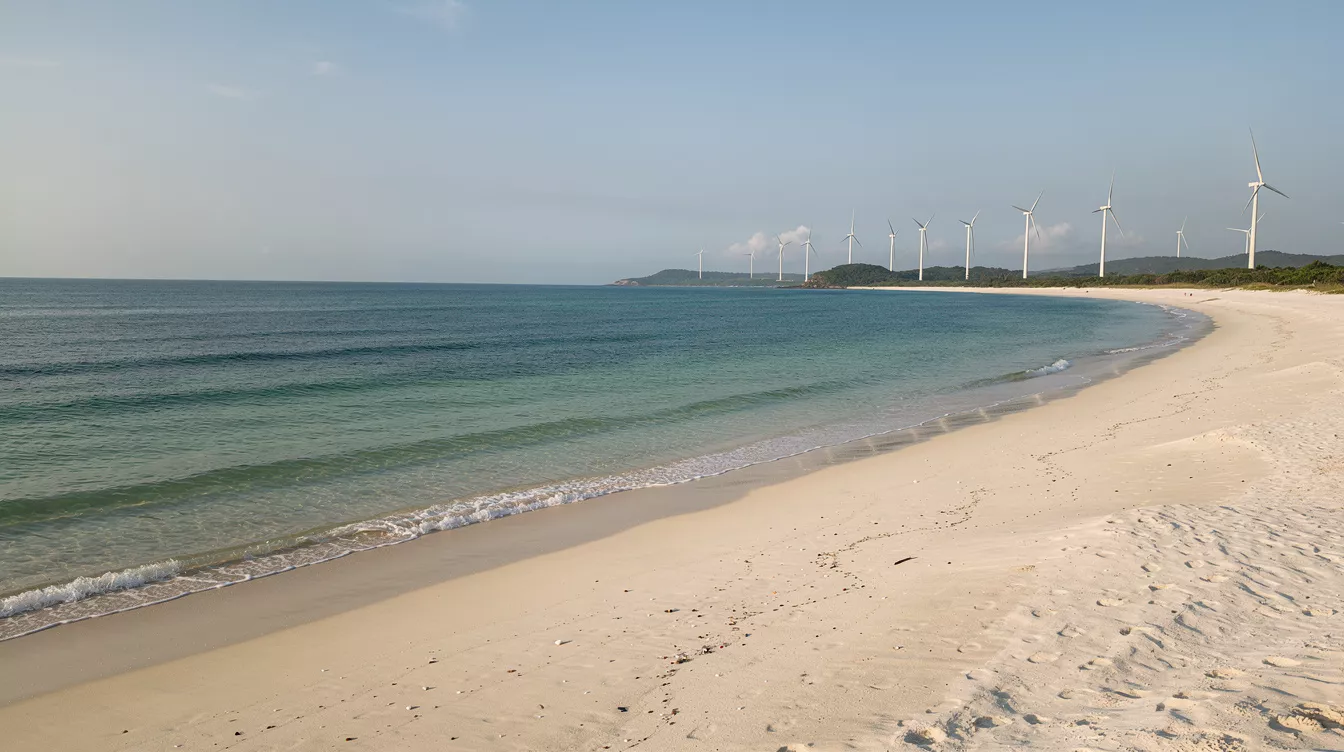
The road north from Laoag runs straight through flat sugarcane country before it bends toward the coast at Bangui Bay. That’s where you first see them: a row of wind turbines turning hard in the same direction, every one of them, all year long in season. The same wind pressing those blades is the wind that will make Saud Beach worth the trip. Without it, the beach is just sand. With it, the water goes flat and green-pale and clear to the bottom.
What the amihan actually does to this beach
The amihan, the northeast monsoon, runs roughly November through April across Ilocos Norte. Because Saud faces northwest, the wind arrives at an oblique angle rather than head-on, and that geometry matters. It smooths the shallows instead of churning them, leaving water clear enough to see the sandy bottom at chest depth.
Water temperature during the amihan sits in the low-to-mid 80s Fahrenheit. And when the habagat, the southwest monsoon, flips in around May or June, it drives directly into this stretch of coast. The beach doesn’t disappear. It just becomes rough, overcast, and not what you came for. The same monsoon reversal mechanics that govern Boracay apply here, just 300 miles further north and with far fewer people watching it happen.
Getting to the top of the Philippines
Fly from Manila’s Ninoy Aquino International Airport to Laoag International Airport on Cebu Pacific or Philippine Airlines. The flight takes about one hour. Tickets run $30 to $80 USD one way depending on how far ahead you book.
From Laoag, Pagudpud is roughly 60 miles north by road, about 1.5 to 2 hours. Shared vans run the route for around $5 USD. A private hire costs closer to $15 USD and gets you there without stops. But no international flight lands at Laoag directly, so add a Manila transit day to any itinerary from the continental US.
The coastal road passes through Bangui, where 15 turbines line the shoreline, each standing roughly 197 feet tall. A boat captain who’s fished these waters for decades once told a journalist the wind here never really rests between December and March. He wasn’t exaggerating. The same northeast monsoon that idles Phuket’s Andaman coast in winter is what powers those turbines and presses Saud’s water flat.
The beach itself, and what the photos skip
Saud Beach runs about 2 kilometers along the Pagudpud coastline. The sand is fine and pale, not the blinding white of Boracay’s Station 1, but close enough. Because the beach faces northwest, afternoon light hits the water directly and the color reads a clear green-blue during the amihan months. There’s no coral at the shoreline. The bottom is sandy and gradual, which is good for wading and less interesting for snorkeling without going further out.
Accommodation ranges from basic guesthouses at around $20 to $30 USD per night to mid-range beach resorts at $50 to $80 USD. A full fish plate at a local eatery costs $3 to $5 USD. And food options thin out quickly past the main resort strip. One family that’s run a small restaurant near the beach for years keeps irregular hours from May onward. Come in October expecting dinner at 8pm and you may be eating from a sari-sari store. That’s not a warning. It’s just honest.
Most visitors on the sand are Filipino. Because most Americans booking the Philippines go straight to Palawan or Boracay, Saud stays priced and paced for people who actually live near it. There’s no beach entrance fee, though some resorts charge a day-use fee of $2 to $5 USD for non-guests. El Nido’s tour infrastructure this is not, and that’s precisely the point.
Your questions about Saud Beach answered
How do you get to Saud Beach from Manila?
Fly Manila to Laoag (about 1 hour, $30 to $80 USD one way). From Laoag, take a shared van north to Pagudpud for around $5 USD, or hire a private vehicle for $15 USD. Total travel time from Manila to beach runs 5 to 6 hours with a smooth connection.
When is Saud Beach actually worth going?
December through March is the tightest and most reliable window. The amihan runs November through April, but the clearest water and flattest conditions cluster in those middle months. Avoid May through October entirely unless rough surf sounds appealing.
How much does a trip to Saud Beach cost per day?
Budget travelers can manage on $25 to $40 USD per day covering a guesthouse, local meals, and transport within the area. Mid-range stays at beach resorts push daily costs to $60 to $100 USD. Neither number includes flights from the US.
One last thing before you book
By 7am in February the amihan has already been working for an hour. The water is flat and pale green in the early light, the turbines at Bangui are turning along the coast to the south, and the sand still holds the cool of the night. That lasts maybe another hour before the sun takes it.