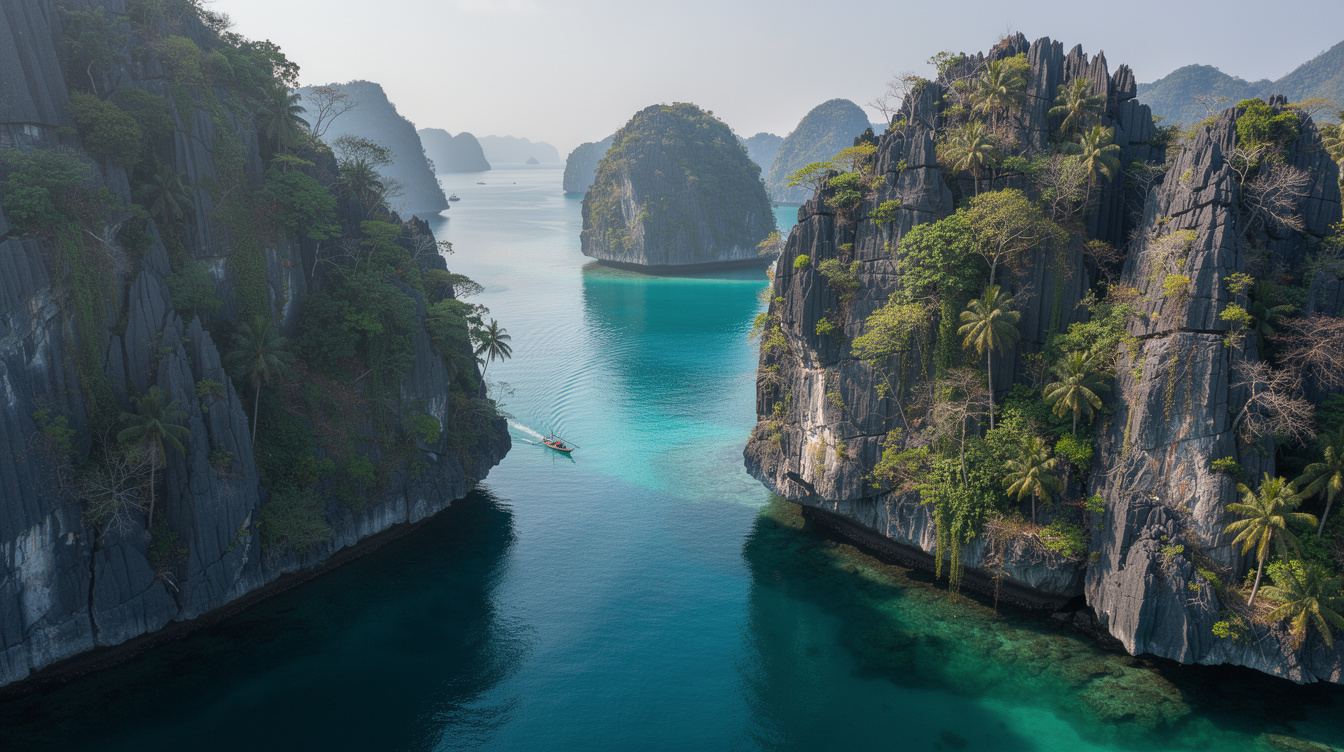
At 7:30am on the beach in El Nido town, four clusters of wooden bangka boats load simultaneously, each tied with a different colored rope. Outboard exhaust mixes with the smell of low tide and salt-wet rope. Every tourist is heading into Bacuit Bay, and almost none of them knows the passengers in the next boat are going somewhere completely different.
El Nido’s 45 islands and islets are divided into four government-regulated tour circuits. The circuit you choose, Tour A, B, C, or D, is the single decision that determines which Philippines you actually see.
What the four tours actually divide
Tour A is the lagoon route: Big Lagoon, Small Lagoon, Secret Lagoon, and Shimizu Island. It’s the most booked because “Big Lagoon” photographs better than anything else in the bay. Tour B covers Cathedral Cave, Cudugnon Cave, and Entalula Beach, a cave-focused circuit that involves less swimming.
Tour C runs to Helicopter Island (named for its rotor-blade silhouette from the water), Secret Beach, Matinloc Shrine, and Tapiutan Island. It’s the most visually dramatic circuit, with a sandbar beach that only appears at low tide. And Tour D, the least-booked, reaches Cadlao Lagoon and Bukal Beach with noticeably smaller groups.
Because the Philippine Tourism Authority regulates these circuits, a bangka licensed for Tour A cannot legally drop passengers at Tour C sites. The tours aren’t suggestions.
Why the lagoons look different from what you booked
The limestone karst walls surrounding Big Lagoon block wind entirely, so the water sits almost flat even when the open bay has chop. That stillness is the photograph. But Small Lagoon, ten minutes away on the same tour, requires threading a narrow gap by kayak. The standard bangka cannot enter.
Kayak rental on the water runs roughly 200 PHP (about $3.50). This is not explained at the town booking desk. Most Tour A operators sell it separately once you’re already at sea. Visitors who skip it see Small Lagoon only from the entrance.
Tour C’s Secret Beach requires something different entirely: swimming through a gap in a limestone cliff, roughly three feet wide, at low tide. There’s no beach visible from the boat. But guests who don’t swim miss it completely, and no brochure mentions that up front.
The timing problem that runs all four tours
Most operators load between 8:00am and 9:00am, and Tour A’s popularity means Big Lagoon sees peak crowding from 10:30am to 1:00pm. Because Tour C and D travel to more distant islands, those beaches stay active later, which actually reduces midday crowd overlap with the Tour A lagoons.
The Habagat (southwest monsoon) runs roughly June through October. During those months, the outer island passages on Tour C and Tour D become weather-dependent or close entirely. Tour A’s inner lagoons stay sheltered behind the karst formations and remain operable through most of Habagat.
Regulated-access beach systems across Southeast Asia follow the same logic: the protected interior beats the exposed exterior when weather turns. El Nido’s tour structure makes that call for you automatically.
El Nido town before the boats leave
The bangkas beach by 5:00pm. The bay turns a flat bronze at dusk, the karst peaks going dark in silhouette. Two blocks from the dock, local spots grill whole fish for around 350 PHP (about $6), and a boat captain who has run Tour A for over a decade will tell you the lagoon is always better after 2:00pm, once the groups have cleared.
And this is the version of El Nido that requires no tour flag and no booking form. Unlike Boracay, El Nido’s best moments don’t happen on the beach in front of your hotel.
Your questions about El Nido beaches answered
How do you actually get to El Nido from Manila?
Direct flights to El Nido Airport (ENI) from Manila take about 1 hour and 10 minutes on carriers including SkyJet. The alternative is flying into Puerto Princesa (PPS) and taking a van transfer north, roughly 5 to 6 hours on a road that narrows in the final stretch, costing approximately $12-$16. The direct flight books out weeks ahead during peak season.
What month gives you the best chance of calm water and emptier boats?
February through early April is the answer. Dry season holds firm, the northeast Amihan wind stays light, and the post-Christmas visitor surge has thinned considerably. The same principle applies across archipelago destinations: shoulder dry season beats peak dry season for crowd-to-condition ratio.
What does a full day on Tour A cost?
Standard Tour A runs 1,200-1,500 PHP per person ($21-$26), booked at the town waterfront. That includes the government environmental fee of 200 PHP (about $3.50). Kayak rental at Small Lagoon is additional, paid on the water, and worth every peso.
At 4:45pm the last bangka clears the limestone passage and the Big Lagoon goes quiet. The water, which spent six hours reflecting tourist boats, turns deep jade. A gray heron lands on a rock ledge above the surface and folds its wings.