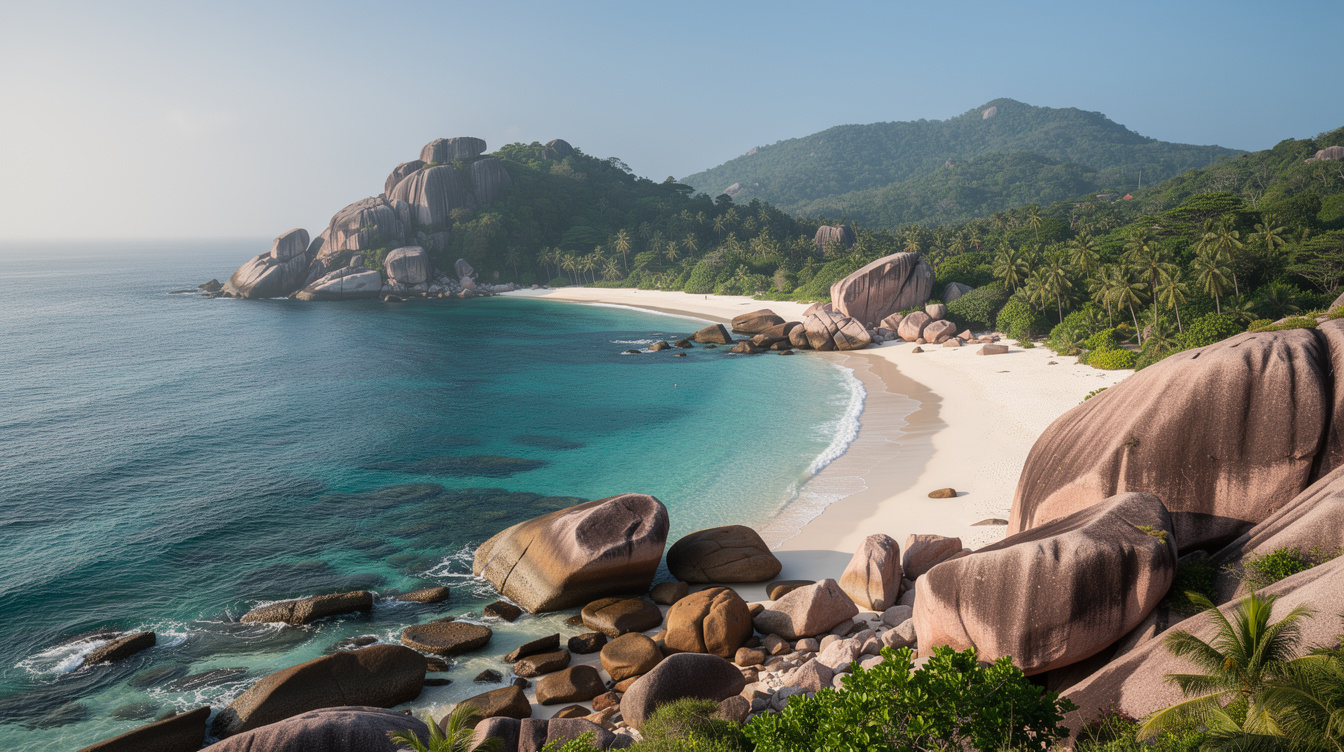
At 8:30am on a June morning, the south end of Anse Lazio is flat enough to reflect the granite boulders above the waterline. Forty meters north, past the curve where the beach bends toward the headland, the surface has texture, small swells pushed by a wind that’s been crossing the Indian Ocean since late April. Both conditions exist simultaneously, on the same arc of pale sand, because of where the bay’s headlands sit relative to the wind’s bearing. Most visitors spread their towels without knowing this.
Why the south end stays calm when the north end doesn’t
Anse Lazio’s bay faces roughly northeast, and its two granite headlands define everything about how the water behaves. The Southeast Trade Wind, dominant from May through October, arrives at an angle that the northern headland can’t fully block. By mid-morning, the water near the rocks at the north end develops short, disorganized chop as wind acceleration builds across the open fetch. The southern section, sheltered by the lower rocky spur near the Bonbon Plume restaurant, stays in partial lee. And that geometry isn’t seasonal, it’s hourly.
The calm end and the choppy end aren’t different days. They’re different ends of the same beach before breakfast. Locals who’ve spent years on Praslin will tell you the south end is where you swim, and the north end is where you watch the light on the boulders. Both are worth your time, but not interchangeably.
What the wind season actually does to the water
Praslin sits at roughly 4 degrees south of the equator, which means the Southeast Trade Wind arrives with real consistency. It builds from May, peaks through July and August, and drops by late October. During this window, the water on the sheltered south section is at its clearest, around 80°F (27°C), and surface texture near the waterline stays minimal before 11am. But the tradeoff is real: snorkeling around the granite formations at the northern tip works best before 9am. After that, the surge makes navigation around the boulders genuinely uncomfortable.
The Northwest Monsoon flips the logic from November through March. The north end calms, the south end can develop a shore break, and January and February bring occasional swell into the bay’s interior. Water temperature climbs to around 84°F (29°C), the air is heavier, and afternoon rain is routine. Trade wind mechanics work the same way across tropical oceans, and Praslin is no exception: the season you pick decides which half of the beach you’re booking.
How the crowd moves and when the beach empties
The catamaran ferry from Victoria Harbour on Mahé to Baie Sainte Anne on Praslin takes roughly 55 to 65 minutes. Day-trippers from Mahé then need a taxi for the 7-mile ride to Anse Lazio’s hillside parking area, which puts the first transfer wave on the sand around 9:30am. Because the last return ferry to Mahé runs mid-to-late afternoon, day visitors start reversing that sequence by 2pm. The other Seychelles beach most visitors compare it to uses an entry gate to control flow. Anse Lazio uses nothing except logistics, and the logistics work in your favor between 2:30pm and 5pm.
There’s no road to the sand. Vehicles stop at a small parking area at the top of the hill, and a concrete path through takamaka and badamier trees takes about 10 minutes down to the beach. The shade on the descent is real and welcome. But the return climb in afternoon heat, typically 82 to 86°F (28-30°C) by midday in June, discourages casual back-and-forth. You come, you stay, you leave when the light goes.
Your questions about Anse Lazio answered
How do you get to Anse Lazio from Mahé?
Ferry from Victoria to Baie Sainte Anne costs roughly $70-$80 USD each way for adults. From Baie Sainte Anne, a taxi to the beach runs around $20-$25 each way and takes 20 to 25 minutes. Air Seychelles flies the Mahé-Praslin route in about 15 minutes, with round-trip fares near $120-$150 USD. And if you’re already staying on Praslin at Grand Anse or Côte d’Or, a taxi to Anse Lazio takes 15 to 20 minutes.
When is the best time to visit?
June is the current sweet spot. The Southeast Trade Wind is established, European school holidays haven’t started, and weekday crowds from Mahé are at their lowest. Wind-driven beach conditions follow the same two-season pattern on islands across the tropics, and Praslin follows it cleanly. July and August are the busiest months of the year. April is a reasonable shoulder option if you’re flexible, but the monsoon hasn’t fully cleared and south-end conditions are less predictable.
What does a day at Anse Lazio cost?
The beach has no entry fee. Bonbon Plume, the one restaurant operating at the south end, runs around $25-$35 for a grilled fish plate and $4-6 for a cold Seybrew. There are no chair rentals, no umbrella stands, and no infrastructure you’d find at a more managed Indian Ocean beach. Mid-range guesthouses on Praslin start around $150-$300 per person per day. Luxury properties cost considerably more.
By 4pm the shadow line from the western hill advances across the sand and the water shifts from turquoise to a deeper blue-green. The last taxi has already taken the day-trippers back to Baie Sainte Anne, and the south end belongs to whoever stayed.