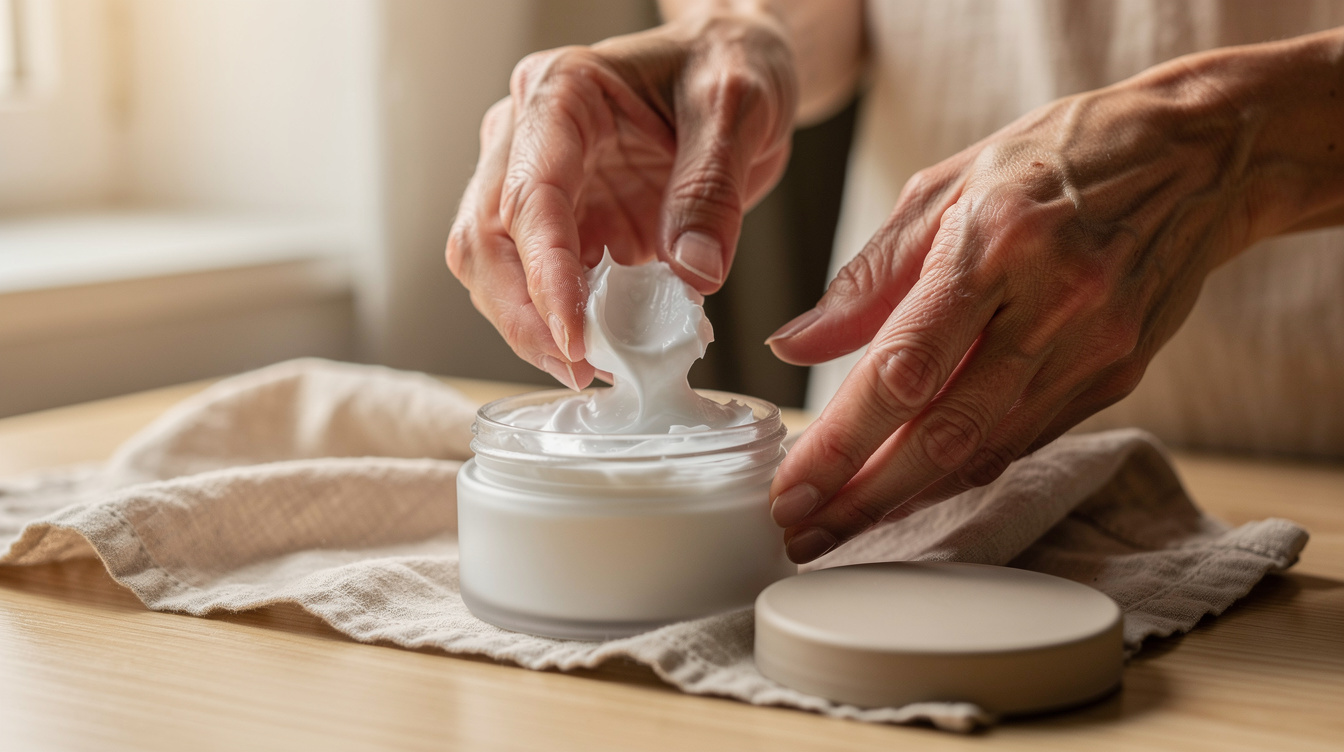
The cream is thick and white, almost chalky before it warms between the palms. It smells faintly floral, not aggressively so, and it costs $10 at any drugstore you are already walking into this week. I am 57, and I have probably spent $200 on hand creams over the past three years that felt good for forty minutes and then vanished. This one did not vanish. That took me by surprise.
Why hands age faster than your face
After menopause, estrogen loss accelerates collagen breakdown across the whole body. But the hands have almost no subcutaneous fat to buffer that change. The face has structural fat pads. The hands have tendons, veins, and a thin dermis sitting directly on bone. And the hands get washed repeatedly every day, exposed to detergents, dry air, and sun through a car windshield in a way your face rarely is.
Most drugstore lotions list water as the first ingredient. They feel soothing immediately and evaporate within the hour. Hairstylists who specialize in mature skin care have pointed out the same pattern with hand products: the formula feels luxurious in the store and does nothing by evening. For skin that has thinned after 50, the formula needs a humectant that pulls moisture from deeper layers, not a film that sits on top and disappears.
What is actually in this $10 cream
The creams worth reaching for at this price point, think O’Keeffe’s Working Hands, Gold Bond Ultimate Healing, or Neutrogena Norwegian Formula, share one thing: glycerin listed second or third on the ingredient list. That placement means the concentration is meaningful, not cosmetic. Glycerin is a humectant. It draws water from the dermis upward toward the outer skin layer, which is why it creates sustained hydration rather than a surface slip.
Shea butter’s fatty acid profile, specifically its oleic and stearic acid content, is close to the skin’s own natural lipid ratio. That is why it absorbs instead of sitting visibly on top. On skin where the barrier has already thinned after 55, shea butter temporarily reinforces the lipid matrix that holds cells together. The surface looks smoother not because it is plumped with water but because the structure underneath is supported. And after three minutes, the finish is dry. That is the oleic-to-stearic ratio working, not marketing.
What nine days of testing actually showed
The first change was not visual. By day three, the skin on my knuckles stopped catching on fabric when I pulled on a cardigan. That slight drag of dry skin snagging on weave had become so normal I had stopped noticing it. Until it stopped.
I applied the cream twice daily: right after washing hands while the skin was still faintly damp, and before bed under thin cotton gloves for thirty minutes. Dermatologists who focus on mature skin care consistently emphasize the damp-skin rule, because glycerin needs ambient moisture to work. Room-temperature air at night is dry enough to pull moisture out of unprotected skin. The gloves change the result significantly. But the packaging never mentions any of this, which is why so many women apply it wrong and decide it does not work. For more on how layering order changes what a product delivers, this applies to hands too.
By day seven, the fine horizontal lines across my knuckles were less pronounced in morning light. Not gone. The skin over the veins on the back of the hand looked less papery. What did not change was the prominence of the veins themselves. That is structural, not a hydration issue. Any cream claiming to fix visible veining is making a promise this product cannot keep, and I respect it more for not trying.
How to apply it so it actually works
Apply to hands within thirty seconds of rinsing, while they are still faintly damp. Press the cream in rather than rubbing fast; rapid friction generates heat that evaporates the formula before it penetrates. At night, a pea-sized amount under a cotton glove for twenty to thirty minutes triples the occlusive effect. That overnight ritual is where the spa-treatment comparison earns its keep. Not the scent. The method. And if your skin is severely flaky before you start, a barrier-first approach used in French pharmacy skincare applies here too: calm before you correct.
Your questions about this $10 hand cream answered
Does it work on the backs of hands or only the palms?
The backs of the hands are where it performs best. The skin there is thinner and more porous, so it absorbs the glycerin and shea butter faster than the thicker palm skin. Press gently into the knuckle area specifically. And if your hands are losing moisture as fast as your face is after 55, the same transepidermal water loss mechanism is at work in both places.
Can I use it on cuticles instead of buying a separate oil?
For daily maintenance, yes. It will soften adequately. But for severely split or overgrown cuticles, a dedicated jojoba-based oil penetrates more efficiently. This cream is sufficient for upkeep, not repair.
Will it transfer onto fabric or a keyboard?
Give it three minutes. After that, the finish is dry enough that it will not transfer onto fabric, a phone screen, or keys. Admittedly, those first three minutes require patience. But that is the only ask.
A jar that looks institutional and costs less than a coffee. White, thick, no impressive packaging. By morning nine, the skin across the knuckles caught the early light without looking like parchment.