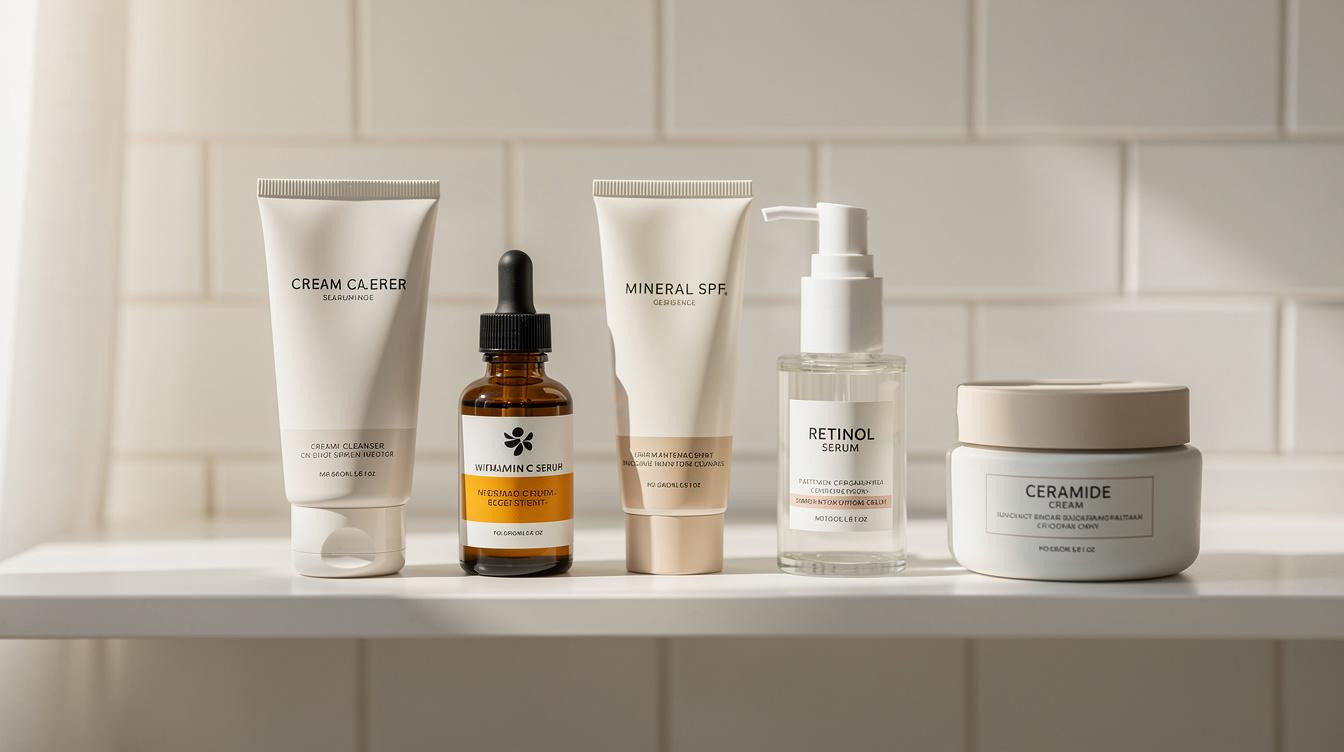
I had eight products on my bathroom shelf and my skin looked worse than it did at 45. Not dramatically older. Just reactive: tight after cleansing, faintly pink at the cheeks by noon, foundation sitting in every line by 3pm. I tried the French routine the way most Americans do, with real skepticism. But the logic underneath it turned out to be the only thing that actually stopped my skin from working against me.
Why more products make mature skin worse
After menopause, skin produces less sebum and the lipid layer that seals in moisture gets thinner. That barrier is what stands between your live tissue and everything you apply. When you stack a vitamin C serum, a glycolic toner, a retinol, and a peptide cream on a compromised barrier, each ingredient has a shorter path to the surface underneath. The stinging you feel is not general sensitivity. It is the barrier failing to buffer the chemistry.
Hairstylists who specialize in mature clients say the same thing about hair: fewer actives, less reactivity, better results. And dermatologists who treat women over 50 consistently echo the same message for skin: a thinner barrier needs fewer demands, not more. The Cleveland Clinic’s guidance on simplified anti-aging routines supports exactly this structure, cleanser, one active, moisturizer, SPF, done.
The morning routine, step by step
Start with a cream cleanser that contains no sulfates and no fragrance. CeraVe Hydrating Cleanser ($14.97 at Target) or La Roche-Posay Toleriane Hydrating Gentle Cleanser ($18.99) both leave a faint slip on the face after rinsing, intact lipids rather than residue. That feeling is the correct one. A sulfate cleanser strips that layer completely, which is why skin over 50 feels tight within 20 minutes of washing.
From there, apply one vitamin C serum and nothing else. On skin over 50, concentrations above 15% ascorbic acid can sting on a compromised barrier, so a 10% L-ascorbic acid formula stabilized with ferulic acid is the right range. L’Oréal Paris Revitalift 12% Pure Vitamin C Serum ($29.99) sits close to that and is widely available at US drugstores. One pump, wait 60 seconds for it to dry, then SPF.
And SPF is not optional here. Harvard Health is explicit: broad-spectrum SPF 30 or higher, every morning, is the single most effective anti-aging intervention available without a prescription. EltaMD UV Clear SPF 46 ($39 at Ulta) sits under makeup without pilling, which matters because heavier mineral formulas tend to bunch in fine lines on drier skin.
The night routine
If you wore SPF and any makeup during the day, start with a double cleanse. Bioderma Sensibio H2O Micellar Water ($14.99 at CVS) dissolves sunscreen and foundation on the first pass. This matters because mineral SPF bonds to skin to stay put during the day, and a single water-based cleanser cannot fully remove it. If the SPF layer stays on overnight, your repair cream sits on top of the day’s debris and does almost nothing.
Then retinol, but not every night. On skin over 50, nightly use without barrier support causes more flaking and redness than it repairs. Board-certified dermatologists who specialize in mature skin consistently recommend starting at twice weekly. RoC Retinol Correxion Line Smoothing Serum ($25.99 at Walgreens, 0.5% concentration) at that frequency accelerates cell turnover without pushing past what the barrier can manage. On the other three nights, CeraVe Moisturizing Cream ($19.97) alone is enough.
What actually changed after 10 days
The redness at my cheeks was gone by day 5. By day 10, a lightweight tinted moisturizer I had given up on because it emphasized every line suddenly sat differently, smoother, because the surface was consistently hydrated. My morning routine now takes about 90 seconds. The shelf holds 5 products. But the real change was not cosmetic. My skin just stopped reacting, and from there everything else followed.
Your questions about the French routine after 50
Can I use retinol if my skin is very dry?
Yes, but apply a thin layer of moisturizer first, wait 2 minutes, then apply the retinol over it. This sandwich method reduces direct contact with the barrier without eliminating the effect. Harvard Health supports retinoid use on mature skin specifically when paired with adequate moisturization.
What if I already own 10 products?
Pick one active, vitamin C in the morning or retinol at night, and move the others to a waiting rotation. Introduce them back one at a time, two weeks apart, watching for redness or tightness as the signal to pull back. And do not rush it.
Does this work if I wear foundation daily?
The double cleanse at night is non-negotiable if you wear foundation or SPF. Skipping it leaves residue that blocks your night cream from penetrating, which means the most expensive repair cream on the market sits on top of the day’s debris and does almost nothing. Start with micellar water, follow with the cream cleanser, then treat.
And if you want to see how simplified beauty thinking applies beyond skin, the same less-is-more logic turns up in the cuts that actually work over 50 too.
Five products on a white bathroom shelf in late May light: a cream cleanser, a small amber-glass vitamin C serum, a mineral SPF tube, a retinol, and a jar of white ceramide cream. The shelf looks almost empty. That is the point.