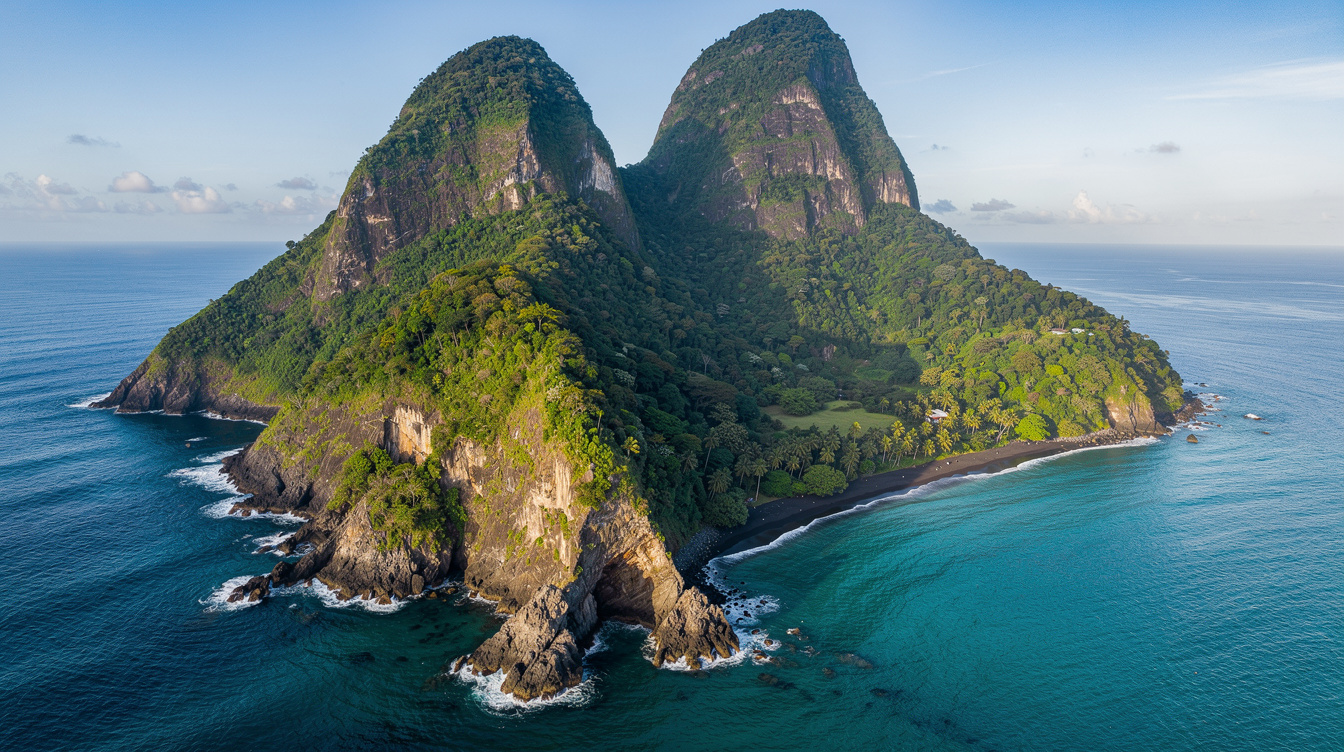
The Pitons are the first thing you see from the plane window and the last thing you stop thinking about. They rise 2,619 feet (Gros Piton) and 2,461 feet (Petit Piton) from the Caribbean Sea at the island’s southwest corner, and they’re not decorative. Because they sit where they do, they block the trade winds on the leeward coast, pull rain from Atlantic clouds, and shade Anse Chastanet’s sand by early afternoon. The ferry from Castries to Soufrière runs roughly 25 miles by water. The road over the mountains takes about the same time. Which one you take on day one sets the rhythm for everything else.
The mountains split the island into two different trips
Saint Lucia is 27 miles long and 14 miles wide, but the Barre de l’Isle ridge cuts across the middle at around 1,100 feet and divides it climatically. Castries sits on a sheltered northwestern harbor where the air is flat and dry. Soufrière, 25 miles south by road, sits in a bowl of green mountains where afternoon clouds park over the Pitons and temperatures run several degrees cooler by evening.
The drive between them climbs, narrows, and winds for 1.5 to 2 hours depending on traffic. And that drive is not a transfer. It’s the moment the island shifts registers entirely. Neighboring Martinique has the same Atlantic-Caribbean split, but Saint Lucia’s volcanic interior makes the contrast sharper and the consequence more personal.
The Pitons control the light, which means they control your beach day
Anse Chastanet sits on the Caribbean side, about a mile north of the Pitons by trail. Because Gros Piton and Petit Piton rise directly to the south and southwest, they cut the afternoon sun well before any flat-coast Caribbean beach would. The shadow drops the temperature noticeably and the water, already calm because the leeward coast faces away from Atlantic swell, cools fast. Snorkelers who know this arrive by 10am. The reef starts in roughly 20 feet of water just offshore.
But Anse des Pitons, the cove pinched between the two peaks, holds sun longer because the gap between them funnels late light down to the water. The trade-off: the beach is largely controlled by the Viceroy Sugar Beach resort. Public access by boat or defined walking path exists, though the lounge chairs are resort guests only. And knowing both timings lets you plan both stops in a single day without guessing.
The ferry versus the road is the decision that shapes everything
The Castries-to-Soufrière ferry departs from Vigie Cove and takes roughly 90 minutes southbound along the leeward coast. Fares have historically run $25 to $35 USD one way, though schedules and prices shift seasonally. Because the boat stays on the Caribbean side, there’s almost no swell. What you see from the water, the Pitons rising out of jungle, the sulphur vents steaming above the Soufrière shoreline, cannot be seen from the inland road. Like the approach into Saint Barths, geography forces a decision before you’ve fully settled in.
The road from Castries passes through Marigot Bay and arrives in Soufrière from the north, crossing banana plantation country. Local minibuses run the route for under $5 USD but stop frequently and run on no fixed schedule. A compact car rental in Castries costs roughly $55 to $80 USD per day. The road is paved but narrow in sections, and patience is not optional on the mountain curves.
The Piton hike: what it actually costs you
Gros Piton requires a mandatory guide, arranged through the Soufrière Regional Development Foundation. Guide fees run roughly $20 to $30 USD per guide. The hike takes 3 to 4 hours round trip on steep volcanic rock with sustained elevation gain. Because the peaks generate their own microclimate, clouds often settle on the summit by late morning. Local guides will tell you the same thing: start before 7am or accept that you’ll hike in cloud.
The trail is genuinely steep, not difficult by alpine standards, but unforgiving in sandals. Caribbean island hikes share this honest calculus: the altitude keeps the summit cool, which is exactly why the view is worth the early start. But the volcanic rock is loose in places, and there’s almost no shade in the upper section.
Your questions about Saint Lucia answered
How do you get from the airport to Soufrière?
Hewanorra International Airport (UVF) sits at the island’s southern tip, about 40 minutes from Soufrière by road. A taxi runs roughly $55 to $70 USD. There’s no direct public bus from UVF to Soufrière. The geography here, like at Grace Bay, means the protected side of the island requires an intentional routing decision before you even leave the airport.
When is the best time to visit Saint Lucia?
January through April is the dry season on the leeward Caribbean coast, the most reliable stretch for beach days and the Piton hike. Hurricane season runs June through November, with September and October carrying the highest historical risk. June is transitional: warm, occasionally wet, and noticeably cheaper on accommodation.
How much does a trip to Saint Lucia actually cost?
Jade Mountain and Viceroy Sugar Beach charge upward of $700 to $1,200 USD per night in high season. Guesthouses in Soufrière town run $80 to $150 USD. Meals at local cook shops cost $7 to $12 USD. A full day of guided hiking, the ferry, and two beach stops runs roughly $80 to $120 USD per person without accommodation.
At 5:45am, before the cloud settles over Gros Piton, the peak catches the first light and goes orange against a sky that’s still pale gray. The fishermen at Soufrière dock are already out, and the water is cold enough that you can feel the mountain in it.