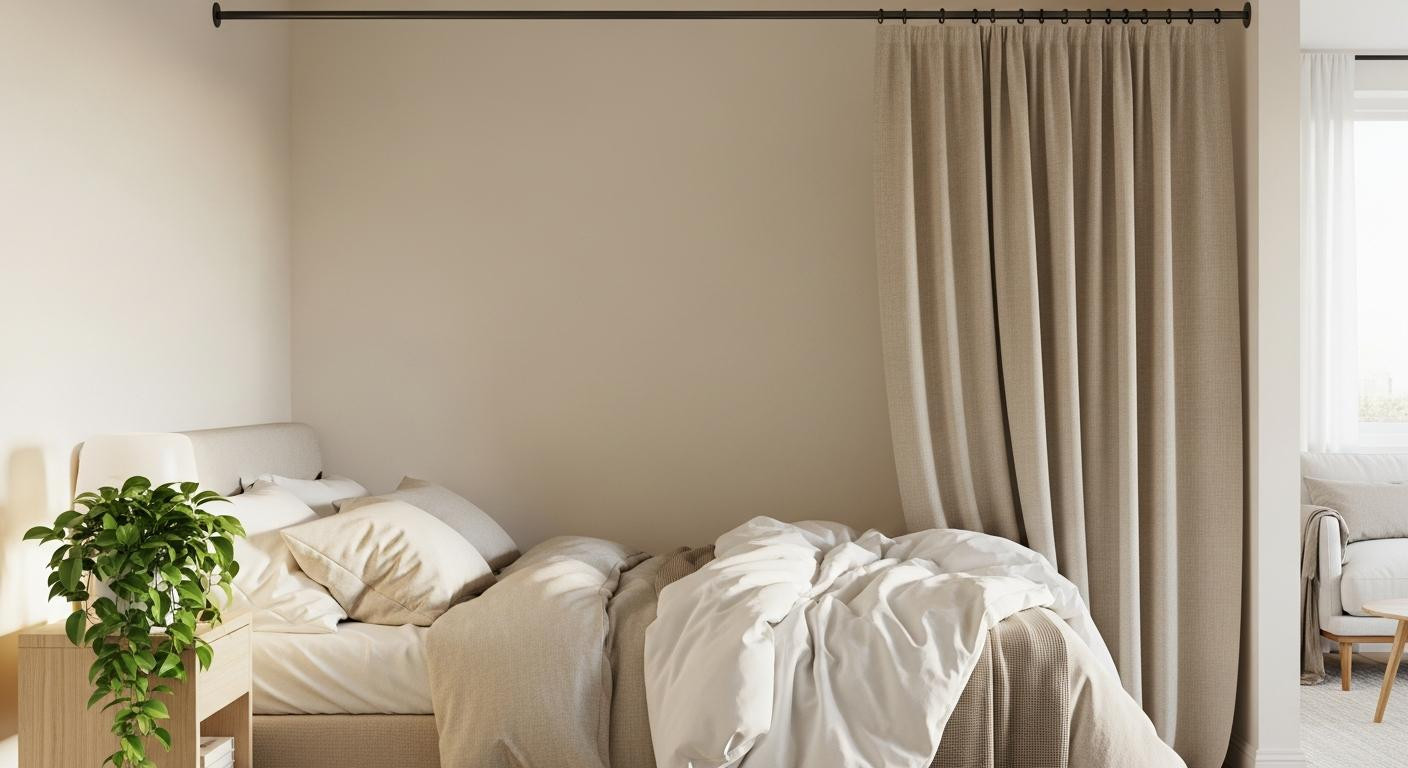
Your studio at 9:47pm on a Tuesday when you close your laptop and realize your bed sits six feet from your desk, visible from the front door, the kitchen, the single window. You’ve lived here eleven months and every surface feels public. The space measures 340 square feet but reads like 180 because nothing separates rest from work from chaos. Then you install a $60 Umbra tension rod with oatmeal linen curtains between the sleeping alcove and living area, and the apartment stops feeling like one exposed box.
The change isn’t about square footage. It’s about finally having a room your eyes can’t see into from everywhere else.
What changed when the curtain went up
The bed disappears from the front-door sight line. The morning light filters through linen instead of blasting the unmade duvet. The apartment gains definition: a place to work, a place to sleep, a threshold between them.
Installation took 20 minutes. No drill, no anchors, no landlord permission. The Umbra rod adjusts from 7 to 10 feet height and 36 to 66 inches width using a twist mechanism that creates spring tension between two surfaces. It holds 15 pounds, enough for most standard curtain panels.
The curtains ran another $87 from West Elm. The linen scatters light instead of reflecting it, so the divided space feels softer, not darker. That texture matters more than you’d think when you’re trying to make a rental feel intentional instead of makeshift.
What tension rods actually solve in studios under 400 square feet
Privacy without permanent construction
The Umbra rod requires no drilling into ceilings or walls. No screws, no anchors, no patching upon removal. You twist the mechanism until the spring pressure holds the rod in place between two parallel surfaces.
Contrast this with track-mounted curtain systems that require ceiling anchors. Those work beautifully if you own the place. But in a rental, you’re gambling on whether your security deposit covers the holes.
Spatial definition that doesn’t block light
Sheer or semi-sheer linen allows daylight penetration while obscuring visual clutter. A bookshelf room divider blocks sight lines but also blocks natural light, making a 340 sq ft studio feel like two dark 170 sq ft rooms. Curtains create psychological separation without creating a cave.
This only works if the studio has at least one window and ceiling height of 8+ feet to avoid claustrophobia. According to ASID-certified interior designers, floor-to-ceiling fabric in spaces with 7.5-foot ceilings or lower draws the eye to the compressed height and makes the room feel smaller.
Where the setup fails and what to do instead
If your ceilings are under 8 feet
Low ceilings make floor-to-ceiling curtains feel oppressive. The vertical fabric emphasizes the compressed height. In spaces with 7.5-foot ceilings or lower, consider a half-height tension rod mounted 5 feet up with a café curtain that suggests division without enclosing.
Alternatively, use furniture-based zoning instead of fabric dividers. A credenza or low bookshelf creates a visual boundary without trapping the ceiling height.
If you need soundproofing, not just visual privacy
Fabric curtains do almost nothing for sound. If the problem is noise bleed between work calls and a partner’s TV watching, a tension rod won’t solve it. Acoustic panels, white noise machines, or rearranging furniture to create maximum distance between zones will matter more.
This is visual and psychological privacy, not sonic isolation. Design experts featured in Architectural Digest confirm that even heavy blackout curtains reduce noise by less than 3 decibels, which is barely perceptible to the human ear.
If you have exposed brick or textured walls
Tension rods require smooth, parallel surfaces to create the spring pressure that holds them in place. Exposed brick with uneven mortar won’t provide stable contact points. In brick studios, you need a freestanding curtain frame or a ceiling-track system that mounts to the ceiling only.
The $147 upgrade that made the cheap version look intentional
Swapping the $60 tension rod with basic cotton curtains for linen drapes from West Elm or Parachome changes how light moves through the fabric. Polyester-blend curtains from Amazon reflect overhead lighting like shower curtains, creating glare and making the divided space feel cheaper.
Linen diffuses light and adds textural weight. The rod itself can stay budget. The curtains carry the visual load. And you can layer: sheer linen for daytime privacy, blackout panel behind for sleep. This adds cost but maintains the damage-free advantage.
Professional organizers with certification confirm that heavyweight linen in neutral tones (oatmeal, greige, warm white) reads more architectural than polyester or patterned fabric. Floor-length curtains feel more permanent than cropped panels.
Your questions about tension rod room dividers answered
Can a tension rod hold blackout curtains?
The Umbra rod holds 15 pounds, which covers most blackout panels if they’re standard weight (not velvet-backed or triple-weave). Measure your curtain weight before buying. If blackout fabric exceeds 15 pounds, look for heavy-duty tension rods rated to 25+ pounds, typically priced $80 to $120.
Does this work in a studio with exposed brick walls?
No. Tension rods require smooth, parallel surfaces to create the spring pressure that holds them in place. Exposed brick with uneven mortar won’t provide stable contact points. In brick studios, you need a freestanding curtain frame or a ceiling-track system that mounts to the ceiling only.
How do I keep the curtain from looking like a dorm room divider?
Choose heavyweight linen or cotton in neutral tones (oatmeal, greige, warm white) instead of polyester or patterned fabric. Floor-length curtains read more architectural than cropped panels. Add a second rod with sheer underlayer for depth.
Lighting designers with residential portfolios note that adding a slim bedside lamp behind the curtain creates a warm glow that filters through the fabric at night, which makes the divider feel intentional rather than makeshift.
The studio at 9:14pm
You close the curtain and the sleeping area becomes a separate room, soft lamplight filtering through the linen weave. The apartment still measures 340 square feet, but your bed no longer announces itself from the front door. That shift costs $60 and twenty minutes of adjusting a metal rod between two walls.