Your 340-square-foot studio at 6:47pm on a Tuesday when you realize the curtain divider you installed three weeks ago makes the sleeping area feel like a hospital bay, and the bookshelf you dragged to the center of the room blocks the one sight line that used to make the space feel open. The Pinterest solutions promise separate rooms. They deliver visual clutter and 11 fewer square feet of walking space.
The problem isn’t that you lack dividers. The problem sits 18 inches closer than where you think zones should start, and that gap is the difference between a studio that breathes and one that suffocates.
Why studio zoning fails when furniture touches walls
The Kallax shelf pushed flush against the wall creates a visual endpoint instead of a suggestion. When the back of a room divider meets plaster, your eye reads barrier instead of zone transition. The 18-inch rule works because it preserves negative space behind zoning elements, the gap between a bookshelf and the wall lets light pass through, keeps air moving visually, and prevents the hard-stop feeling that makes 340 square feet read like 280.
Designers specify this clearance in floor plans for apartments under 400 square feet because it maintains what ASID-certified interior designers call continuous spatial volume. Your curtain feels institutional because it hangs from wall to wall with zero breathing room. The fabric needs 18 inches of float space on at least one side to read soft instead of surgical.
The 18-inch rule architects actually use in micro-apartments
Twelve inches behind furniture feels accidental, like you couldn’t decide where to place things. Twenty-four inches creates dead zones, space you can’t use for storage or circulation but wide enough to read as wasted floor. Eighteen inches hits the threshold where your eye perceives intentional design.
It’s wide enough for a floor lamp cord, narrow enough that you’re not losing usable square footage, and exactly the width that keeps low furniture under 34 inches tall from blocking window light completely. The 18-inch standard appears in residential design guides as minimum clearance for secondary walkways, the paths you don’t use daily but need accessible.
Studio zoning co-opts this dimension because it’s narrow enough to preserve floor area but wide enough to prevent the trapped-behind-furniture feeling that kills openness in single-room layouts. And in a 250-square-foot studio, three 18-inch floating clearances can visually consume roughly 25 to 40 square feet of circulation zone depending on furniture size, which is why selective placement matters more than scattered application.
The three zones that need 18 inches and the two that don’t
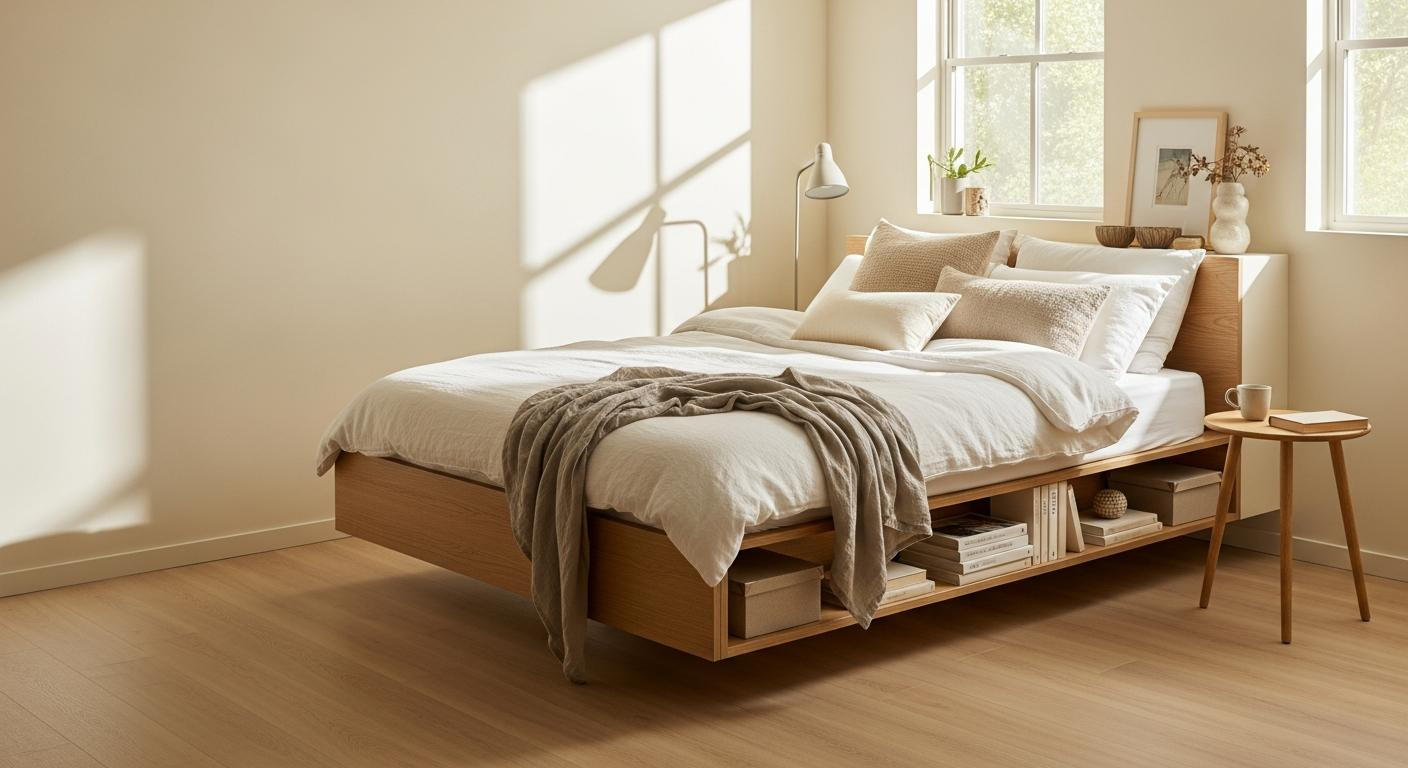
If your bed sits against a wall, you’ve already lost the zone battle. Pulling the frame 18 inches forward creates a suggestion of enclosure without requiring a headboard, curtain, or room divider. The gap behind lets you tuck a floor lamp or phone charger, which gives the space function instead of awkwardness.
The visual result sits somewhere between furniture in a room and a mattress shoved into a corner. But here’s the nuance: this only works if your bed frame depth plus the rear gap doesn’t exceed 102 inches of available wall span, or you’ll block circulation on the opposite side. Standard queen frames run 84 inches deep, leaving exactly 18 inches in a 102-inch allocation.
An 18-inch gap on one side of a desk, not both, that wastes space, creates the office-living boundary without needing a bookshelf or screen. The empty floor becomes the divider. When you’re sitting at the desk, the gap reinforces this is the work area. When you’re on the sofa, the gap keeps the desk from visually crowding into your relaxation zone, especially when paired with warm wood that helps balance all the white.
And the kitchen zone doesn’t need it. Neither does the entryway. Those areas rely on functional boundaries, counters and rugs and doorways, not spatial breathing room.
Why rugs fail without the 18-inch offset
The rug that extends wall-to-wall under your sofa doesn’t zone, it carpets. The edge needs to stop 18 inches short of at least one wall to create a mat-on-floor contrast instead of a floor-covering effect. In a 12×14-foot studio living area, a 9×12 rug leaves an exact 18-inch gap on the 12-foot walls and a 12-inch gap on the 14-foot walls.
When the rug floats with visible hardwood around it, your eye reads living area as distinct from circulation path. That perimeter gap prevents the one-giant-rug problem that makes studios feel like wall-to-wall carpeted hotel rooms from 1987. The floor showing around the edges becomes the zone divider, not the rug itself, in a way that feels intentional without making the room feel too busy.
But an 8×10 rug in that same 12×14 space leaves 24 inches on all sides, which tips into too much breathing room and makes the furniture grouping feel untethered. Your floor is too crowded and walls could fix it in 18 inches explores how vertical breathing room complements this horizontal offset strategy.
Your questions about studio apartment zoning answered
Does the 18-inch rule work in studios under 250 square feet?
Yes, but only for one zone. In a 150-square-foot studio, you get one 18-inch gap, behind the bed or beside a primary piece of furniture. Using the offset in multiple locations would sacrifice too much usable floor. The single gap creates one strong zone instead of three weak suggestions, which is admittedly easier said than done when every piece of furniture competes for limited circulation space.
Can I use 18 inches vertically instead of horizontally?
Partially. Mounting shelves 18 inches below the ceiling creates visual separation between wall storage and living space, but it doesn’t replace horizontal breathing room. Vertical and horizontal gaps solve different problems, ceiling-mounted solutions prevent top-heavy clutter, floor gaps prevent blocked circulation. Your sofa is too big and it’s making your living room feel like a blocked hallway addresses the same circulation problem studio dwellers face when zoning furniture at the wrong scale.
What if my studio has strange angles or alcoves?
Measure from the alcove edge, not the main wall. The 18-inch gap should start where your eye perceives the room beginning, usually the widest uninterrupted wall plane. Professional organizers with certification confirm that visual zoning follows perceived boundaries, not architectural ones, so an alcove counts as its own micro-zone and doesn’t need the full offset treatment.
I moved my mirror to the corner at 45 degrees and my tiny bedroom feels twice as big demonstrates the same rearrangement-over-purchase philosophy that the 18-inch rule embodies, both solve small-space problems through positioning rather than products. And once you establish zones with spatial offsets, matte surfaces make small apartments feel 40% bigger than glossy ones guides material choices within those zones to maximize perceived spaciousness without adding furniture.
Your studio on Thursday morning when you drag the bed frame 18 inches forward and the room suddenly holds two distinct feelings instead of one continuous box. The gap behind catches morning light. The floor breathes. Nothing hangs from the ceiling, nothing blocks the window, and you finally have a bedroom.