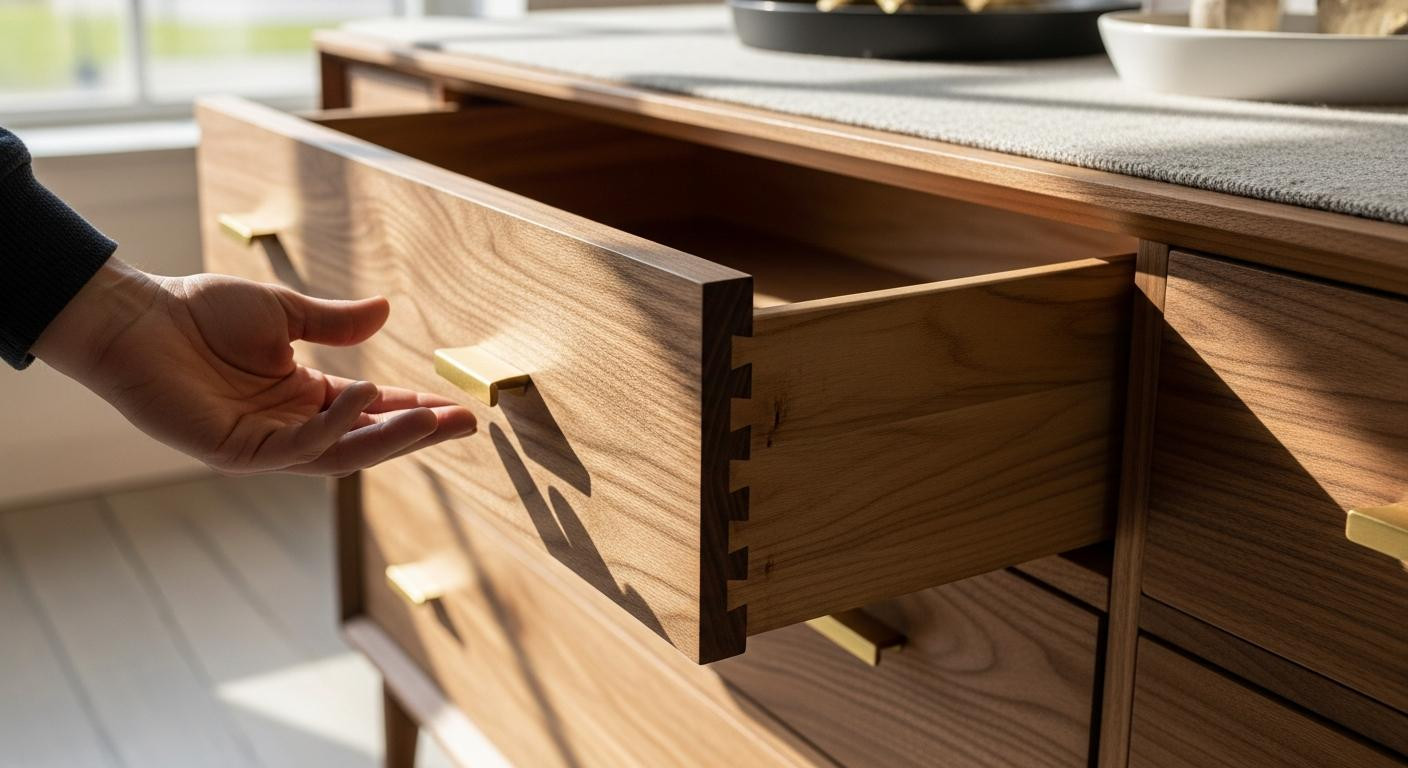
You’re standing in front of a dresser at West Elm on a Saturday afternoon, and the salesperson is walking over. The price tag says $849. The walnut finish catches the light beautifully, and the brass pulls feel heavy in your hand. But when you open the top drawer, it scrapes like cardboard against plastic, and that sound tells you everything you need to know about what’s holding this piece together. The difference between solid construction and expensive-looking junk reveals itself in four tests that take 30 seconds total, and furniture professionals run all four before they even consider sitting down.
What separates a dresser that lasts 40 years from one that wobbles after two moves isn’t subjective. It’s joinery, material density, and frame geometry, all of which telegraph through your hands faster than a sales pitch can start.
The drawer glide test reveals joinery in 8 seconds
Pull the drawer halfway out and stop. Listen. Quality drawers with dovetail joints glide without sound because the interlocking wood fingers distribute weight evenly across the entire drawer box. Stapled particleboard drawers scrape, catch, or rattle because the staples don’t hold lateral tension and the box flexes under its own weight.
Press your palm flat against the drawer front while it’s extended. Real dovetails hold firm without shifting. Stapled corners create a subtle gap between the drawer face and side panel, usually 1 to 2 millimeters, that you can feel before you see it. That gap means the staples are pulling loose from compressed particleboard that behaves like wet cardboard under pressure.
And even when retailers use ball-bearing glides to mask construction flaws, the joint flexibility still comes through to your hand. Solid wood drawers feel controlled. Cheap assemblies feel vague, like there’s play in the system you can’t quite locate.
The four-corner pressure test shows frame stability in 12 seconds
Stand at one end of the dresser or cabinet. Press down firmly on the top left corner with your right hand while pressing the bottom right leg with your left foot. Solid hardwood frames resist this diagonal pressure because mortise-and-tenon joinery locks the structure into a rigid grid. Frames joined with screws or L-brackets shift 2 to 3 millimeters, creating a visible gap between the back panel and the wall.
But don’t stop there. Grip the top surface and rock the piece forward and back using about 10 pounds of pressure. Well-made furniture anchors to the floor without movement because corner blocks and stretchers triangulate the leg positions. Wobbly pieces use brackets screwed into particleboard, which compresses and loosens within 18 months of normal use.
Admittedly, very heavy pieces mask this difference through sheer mass. Lighter construction always reveals attachment quality through that first wobble, and that’s exactly what you’re testing for.
The finish inspection catches thin veneer in 6 seconds
Tilt a tabletop or dresser surface until overhead showroom lights hit it at a 45-degree angle. Solid wood finishes create depth because light penetrates three or four clear coat layers before reflecting off grain variations beneath. Printed veneer or laminate reflects flatly, like a photograph under glass, because there’s no dimensional grain to create shadow variation.
Run your finger along the edge where the top meets the side panel. Quality veneer wraps this corner smoothly with no seam line. Cheap veneer shows a hairline gap or slight color mismatch where two pieces meet at 90 degrees. Better yet, check drawer edges where daily use chips thin veneer away from particleboard cores.
If you see brown fiberboard beneath oak-colored surface coating, you’re looking at furniture that won’t age well. And that’s the kind of detail that separates investment pieces from impulse buys, especially when you’re allocating budget strategically.
The hardware weight test separates quality metal in 4 seconds
Lift one drawer pull or cabinet knob and feel its weight in your palm. Solid brass, bronze, or steel hardware weighs 40 to 80 percent more than zinc alloy castings because denser metals resist corrosion and daily wear. Lightweight pulls feel almost hollow, and after 200 uses they develop a brassy smell on your fingers from oxidizing zinc.
High-end furniture uses forged or machined hardware that costs $8 to $24 per pull at wholesale. Budget pieces use stamped zinc that costs 80 cents. The weight difference telegraphs construction priorities instantly, and it’s one of those details that quietly elevates the whole piece when done right.
But the real insight comes when you combine all four tests. A dresser might pass the drawer test but fail the corner pressure check, which tells you the manufacturer invested in visible details while cutting corners on frame construction.
What makes this approach work across price points
According to furniture professionals featured in consumer quality guides, these tests work identically at Room & Board and HomeGoods because construction physics don’t change with retail markup. A $400 dresser with dovetail joinery outlasts a $1,200 dresser with stapled corners, which is why replacing cheap furniture every three years costs more than buying quality once.
Design experts with residential portfolios note that solid hardwood pieces with mortise-and-tenon joinery survive 40 to 60 years in commercial settings like hotels. Particleboard furniture with stapled corners typically fails within 5 to 8 years of residential use, often when moved between homes or exposed to humidity changes.
And that’s the balance that makes this testing method valuable. You’re not chasing perfection. You’re identifying the construction flaws that guarantee premature failure.
Your questions about spotting quality furniture answered
Can you trust solid wood labels if the price seems low
Legally, solid wood labels only require 60 percent wood content in some jurisdictions, meaning a dresser can use solid oak drawer fronts with particleboard sides and still earn the label. Check joinery and finish depth instead of marketing language. Real solid wood construction shows visible grain on all surfaces, including drawer sides and interior panels that nobody photographs for the product listing.
Do expensive stores always sell better furniture
Restoration Hardware and Pottery Barn use solid construction on flagship lines but offer budget tiers with similar aesthetic details and cheaper joinery. The drawer test works the same everywhere because physics don’t respect branding. Price predicts quality less than material choices and joinery methods do, which is why $200 spent on one quality piece beats $800 spread across replaceable junk.
How do you test upholstered furniture the same way
Sit hard on one corner of a sofa or chair and press down. Quality frames don’t flex or creak because the rails use corner blocks and glued mortise-and-tenon joints. Cheap frames produce audible movement or creaking from stapled butt joints. Lift one end of the piece slightly. Solid hardwood frames weigh 60 to 100 pounds for a standard sofa. Engineered wood and particleboard frames feel noticeably lighter, often under 40 pounds, which correlates directly with longevity under daily use.
Your hand on a dresser at West Elm on Saturday afternoon, pressing corners and opening drawers with the confidence of someone who knows exactly what separates construction from decoration. The salesperson approaches and you smile, because you’ve already run four tests in 30 seconds and the results are clear. The drawer glides silently, the frame doesn’t shift under pressure, the finish shows depth under angled light, and the brass pulls feel substantial in your palm. It’s the kind of furniture that makes a room feel intentional rather than assembled, and you didn’t need a design degree to recognize it.