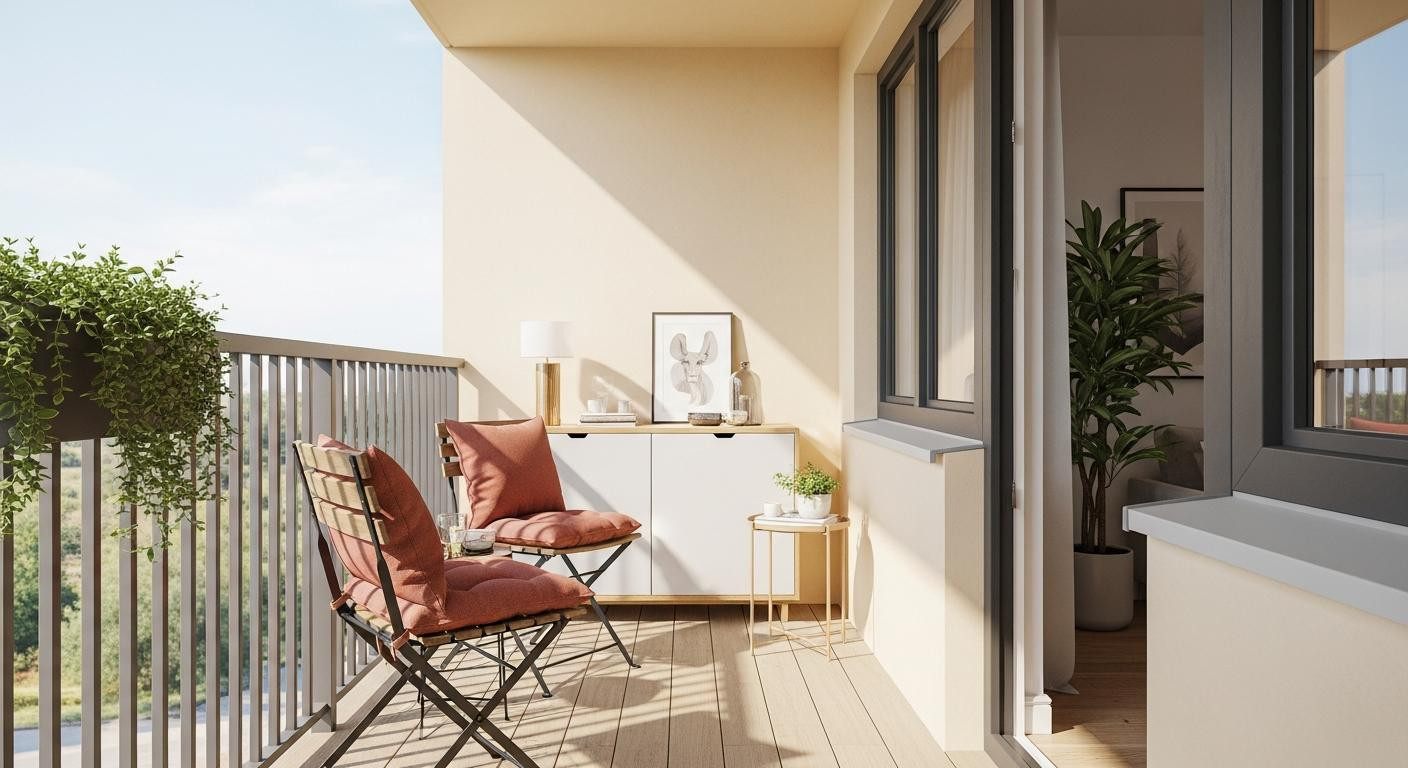
Your balcony measured 50 square feet on the third Saturday in April when you stood holding a folding bistro set from Target, trying to figure out why the space felt like a fire escape with a view rather than the outdoor room you’d imagined. The furniture fit. The measurements checked. But the psychological experience, walking out, sitting down, wanting to stay, never materialized.
Your neighbor’s balcony is 48 square feet and photographs like a restaurant patio. The difference isn’t budget or products. It’s three layout decisions that shift how confined space registers in your brain.
The 32-inch dead zone that keeps 50 sq ft feeling like a ledge
Most people push all their balcony furniture against the railing, leaving 30 to 36 inches of open floor space between the door and the chairs. That empty center reads as leftover space, not room. And your brain knows the difference.
Interior designers with residential portfolios note that indoor rooms never work this way. You don’t shove your sofa against the windows and leave the middle bare. But balconies get treated like ledges with seating, which is why they feel precarious instead of grounded.
The typical 50 square foot balcony measures 5 feet deep by 10 feet long. When furniture sits at the railing edge, you’re left with a psychological no-man’s-land that undermines any attempt at creating a room-like feeling. The visual emptiness works against you.
Three zones turned 50 square feet into a room people don’t want to leave
The fix requires rethinking your balcony as layered space, not linear edge. Pulling furniture away from railings creates depth that tricks your brain into perceiving more square footage than actually exists.
The 18-inch anchor zone (floor to railing height)
Place your heaviest visual element, a low storage bench, credenza, or large planter box, against the back wall of the balcony. It must be at least 18 inches tall to register as furniture rather than clutter. This piece establishes the room’s back wall psychologically.
That anchored weight makes the space feel grounded. Without it, everything floats toward the railing and the room feeling collapses.
The 24-inch sitting zone (where seating actually goes)
Your chairs belong 24 inches forward from the anchor zone, not pushed against the railing. This creates layered depth instead of a single plane. The gap between anchor and seating is what transforms ledge into room.
And yes, this means you’re sitting with empty space behind you. That’s the point. Rooms have circulation paths. Ledges don’t.
The balcony door frame trick that doubled perceived square footage in 4 minutes
Your brain measures room size from the threshold, not from the far edge. When you step onto your balcony and see straight across to the railing with furniture at the opposite end, you’re reading obstacle course, not room.
Why your brain measures from the doorway, not the railing
Environmental psychologists studying outdoor spaces confirm that humans assess room size from entry perspective. The fix takes 4 minutes and costs nothing if you already own a tall plant or folding screen.
Place one vertical element within 12 inches of your door frame’s left or right side. Never center, it blocks passage. This frames the entry and forces your eyes to scan horizontally rather than straight to the railing. Vertical space utilization works the same way indoors.
The sight line that makes 50 sq ft photograph like 80
Angle your chairs 15 to 20 degrees toward the railing corner instead of parallel to the building wall. Diagonal furniture arrangement adds dimension that straight-on layouts compress. The space gains visual depth without gaining actual inches.
But this only works if your balcony allows privacy screening. Without visual separation from neighbors, 50 square feet can’t achieve room psychology because the psychological boundary never forms.
What stopped working when I treated my balcony like an apartment patio
Patio furniture designed for 120 plus square foot ground-level spaces fails on elevated 50 square foot balconies because the psychological context differs. Patios feel expansive. Balconies feel precarious.
The room-like transformation required accepting the space as vertical extension of interior, think window seat with railing, not miniature backyard. Preparing the space properly matters more than the furniture you eventually choose.
Professional organizers with certification confirm that scale mismatch is the most common balcony failure. You can’t shrink patio logic and expect it to work at 50 square feet.
Your questions about small balcony transformation answered
Does this work if my balcony is only 4.5 feet deep instead of 5?
Four feet can achieve two zones, anchor plus seating, but three-zone layout requires 4.5 plus feet. For narrower balconies, combine zones by using seating that doubles as anchor, like a storage bench against the back wall with cushions.
What if my lease prohibits drilling into exterior walls?
Freestanding anchor options include weighted planter boxes, 60 plus pounds when filled, or privacy screens with base plates. Tension systems between railing and overhang work without permanent modification.
How much does this cost if I own nothing?
Anchor furniture runs $60 to $120 for secondhand credenzas or DIY cinder block benches. Seating costs $40 to $80 for folding bistro chairs. Framing elements, tall plants or tension screens, range $15 to $35. Total investment sits between $115 and $235.
Your coffee at 7:42am on a Tuesday in May, steam rising into morning light while you sit 24 inches from the railing with your back against a credenza that wasn’t there three weeks ago. The balcony still measures 50 square feet. Your brain registers a room.