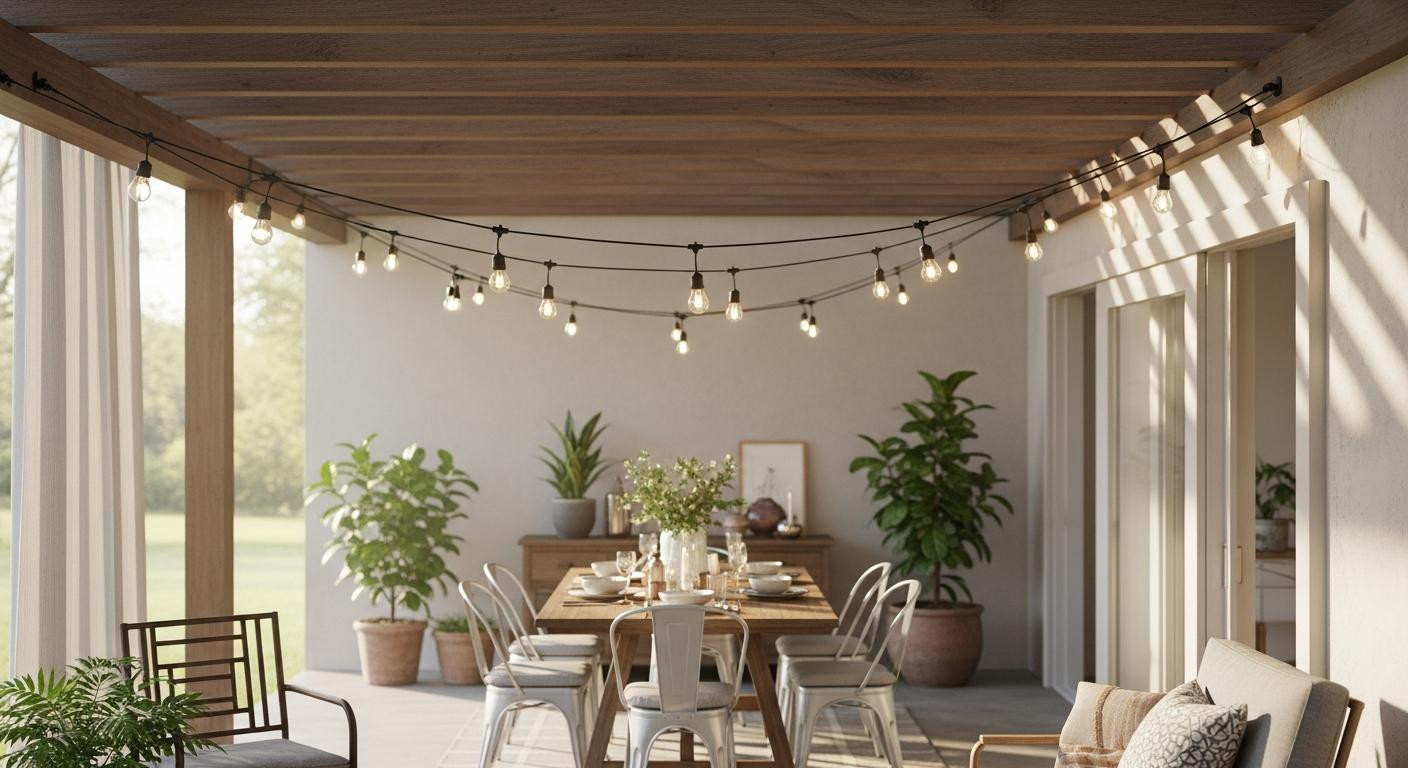
Your patio string lights at 8:47pm on Saturday when guests arrive and the center section sags 14 inches lower than where you hung it last weekend, creating a drooping curve that catches the tall guy’s head when he walks to the cooler. The lights cost $64 at Target. The installation took 90 minutes. Everything followed the package directions: hooks screwed into posts, lights clipped on, bulbs installed. By the third dinner party, the sag makes the whole setup look temporary and careless, like decorations you meant to take down.
The direct-hang method that guarantees sag within 3 weeks
Hanging lights directly between two anchor points, the method shown on 90% of packaging, creates inevitable sag because of basic physics. A typical 50-foot string weighs 3-4 pounds empty, 8-12 pounds with bulbs installed. Vinyl-coated wire elongates under sustained tension, especially when spans exceed 15 feet between supports.
That initial taut line becomes a smile-shaped curve that gets worse after rain adds weight. Anything over 15 feet will sag regardless of initial tension. The visual gets progressively worse: what started as a clean horizontal line droops into a parabolic curve that deepens every week.
And this method works fine for spans under 12 feet, which almost no one actually has. Most patios, pergolas, and backyard setups require 20-30 foot runs. That’s where the failure happens, not in your installation technique but in the physics of the approach itself.
What professional installers tension first (before touching the lights)
The support wire that holds 40 pounds without stretching
Landscape lighting installers with residential portfolios run 1/8 to 3/16 inch galvanized steel aircraft cable or vinyl-coated wire as primary support before hanging a single bulb. This creates a structure capable of holding 40+ pounds across a 30-foot span. The wire itself becomes the permanent infrastructure that prevents sag, not the light string.
Turnbuckles tension the wire until it’s taut enough to pluck like a guitar string. Home improvement contractors featured in outdoor living publications confirm the wire must support at least 15 pounds of tension to stay level. But the key is this: the lights attach to the wire, not replace it.
Why spacing clips every 18 inches prevents the slide problem
Even with support wire, lights slide toward the center if not secured. Heavy-duty zip ties or coaxial staple clips every 12-18 inches lock lights in place along the tensioned cable. What this looks like when done right: the lights appear to float at the exact height you want, with zero sag, because the weight transfers to the cable rather than the light string itself.
The attachment points create friction that keeps bulbs evenly distributed. Without them, gravity pulls everything toward the middle within days. And that even spacing is what makes the installation look intentional instead of improvised.
The anchor point test that predicts failure before you hang anything
If your post moves 1/4 inch under hand pressure, it won’t hold tension
Grab the intended anchor point with both hands and push hard. If it flexes more than 1/4 inch, it cannot maintain the tension required for sag-free lights. A 25-foot span under proper tension exerts significant lateral force that weak anchors can’t handle.
Design experts featured in Architectural Digest recommend 6×6 posts minimum, set 24+ inches into the ground with concrete. Pergola beams must be structural, not decorative trim. That wobble test reveals whether your anchor will hold or gradually give way over the season.
The tree branch calculation that saves you from re-hanging in July
Trees grow, branches move, leaves add weight. If using trees as anchor points, choose trunks over 8 inches diameter or structural branches over 4 inches. Spring installation on deciduous trees means the anchor point will shift 2-3 inches once leaves fill in.
Account for this by over-tensioning initially or choosing evergreens. The movement isn’t dramatic week to week, but by mid-summer your perfectly level lights have developed a tilt you didn’t plan for. That’s the live-anchor problem professionals warn about.
The installation sequence that prevents the do-over
Professional order of operations: install anchors and verify stability, run support wire and tension with turnbuckle until taut, remove bulbs from light string completely, attach lights to wire with clips every 12-18 inches, reinstall bulbs after everything is secured. This sequence prevents broken bulbs and ensures you can focus on clip placement.
Removing bulbs matters because glass bulbs add weight and break easily during installation. The extra 10 minutes prevents replacement costs and finger cuts from shattered glass. And you’re working with the actual weight of the cord, not the final loaded system, which makes tensioning more predictable.
From there, the final step is simple: screw bulbs back in once the mechanical system is locked down. That’s when you see whether your spacing worked, whether the height is consistent end-to-end, whether the whole thing looks like permanent outdoor infrastructure instead of temporary decoration.
Your questions about string lights done right answered
Can I use the existing hooks my landlord installed last year?
Test them first. Screw-in cup hooks rated for under 10 pounds won’t hold tensioned support wire. You need lag bolts or structural eye bolts rated for 50+ pounds. If the existing hooks wiggle when you pull hard, they’re decorative, not structural.
The good news: eye bolts install into the same holes if you drill them slightly larger. That upgrade costs $4-7 per anchor point but makes the difference between lights that stay level and lights that pull free by August.
How do I light a 40-foot span without a center post?
You don’t. Physics wins. Anything over 30 feet requires a center support point like a post, tree, or suspended cable attached to overhead structure. Professional installers use 6×6 posts set in concrete footings for mid-span support.
The alternative: create two separate 20-foot runs that meet in the middle, each independently tensioned. That approach works if you can hide the transition point behind furniture placement or visual breaks in the space. But trying to span 40 feet with one continuous run guarantees sag by week two.
What’s the actual time difference between direct-hang and support wire method?
Direct-hang takes about 45 minutes for a 25-foot run. Support wire method takes 2 hours for the same run, but it stays perfect for 3+ years. The extra 75 minutes covers anchor reinforcement, wire installation, turnbuckle tensioning, and clip spacing.
You re-hang direct-install lights 2-3 times per season when sag becomes embarrassing. That totals 4+ hours over two summers, not counting the frustration of knowing your setup looks sloppy every time you walk outside. That’s the calculation that makes the initial time investment worth it.
Your patio at 9:13pm on Thursday when the lights hit the same height end-to-end, 8 feet 4 inches above the concrete, and the Edison bulbs create parallel shadows across the table where four neighbors just sat down without anyone mentioning the lights at all.