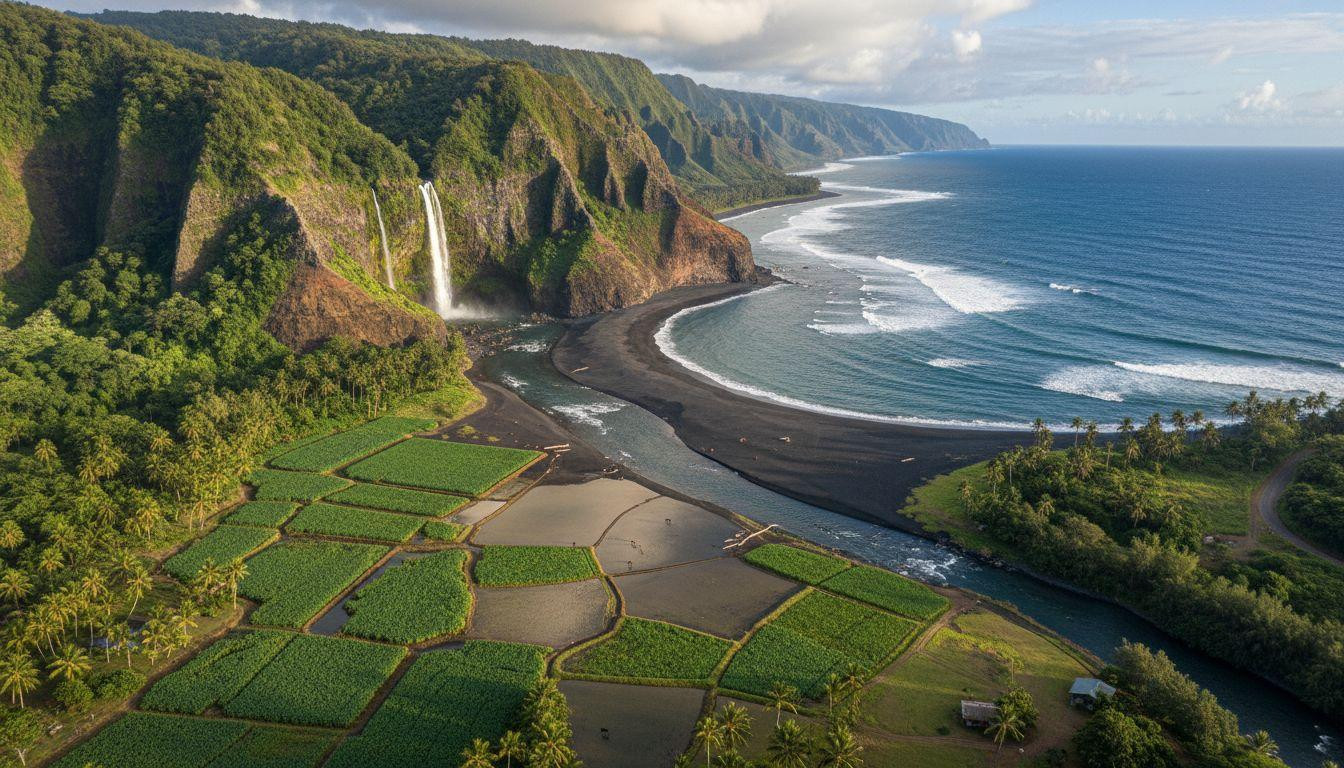
The road down to Waipio Valley drops 800 feet in less than a mile. The grade hits 25 percent in places. Most rental agencies ban their vehicles from attempting it. This keeps the black sand beach at the bottom quiet. Fewer than 10,000 people reach it each year, though half a million stop at the lookout above.
The beach stretches a half-mile where a cold river meets dark blue Pacific waves. Black basalt sand covers the shore. Behind it, 2,000-foot cliffs rise straight up, covered in jungle. Waterfalls appear after rain. The tallest, Hi’ilawe, drops 1,600 feet when flowing. Wild horses wander the taro fields near the water.
The Valley of Kings keeps its distance
Waipio means “curved water” in Hawaiian. Kings lived here before 1800. The population reached 10,000 at its peak. Kamehameha I took refuge in the valley during unification wars. Seven heiau temples mark sacred ground. Signs indicate kapu zones where visitors cannot enter.
Today, 50 residents farm taro in the valley bottom. They grow it the old way, in flooded terraces called lo’i. The work connects them to ancestors who fed thousands from this soil. Tourism brings money but also disruption. Helicopters buzz overhead. Tourists feed the horses despite warnings. The community enforces quiet rules now.
Cliffs that swallow sound
The valley walls trap moisture and muffle noise. Surf crashes against the beach, but the sound stays contained. Morning fog lifts around 8am in May. For maybe ten minutes, light turns the whole scene gold. Then the mist burns off and the cliffs go back to emerald.
Waterfalls multiply after storms. Three to five are visible from the beach on dry days. After heavy rain, a dozen temporary falls appear. They vanish within hours as the rock drinks the water back.
Horses as valley guardians
Between 50 and 100 feral horses roam free here. They descend from stock brought by early Hawaiians. Locals consider them protectors of the valley. The horses know the trails better than people do. They appear at dawn and dusk near the river mouth, sometimes five at a time, sometimes twenty.
Feeding them is prohibited. Getting closer than 50 feet risks a fine. They tolerate human presence but remain wild. A few miles north, Pololu Valley offers easier hiking with similar coastal views but no horses and fewer cultural restrictions.
What reaching the beach requires
Two options exist for descent. The first involves hiking the paved road. It takes 30 to 45 minutes down, twice that coming back up. The second uses a guided tour via 4WD shuttle or wagon. Tours cost $65 to $95 per adult and include cultural interpretation.
Independent hikers need sturdy shoes with grip. The pavement gets slick when wet. Flip-flops cause injuries. Bring two liters of water per person. The climb back up burns legs. Rest stops help. Most people take 90 minutes to two hours for the round trip.
Tour operators and protocols
Waipio Valley Shuttle and Waipio Valley Wagon Tours both operate daily from 9am to 4pm. Reservations are mandatory. Group sizes stay between 6 and 12 people. Guides explain taro farming, heiau locations, and horse behavior. They enforce kapu boundaries and quiet conduct.
The tours last two to three hours. Transport accounts for $40 of the fee, cultural education the rest. No extras are charged. Tours leave from Honokaa, eight miles east of the lookout. For those seeking volcanic beach experiences elsewhere, other Big Island options exist with different access challenges.
What the beach delivers
The sand feels velvety underfoot, finer than most black sand beaches. It formed when lava hit ocean water and shattered into glass fragments. Over time, waves ground the glass into powder. The river bisects the beach. Crossing it requires wading knee-deep in cold water during normal flow. After storms, the current becomes dangerous.
Swimming is risky most of the year. Wave heights average 4 to 8 feet from April through June. Rip currents form near the river mouth. Locals advise against entering the water. The beach works better for walking and photography than recreation.
Honoring the space means staying quiet
Kapu signs mark private land and sacred sites. Heiau temples sit near the beach but remain off-limits. Taro fields belong to families who farm them. Walking through crops or picking fruit is theft. Loud voices disturb residents and horses alike. The valley demands reverence, not excitement.
Cell service drops to one or two bars in the valley. AT&T and Verizon work intermittently. The lookout above has strong signal. No restrooms exist at beach level. The nearest facilities sit at the lookout parking area. Emergency response takes 45 to 90 minutes from Hilo hospital. Helicopter evacuation is possible for critical injuries.
Compared to cultural heritage sites in other regions, Waipio maintains stricter access controls to preserve its sacred character while still allowing respectful visitation.
Your questions about Waipio Valley Black Sand Beach answered
When should I visit for the best experience?
April through June or September through October offer the best conditions. May brings 4 to 6 inches of rain, far less than December’s 15 to 20 inches. Temperatures stay around 82 degrees Fahrenheit. Crowds drop to 20 percent below summer peaks. Morning mist clears by mid-morning 80 percent of days. Sunrise happens around 5:50am in early May, sunset near 7pm.
How much does a visit cost?
Guided tours run $65 to $95 per adult, $45 to $55 for children. Self-hiking is free but requires fitness. Lodging in Honokaa costs $150 to $250 per night for budget options, $250 to $400 for mid-range. Meals average $20 to $35. Rental cars from Kona Airport run $150 to $250 daily for 4WD vehicles, though many agencies prohibit driving the Waipio road. Gas costs $4.50 to $5 per gallon on the Big Island.
What makes this different from Punaluu Black Sand Beach?
Punaluu sees over one million visitors annually and offers roadside parking with easy beach access. Green sea turtles attract crowds there. Waipio receives fewer than 10,000 beach visitors per year due to access barriers. It provides cultural immersion through taro farms, sacred sites, and resident interaction. Punaluu delivers convenience and wildlife. Waipio demands effort and offers authenticity. The isolation and natural drama here create a different kind of beach experience entirely.
The river runs cold even in summer. It flows from springs high in the valley. Where it meets the ocean, the temperature drops ten degrees in seconds. Locals say the contrast wakes you up. The black sand holds heat from the sun. Your feet burn if you stand still too long. Then you step into the river and everything changes.