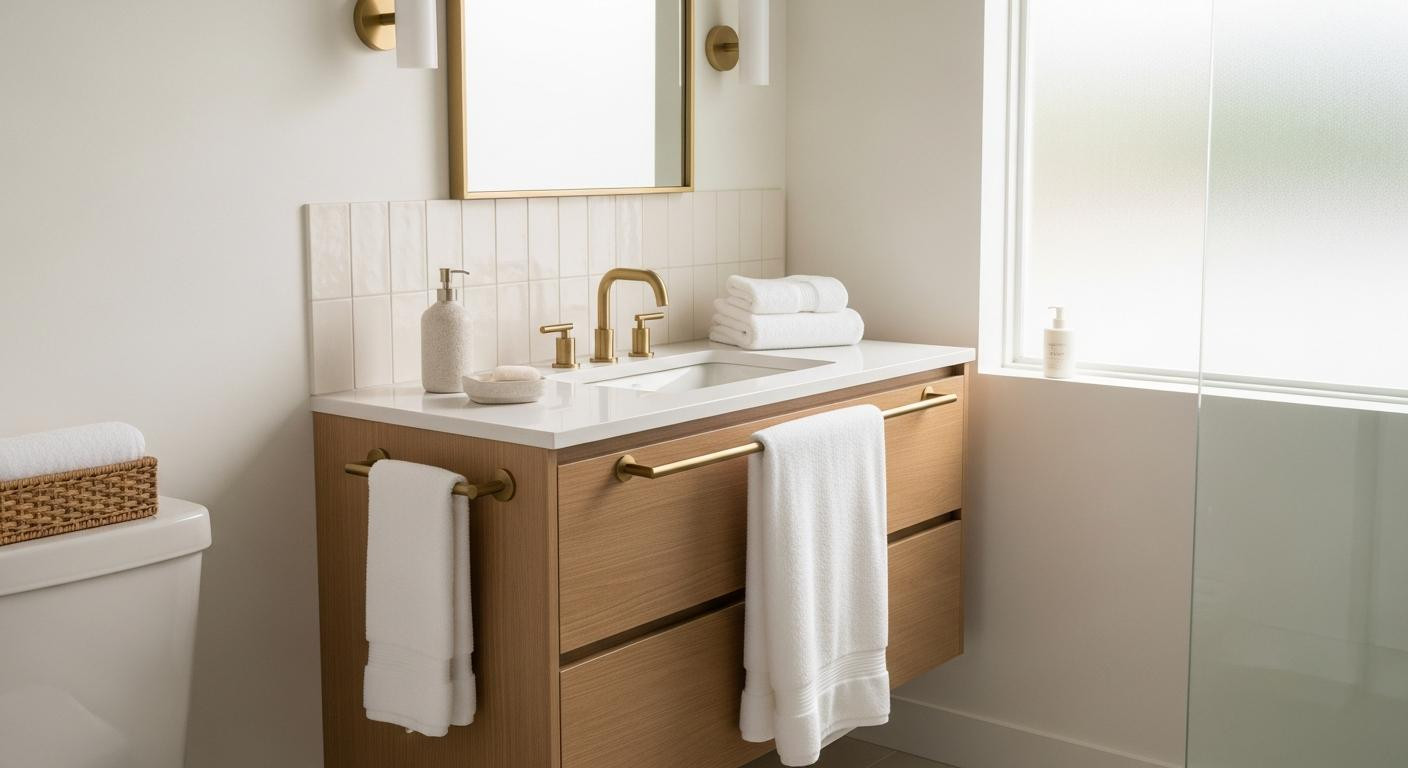
Your guest bathroom’s towel bar sits 48 inches off the floor because that’s what the contractor’s template said, but your husband bends awkwardly to grab his towel and your nine-year-old can’t reach it without a step stool. The measurement came from the National Kitchen & Bath Association’s 2015 guidelines, which recommend 48 inches to the bar’s center as the universal standard for adult-height bathrooms. That number works in 60-square-foot powder rooms with standard vanities, but it falls apart in family baths with tall counters, kids under ten, or floating vanities that sit higher than builder-grade cabinets. The rule isn’t wrong, it’s incomplete.
Why 48 inches became the default and where it actually works
The 48-inch rule traces back to ergonomic studies showing average adult arm reach from a standing position lands comfortably at 46-50 inches when grabbing a towel after washing hands at a standard 36-inch vanity. NKBA published this as a guideline in the early 2000s, and contractors adopted it as gospel because it simplified installations across tract housing. The measurement works perfectly in three scenarios: guest baths with 32-36 inch vanities where only adults use the space, primary bathrooms with standard countertop heights, and powder rooms where the bar mounts 20 inches above the sink rim.
Interior designers featured in House Beautiful confirm that 48 inches creates visual alignment with standard mirror centers and light-switch mid-heights in traditional bathroom layouts. But those layouts represent maybe half of U.S. bathrooms in 2026. And when you mount a bar at this height over a 38-inch floating vanity, you end up with only 10 inches of clearance, causing folded towels to graze the counter and look sloppy.
The 4 bathroom types where 48 inches feels wrong
Floating vanities that sit 34-38 inches high
When your vanity countertop clears 36 inches, a 48-inch towel bar leaves only 10-12 inches of clearance. NKBA-certified designers quoted in The Spruce recommend 42-44 inches in these setups so towels hang with 14-16 inches of visual breathing room. The bar feels more intentional when it maintains that proportion, not fighting the vanity’s height.
Family bathrooms shared with kids under 12
Universal design specialists cited in Architectural Digest install two bars in family baths: one at 36-40 inches for children, one at 70 inches in hooks or rings for adults. The lower bar keeps kids from climbing counters or dragging towels on the floor. Admittedly, it’s easier said than done in tight spaces, but the dual-height approach eliminates the morning tug-of-war over who can actually reach the thing.
Bathrooms with vanities taller than 38 inches
Tall vanities, common in new construction targeting homeowners over six feet, push optimal towel bar height to 46-50 inches to maintain the 18-20 inch clearance ratio that prevents counter-dragging. But this only works if your ceilings clear 8 feet and you’re not mounting sconces at eye level. Beyond 50 inches, you start competing with mirrors and light fixtures, and the whole composition feels top-heavy.
ADA-accessible bathrooms
ADA guidelines recommend 42 inches maximum for hand-towel bars above protruding vanities, specifically to accommodate wheelchair users and individuals with limited reach. If you’re designing for aging in place or multigenerational households, this measurement becomes your ceiling, not your starting point. And that 42-inch height often looks better anyway, especially when paired with warm wood vanities and rounded mirrors that sit lower than traditional frameless glass.
The visual alignment rule that matters more than 48 inches
Interior stylists featured in Apartment Therapy call this the “implied horizon” rule: when your towel bar aligns with the center of your mirror and the midpoint of your sconces, the room reads as intentional even if the exact height varies from 42 to 50 inches. Lighting designers note that this alignment creates a gentle band of texture at eye level that doesn’t compete with overhead lighting. The bar becomes part of the room’s horizontal rhythm, not an afterthought screwed into the wall wherever the stud was.
One long 30-48 inch bar mounted directly under a floating vanity acts as a visual divider for double-sink setups, giving each user a dedicated towel zone. Designers quoted in Domino say this trick reads more modern than two short bars and eliminates the “which towel is mine” question. The bar sits 2-4 inches below the counter, creating storage that feels built-in. That’s the kind of detail that quietly elevates the whole space, especially when you’re working with rental bathroom upgrades under $150 and can’t touch the tile or plumbing.
What to buy and where to mount it in 2026
Budget options under $50 include standard 24-inch bars in brushed stainless or matte black from big-box retailers, both popular in “warm minimal” bathroom reels. Mid-range picks like 30-inch brass bars at $80-$140 show up in “cozy modern” staged baths where the finish matches cabinet pulls and faucets. High-end 40-inch bars at $200-$400 justify their cost when you need long lengths that span wide vanities without sagging, and the heavier gauge metal feels substantial when you grab it with wet hands.
Mount at 46-48 inches in standard baths, 42-44 inches with tall vanities, 36-40 inches in kids’ spaces, and always align with your mirror’s horizontal center for that hotel-bath composition. And if you’re mounting the bar under a floating vanity, make sure it clears the cabinet by at least 2 inches so you can clean underneath without contorting your arm. Beyond the practical clearance, aligning hardware with mirror centers and storage zones creates the visual coherence that makes small bathrooms feel intentional.
Your questions about towel bar height rules answered
Can I install a towel bar above the toilet if space is tight?
You can, but keep it 12-18 inches above the tank rim to prevent head-bumping. Stagers featured in Houzz say they avoid this placement in primary baths because it looks cheap and feels uncomfortable, but it works in narrow powder rooms where wall space is genuinely limited. Just make sure towels can’t snag the flush handle or drape onto the seat.
Do towel rings follow the same 48-inch rule?
Towel rings mount with the ring’s bottom at 48 inches, or 20 inches above your counter rim, whichever creates better visual proportion. In Parisian-inspired baths, designers place rings at 50-52 inches to add vertical interest without overwhelming the mirror. That higher placement only works when you have portable upgrades that don’t require permanent wall damage, making it perfect for renters who want elevated style without losing their security deposit.
How much does professional towel bar installation cost?
DIY hardware runs $15-$400 depending on finish and length. Hiring a handyman adds $75-$150 per bar if you’re uncomfortable drilling into tile or drywall, per 2025 service data. The labor cost makes sense when you’re installing multiple bars at precise heights or mounting into tricky surfaces like marble or glass tile where one wrong hole ruins the whole wall. But for standard drywall with visible studs, simple upgrades that follow your existing layout are absolutely DIY-friendly with a level and the right anchors.
Your bathroom on a Thursday morning when the towel bar sits exactly where your hand expects it, 46 inches off the floor, aligned with the mirror’s center, mounted under the floating vanity so folded towels frame the sink in thirds. The light catches brass at the same height as the sconces. Everything lines up.