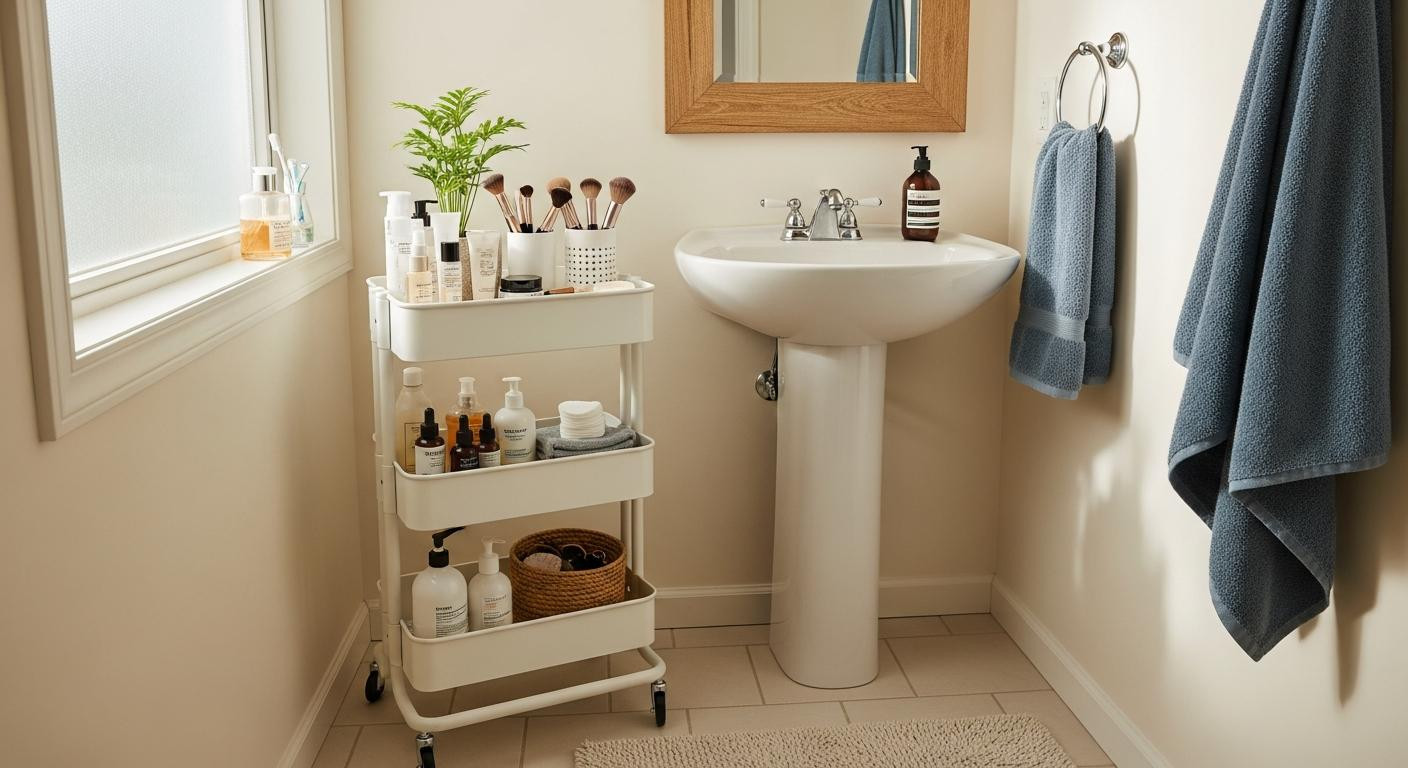
Your Tuesday morning starts at 7:14am digging through three baskets under your pedestal sink for the hair serum that rolled behind the toilet brush sometime last week. The mascara sits on the tank because the counter holds your roommate’s entire skincare lineup. By the time you find everything, you’re already 11 minutes behind schedule and the bathroom still looks like a crime scene.
Your 42-square-foot rental bathroom has zero drawers, one tiny medicine cabinet from 1987, and a shared-space agreement that’s failing every morning. The problem isn’t the stuff you own. It’s that nothing moves when you do.
The mobility gap that static storage can’t solve
Traditional bathroom storage forces you to adapt your routine to fixed locations. Medicine cabinets hold backup products you can’t see, under-sink bins require awkward crouching to access items hiding in the back, and shower caddies sit three feet from where you actually apply your moisturizer.
But here’s what actually happens in a tiny bathroom. Makeup application works best at the mirror with natural light, often near the window, not the sink. Hair styling needs counter space and outlet access that shifts depending on whether you’re using a flat iron or diffuser. Skincare routines feel calmer at the tub edge during evening wind-down, not hunched over a pedestal sink.
The result is constant movement between storage spots and usage spots, carrying armfuls of bottles across 35-50 square feet of tile. And in urban rentals where pedestal sinks appear in 30-50% of units, that gap between where things live and where you need them creates daily friction.
What the IKEA RÅSKOG actually does in 40 square feet
The $40 RÅSKOG utility cart organizes 20-30 toiletries across three tiers that follow your 8am scramble instead of anchoring you to one spot. At 13.75 inches wide and 17.75 inches long, it creates vertical storage without consuming the floor space a traditional vanity would demand.
The bottom tier holds backup products and hair tools in heat-resistant containers, keeping cords and hot surfaces away from daily-use items. The middle tier, which adjusts to different heights, works for skincare divided into face, nails, and hair zones using drugstore trays. The top tier becomes your immediate-access station for makeup brushes and the products you grab every single morning without thinking.
And those wheels change everything. The cart rolls to your side of the sink during your routine, then tucks into the corner or rolls to your bedroom when you’re finished. That mobility solves the shared-bathroom standoff where counter space becomes territorial and someone’s stuff always looks like it’s invading the other person’s zone.
The NISSAFORS variation for under-sink caverns
The $30 NISSAFORS fits the curved void under pedestal sinks where traditional storage bins create wasted air pockets around the plumbing. At 11.75 inches wide and 19.875 inches long, it’s slimmer than the RÅSKOG, which helps in bathrooms narrower than 48 inches wall-to-wall.
Interior designers featured in Apartment Therapy recommend removing the wheels entirely for a stable 32.625-inch unit that slides into the space most pedestals offer. This mirrors how IKEA’s Billy bookcase gets hacked for entryway storage, transforming standard pieces into space-specific solutions.
The paint trick matters here because bare steel looks industrial in bathrooms that lean traditional. Spray paint designed for metal, around $7 at Home Depot, bonds to powder-coated surfaces without priming. Matte white or brushed metallic finishes transform the cart into something that belongs next to your existing fixtures instead of fighting them visually.
Where it fails in bathrooms under 35 square feet
The 17.75-inch RÅSKOG depth requires at least 16 inches of clearance from the toilet for comfortable movement. That’s tight in bathrooms narrower than 48 inches, where every inch of floor space determines whether you can turn around without bumping into something.
Door swing patterns create collision zones too. Inward-opening doors in small bathrooms conflict with cart placement near the sink, and shower curtains that billow out during hot showers will catch on cart corners if you park it too close. Admittedly, this trades floor openness for vertical organization, a deal-breaker if you need every inch for movement.
But the weight limits tell you what works. The RÅSKOG holds 26-40 pounds total depending on how you distribute items across tiers. Professional organizers with NAPO certification note that keeping heavier bottles on lower tiers prevents tipping when you pull the cart across uneven grout lines.
Your questions about IKEA’s rolling cart bathroom hack answered
Does the cart tip when you load the top tier with heavy bottles?
The top tier should hold no more than 10 pounds to maintain stability when moving the cart. Store full-size shampoo bottles and body lotions on the bottom tier, saving the top for lightweight items like cotton rounds and travel-size serums.
And if your floor has significant grout lines or slight unevenness, stick Command strips under the bottom tier against the baseboard when parked. That prevents rolling during reach-ups without permanent damage to rental walls.
Will wheels scratch my rental’s tile floor?
The powder-coated steel wheels leave no marks on ceramic or vinyl tile after daily movement, according to testing notes from design publications. Similar to how tension rods solve renter problems without damage, these carts work within lease restrictions.
But natural stone or unsealed concrete needs protection. Felt pads, around $5 for 16 pads at Target, go under each wheel to prevent micro-scratches during pivots.
How do you keep three tiers organized when you’re rushing?
Assign each tier to a routine phase instead of a product category. Morning face products on top, hair styling tools in the middle, evening skincare on the bottom. That workflow-based system eliminates search time because your hand knows where to reach based on what you’re doing, not what you’re looking for.
Divided trays from Amazon, around $10-20, fit inside each tier to prevent product drift during pulls. Trays create the same visual calm on rolling carts that they deliver on countertops, grouping like items so nothing disappears into the back corner.
Thursday evening, 6:42pm. The cart sits near the tub edge where late-day window light hits the top tier’s glass bottles, turning drugstore serums into something that photographs like a spa setup. You roll it there for the 10-minute routine that used to require three trips to the sink. The bathroom finally moves with you.