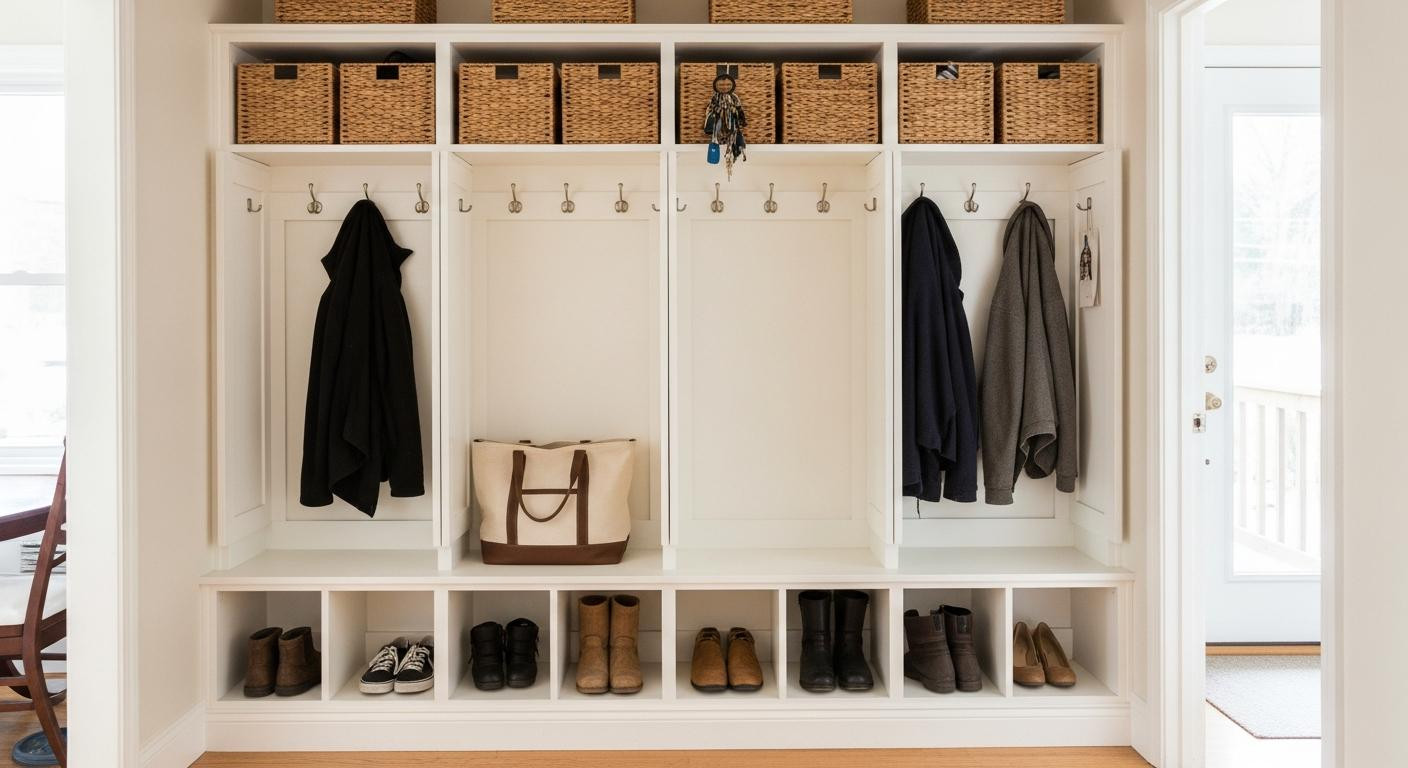
Your Tuesday morning starts at 7:14am hunting for your left work shoe somewhere near the door where jackets hang from the doorknob because your 4×6 entryway has no closet, no hooks, no system. The mail piles on the floor next to your partner’s gym bag, which leans against the wall you’ve walked past 340 times since January without solving the chaos. Two IKEA Billy bookcases arrived Saturday for $158 total. By Sunday evening, the wall where nothing worked suddenly held coats at eye level, shoes in cubbies at shin height, and keys in a basket you can grab without thinking.
The hunting stopped.
The entryway problem nobody warns you about when you rent a pre-war walk-up
My building’s 1924 floor plan dedicates 24 square feet to the “entry,” a generous term for the space between the front door and where the living room starts six feet later. No coat closet. No built-in bench.
The landlord installed one overhead light fixture that casts shadows at 6pm when you’re trying to find anything. By February, the drop zone held three coats on the floor, eight pairs of shoes in a pile, my partner’s work bag blocking the baseboard heater, and a stress headache every time I opened the front door.
The internet kept showing me $800 entryway consoles that don’t fit spaces under 30 inches wide.
Why I picked Billy bookcases instead of actual mudroom furniture
Measure first: my wall runs 72 inches between the door frame and the living room opening, but only 62 inches of that clears the door swing. West Elm’s narrow console measures 64 inches wide.
IKEA’s Billy bookcase: 31.5 inches. Two of them side-by-side leave a 9-inch gap I filled with hooks.
Vertical storage beats horizontal in spaces under 25 square feet
Floor real estate costs too much in tiny entryways. A console sits 30 inches tall, wasting the 50 inches of wall above it.
Mounted Billy shelves reach from 12 inches off the floor to 78 inches high, creating four zones: shoe cubbies at the bottom, coat hooks at shoulder height, bag storage at waist level, keys and sunglasses up top where you see them leaving. That vertical shift makes the narrow space feel intentional instead of cramped.
And the open cubbies let you see everything without opening doors, which keeps the morning routine from turning into a scavenger hunt.
The 90-minute transformation that changed how 6pm feels
Each Billy took 35 minutes to build on Saturday afternoon. The modification: I removed the backing boards entirely, mounted the frames directly to the wall using the included brackets plus four additional toggle bolts from Lowe’s.
This creates open cubbies instead of closed shelving, letting you grab shoes without thinking about it. Coats hang from Command hooks screwed into the bookcase’s side panels at 62 inches high, the exact height where my hand lands naturally when I walk in.
But the moment the space started working differently came Sunday at 4pm. My partner walked in from errands, hung his jacket on a hook without asking where it goes, dropped his keys in the top cubby basket.
I watched him do it. He didn’t hunt. The system made sense to someone who didn’t build it, which is when you know the setup actually works.
What $158 actually bought me beyond shelf space
The Billy hack didn’t just organize objects. It bought me the 4 minutes I used to spend looking for my badge every morning, the visual calm when I open the front door at 6:47pm after a meeting that ran late.
The apartment feels like I’m arriving home instead of stepping into my own mess. The shoe pile is gone. The stress headache doesn’t start in the entryway anymore.
According to ASID-certified interior designers, entryways set the emotional tone for your entire home. When that first impression feels chaotic, the rest of the space carries that tension even if the living room is perfectly organized.
The calm at the threshold shifts everything that comes after. And that shift cost less than two trips to Target for storage bins that never quite solved the problem.
The simple IKEA shelf hack that created a mudroom in my tiny entryway: your questions answered
Does this work if your entryway is narrower than 6 feet?
One Billy bookcase measures 31.5 inches wide. If your wall clears 36 inches accounting for door swing, you can mount a single unit.
Pair it with a narrow shoe rack like IKEA’s Hemnes placed perpendicular to create an L-shape. Professional organizers with certification confirm that even 18 square feet can function as a mudroom if you use vertical wall space instead of floor consoles.
Can renters actually mount Billy bookcases without losing their deposit?
Toggle bolts leave four small holes per unit, easily patched with spackle at move-out. I kept the backing boards in storage, and reinstalling them takes 10 minutes, converting the setup back to freestanding furniture if needed.
Damage cost: approximately $15 in wall repair materials. That’s cheaper than most security deposit deductions for normal wear.
What fits in 31.5 inches of vertical storage?
Four pairs of adult shoes per cubby row. Six coats on side-mounted hooks. Two tote bags in the middle shelf.
One woven basket for keys, sunglasses, dog leashes. The system holds everything two people drop daily without looking crowded, and the weight distributes across the wall anchors instead of stressing a single point.
Design experts featured in Architectural Digest recommend calculating 12 inches of vertical clearance per shoe pair and 18 inches per coat to avoid visual clutter, measurements this hack naturally creates.
Thursday morning now starts with my hand reaching automatically to the top-right basket where my sunglasses sit next to my partner’s chapstick. The keys jingle in their spot. My coat hangs where I left it Tuesday, smelling faintly like the coffee shop two blocks away where I stopped before work.
The entryway doesn’t require thought anymore. It just works, quietly, every single morning at 7:14am.