
World Sleep Day 2026 fell on Friday, March 13, 2026, and Saatva marked the date with $400 off qualifying orders of $1,000 or more. That promotion is over. The terms that made it worth taking are not: 365 nights to sleep on the mattress, a lifetime warranty, and free in-room delivery with your old mattress carried out. Sale or no sale, those three things sit behind every Saatva price.
This review is part of our guide to the best innerspring mattresses, where the strongest models are compared side by side.
Keep reading if:
- You are replacing a mattress that is already failing you. A 365-night trial gives you far more than five extra months of waiting for a bigger markdown.
- You want a hotel-style innerspring without the showroom markup. The Saatva Classic is Saatva’s flagship bed, and it is what every price and firmness below describes.
- Skip it if you want a bed-in-a-box under $800, a deep memory-foam hug, or a mattress you can carry up the stairs alone. Saatva never ships compressed, and its cheapest twin starts at $1,449.
Our pick
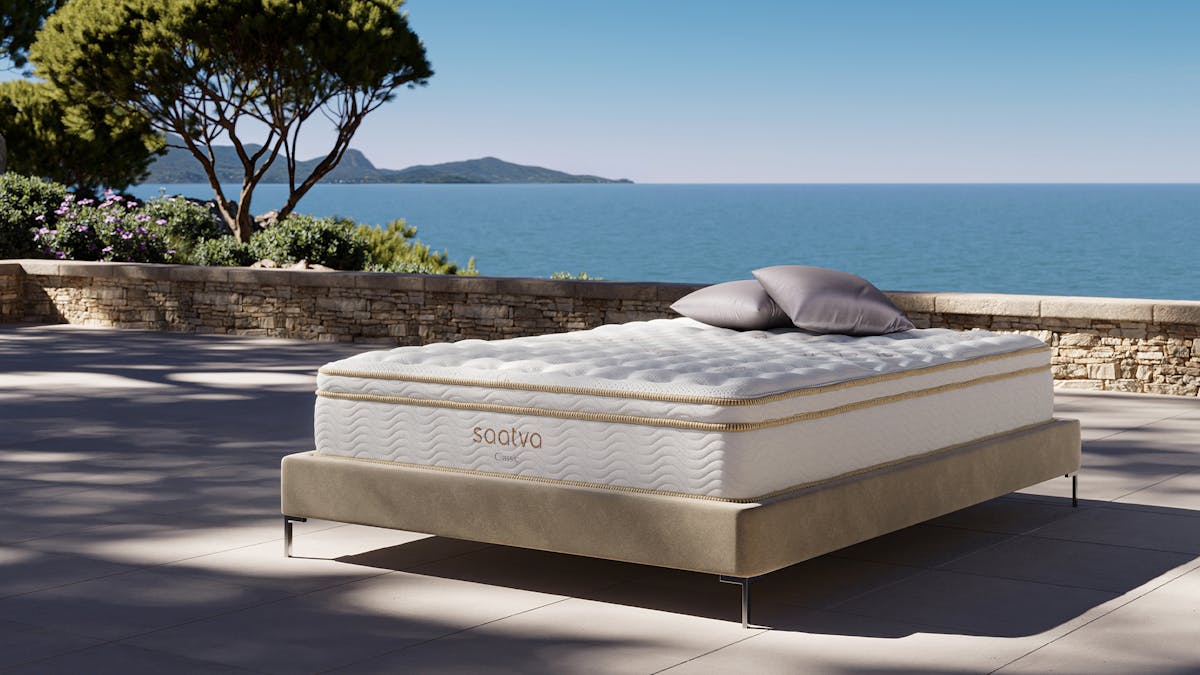
Saatva Classic — an innerspring option if you want in-room setup rather than a compressed box.
- 365-night home trial
- Free in-room delivery and setup
- Lifetime warranty
- Choose from Plush Soft, Luxury Firm, and Firm
What is World Sleep Day, and why do mattress brands promote sales around it?
World Sleep Day is run by the World Sleep Day Committee of the World Sleep Society, and it has a rule for its own date: the Friday before the spring vernal equinox. The first edition was held on March 14, 2008 under the slogan “Sleep Well, Live Fully Awake,” and it has moved with the calendar ever since.
The 2026 edition carried the theme “Sleep Well, Live Better”, written by a committee co-chaired by Dr. Fang Han and Dr. Lourdes DelRosso.
Mattress retailers treat the week around it as Sleep Week, their answer to a March calendar that has no holiday weekend to hang a promotion on. That is the whole mechanism: an awareness day gives an industry a reason to cut prices in a month that is otherwise quiet. Nothing about the date obliges a brand to discount, and nothing obliges you to buy because the date arrived.
The themes are the useful part. Each one tells you what the sleep conversation is focused on that year, and the official run of them looks like this:
| Year | Date | Theme |
|---|---|---|
| 2022 | March 18 | Healthy Sleep, Sound Mind, Happy World |
| 2023 | March 17 | Sleep is Essential to Health |
| 2024 | March 15 | Sleep Equity for Global Health |
| 2025 | March 14 | Make Sleep Health a Priority |
| 2026 | March 13 | Sleep Well, Live Better |
What was Saatva’s March 2026 World Sleep Day offer?
Saatva ran its Sleep Week event across World Sleep Day 2026 with $400 off qualifying orders of $1,000 or more. The retailer’s sale applied to mattress purchases and other qualifying items; the event has ended, so those terms are historical, not a live offer.
Retail promotions can change from year to year. Treat any World Sleep Day discount as a snapshot of one retailer’s offer, not as a rule about what the date is worth.
Who is eligible for Saatva’s $225 discount?
Saatva advertises a $225 discount on purchases of $1,000 or more for eligible groups, including active military, veterans, first responders, government employees, nurses, teachers, seniors and students. Saatva says eligibility is verified through ID.me during checkout.
This is a separate eligibility-based offer. Check Saatva’s current terms at checkout before planning around it; do not assume an expired seasonal promotion can be combined with it.
What were the Saatva Classic list prices by size?
Two heights are available, and the 14.5″ profile costs $20 more than the 11.5″ at every size. The figures below are list prices recorded for this comparison; the March 2026 event has ended, and later promotions may use different terms. Check the retailer for the offer available when you shop.
| Size | 11.5″ height | 14.5″ height |
|---|---|---|
| Twin | $1,449 | $1,469 |
| Twin XL | $1,584 | $1,604 |
| Full | $2,029 | $2,049 |
| Queen | $2,229 | $2,249 |
| King | $2,729 | $2,749 |
| California King | $2,729 | $2,749 |
| Split King | $3,168 | $3,208 |
See the Saatva Classic price in your size →
Which Saatva Classic firmness fits your sleep position?
The Classic comes in three comfort levels, and the wrong one will feel wrong on night one no matter what the sale did to the price:
- Plush Soft (3/10) — a contouring, body-hugging feel. Saatva steers side sleepers and lighter sleepers here.
- Luxury Firm (5-7/10) — the most popular level, and the safe choice for couples who disagree about firmness. It suits every sleep position.
- Firm (8/10) — a “floating on top” feel for stomach sleepers, back sleepers who want a very firm bed, and heavier sleepers in the 250-300 pound range.
Side sleepers with broad shoulders usually regret anything above 7/10 within a week, because the shoulder has nowhere to sink and the arm goes numb. Stomach sleepers usually regret anything below 5/10, because the hips drop and the lower back takes over. Pick the firmness before you chase the discount, because the trial covers the bed, not the time you spend arguing with your own choice.
How is the Saatva Classic built?
The Saatva Classic is a dual-coil innerspring with a 3″ Euro pillow top, which is the cushioned layer sewn flush with the mattress edge rather than ballooning over it. The support core is a set of more than 1,000 triple-tempered recycled carbon steel coils, a comfort layer of coils sitting on a support layer of coils — that is what gives the bed its springy, responsive surface instead of the dead feel of foam.
The cover is organic cotton treated with Saatva’s Guardin botanical antimicrobial treatment, and the middle third of the mattress carries Saatva’s Lumbar Zone support, which is firmer where your lower back sits. Mattresses of this type are not compressed into a box: Saatva delivers it to the room you choose and sets it up there. Saatva states its innersprings can last upwards of 10 years with normal use, and advises rotating the mattress after six months and then once a year so the surface breaks in evenly.
What are the trial, delivery, return and warranty terms?
- 365-night home trial on mattresses and bedroom furniture. Saatva’s terms refund the purchase price if you return inside the window, with a $99 processing fee as the only cost to you. Pillow, bedding and rug orders carry 45-day free returns, and mattress toppers carry a 180-night trial.
- Free white glove delivery on every mattress order: hand-delivered, set up in the room of your choice, and your old mattress and foundation are taken away free if you select removal at checkout. Saatva typically ships from its factories within 9-21 days depending on your ZIP code.
- Lifetime warranty on the mattress, with an Extend protection plan available separately for accidental stains and damage the warranty does not cover.
- Financing through Affirm, plus a Truemed route where Saatva says customers may qualify to save around 30% using HSA/FSA funds. Saatva does not take HSA/FSA cards directly at checkout.
Read those four lines next to any discount and the headline matters less: the trial is what protects you if the mattress is wrong, and it does not depend on which week you ordered. The March offer has ended, so compare today’s price and return terms before you commit.
Should you wait for a sale or replace your mattress now?
- Buy on the event if you already know you want this model, you qualify for the $225 ID.me discount or you do not, and your order clears the $1,000 threshold — the discount is applied to the whole cart, so adding the foundation or pillows in the same order is what unlocks it.
- Buy anyway if your current mattress is more than eight years old, sags visibly, or leaves you waking with back pain. With a 9-21 day delivery window and a 365-night trial, the cost of waiting for a bigger markdown is months of sleeping on a bed you have already decided to replace.
- Wait if the bed you want is a cheaper boxed model, if you are moving house in the next three weeks, or if you have not yet decided between innerspring and foam. A discount is the weakest reason to commit to a ten-year purchase.
For the record: the Saatva Classic is not the only luxury innerspring worth your money. If you are weighing it against a Beautyrest Black, our side-by-side on the verified differences is the faster read, and Saatva HD against WinkBed Plus covers the heavy-sleeper end of the range.
What does sleep health have to do with choosing a mattress?
Two figures frame the whole argument. CDC analysis of 2014 survey data found that 34.8% of US adults reported sleeping less than seven hours in a 24-hour period. RAND estimated that insufficient sleep costs the US economy up to $411 billion annually in lost output. The World Sleep Society’s own position is blunter: sleep is treated as a pillar of health alongside nutrition and physical activity, and poor sleep is associated with obesity, diabetes, coronary artery disease and cardiovascular mortality.
A mattress is the one lever in that list you pull once and then live with for a decade. It will not fix a schedule that does not allow seven hours, and it will not diagnose anything. If you snore loudly, wake gasping, or stay exhausted after a full night’s sleep, take that to a doctor — that is a clinical question, and a new mattress is not an answer to it.
What the purchase does buy is eight hours a night on a surface chosen for how you actually sleep, which is why the firmness table above matters more than the discount table. The sleep-habits side of the same problem is worth reading too: the sleep myths that keep people tired and five strategies for falling asleep faster both cover what a mattress cannot do for you.
When is the next World Sleep Day?
Because the date follows the equinox, it shifts from year to year. The next vernal equinox in 2027 is Saturday, March 20, placing World Sleep Day on Friday, March 19, 2027. Promotion amounts are set by retailers and are not guaranteed to repeat.
If you would rather read the source than the retail layer, the World Sleep Society’s 2026 toolkit is free, and our World Sleep Almanac covers the mattress side of the question year-round.
World Sleep Almanac score: 8/10
Our editorial assessment of the Saatva Classic: it earns high marks for a full-year home trial, in-room delivery and setup, and a lifetime warranty. Its dual-coil construction and three firmness choices make the offer more adaptable than a single-feel mattress. The trade-off is price: the size-and-height prices listed above are premium, and the March 2026 discount has expired.
- Trial and returns: 9/10 — the 365-night trial is unusually long; the stated $99 processing fee still applies to a return.
- Warranty: 10/10 — Saatva offers a lifetime warranty.
- Construction and choice: 8/10 — dual coils, two heights and three firmness levels offer meaningful choice, but not a deep memory-foam feel.
- Price and value: 6/10 — this is a premium-priced mattress, and the seasonal $400 offer is no longer available.
This is an editorial score based on the listed purchase terms and specifications, not a sleep test.
Verdict: choose the Saatva Classic for an innerspring with a year-long home trial, in-room delivery and several firmness options; skip it if you need a low-cost boxed mattress or a deep foam hug. The March 2026 promotion is over, so judge the bed by its current price, firmness choice and return terms—not an expired discount.
Bottom line
If the Classic matches the feel you want, check the current size and height options directly with Saatva before ordering.
Questions readers ask about World Sleep Day and the sales around it
Is the World Sleep Day discount applied to the whole order?
Yes. Saatva’s promotion runs on the cart total: the $400 event in March 2026 applied to orders of $1,000 or more, mattress, foundation and bedding together, and it was taken off automatically at checkout with no code.
Who can use Saatva’s ID.me discount?
Saatva lists active military, veterans, first responders, government employees, nurses, teachers, seniors and students among eligible groups. The $225 discount applies to purchases of $1,000 or more after ID.me verification, according to Saatva.
Is World Sleep Day the cheapest time of year to buy a Saatva?
Not reliably. The $400 March 2026 event was a time-limited promotion, and Saatva runs offers at other points in the year. The threshold and headline discount can change, so do not assume that a World Sleep Day offer will repeat.
What does it actually cost me if the mattress is wrong?
Saatva refunds the purchase price inside the 365-night trial and charges a $99 processing fee to handle the return, with pickup arranged. Exchanges to a different size, height or firmness follow the same process, and the fee is the only stated cost.
How long between ordering and sleeping on it?
Saatva builds to order and typically delivers within 9-21 days depending on your ZIP code, including in-room setup and optional removal of your old mattress and foundation. Do not order if you are moving in that window without checking the delivery date first.
What does the World Sleep Society publish for World Sleep Day?
A free annual toolkit carries the theme, the key messaging, the history of every slogan since 2008 and the reference list behind the health claims. It is the primary document behind most of what retailers write about the date.
Reviewed by the World Sleep Almanac editorial team — October 1, 2026.
Keep comparing
- Best Mattress for Petite Sleepers 2026: Saatva Plush Soft First
- Best Daybed Mattress 2026: Saatva Classic Wins, PlushBeds Runner-Up
- 10 Inch vs 12 Inch Mattress: Thickness Matters Less Than You Think
- Best Mattress for Airbnb Hosts 2026: Saatva Classic Wins
- Morning Person vs Night Owl: Which Bed Fits Your Chronotype
- Best Mattress for Shift Workers 2026: Saatva Classic First
- Best Mattress for Motion Isolation 2026: Saatva Classic First
- Tempur-Pedic Return Policy: 90 Nights, $175 Fee, Who Should Skip It