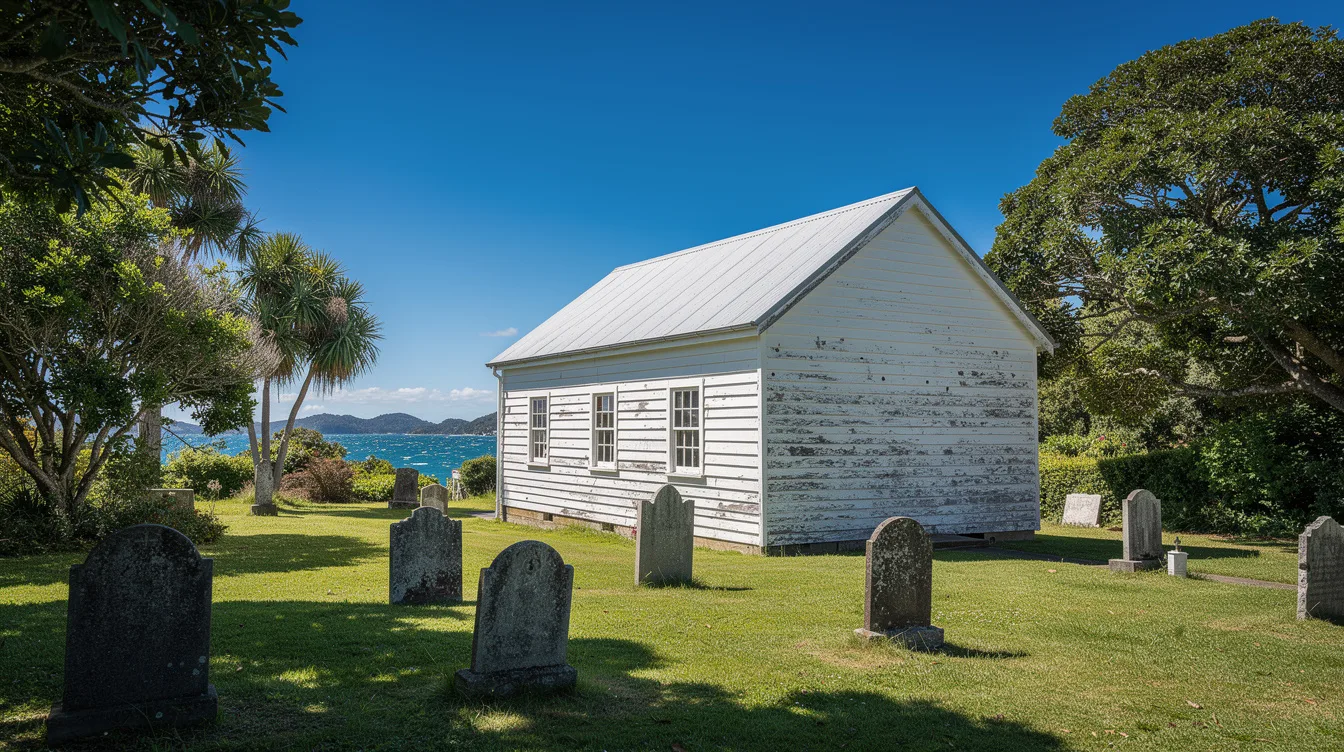
Russell is quiet now, which makes its old violence harder to miss. In this Bay of Islands village, Christ Church still carries musket-ball damage from the 1845 Battle of Kororāreka, when conflict came directly to the waterfront.
You can stand near the church and see why this is more than a tidy heritage stop. The marks turn a peaceful harbor town into a physical record of the Northern War, tied to the unsettled years after the Treaty of Waitangi.
The musket marks make the history feel close
Christ Church preserves visible damage associated with the 1845 conflict. That fact gives the building its charge: you are not looking at a polished interpretation of history, but at scars left on a place of worship.
And the title’s answer is blunt. Kororāreka was a key site in the battle, so the church became caught in a struggle that reached the town itself. The harbor may look composed today, but the past here was anything but.
You don’t need a long museum visit to feel the shift in mood. Start at the church, then walk the compact center, where timber buildings and the waterfront soften the scene without erasing what happened.
Kororāreka had a rougher reputation than Russell does now
Before it became Russell, the settlement was known as Kororāreka. It grew as an early European port shaped by trade, missionary activity, whaling, and colonial administration.
But its waterfront culture was disorderly enough to earn the nickname “Hell Hole of the Pacific.” That sounds theatrical now, yet it explains why this small place holds such an outsized role in New Zealand history.
You’ll find the contrast is Russell’s real appeal. It is calm, but not bland. The harborfront invites a slow lunch around Russell Wharf and The Strand, while the church and nearby sites keep the town from becoming merely a pretty pause between cruises.
What else belongs on a Russell day
The history continues beyond Christ Church. Visit Pompallier Mission and Printery and the Russell Museum, then head to Flagstaff Hill / Te Maiki, linked to the flagstaff repeatedly cut down during the 1840s.
And if you need a break from old conflicts, Long Beach at Oneroa Bay sits over the hill from town. It is sheltered, so a swim changes the pace quickly. The limitation is simple: Russell is small, and that slower rhythm is the point.
You can also walk sections of the roughly 21-km Russell Walkway, which runs through native forest and coastal scenery. Don’t treat it as a checklist. Pick a section that fits your day, then leave time for the water.
Can you use Russell as a base for the Bay of Islands?
Yes, especially if you want evenings that feel quieter than Paihia. Russell is a departure point for sailing trips, fishing charters, dolphin-watching excursions, and cruises toward Cape Brett and the Hole in the Rock.
But Paihia has the wider concentration of tours and easier transport logistics. You may prefer Paihia for convenience, then cross to Russell when you want heritage, a waterfront table, and less movement around you.
The ferry is the arrival Russell deserves
The passenger ferry from Paihia takes about 15 minutes. It is usually the simplest way in, and the crossing makes Russell feel separate from Paihia even though they face each other across the inner bay.
You watch the water open around the boat, then step into a village that is compact enough to explore on foot. That short crossing does useful work: it slows you down before the history does.
And if you have a car, the vehicle ferry runs between Opua and Okiato in about five minutes. Russell is also roughly a three-hour drive from Auckland, though the ferry route offers the more memorable approach.
Stay long enough for the harbor to empty
Two to three nights gives you room for both the Bay of Islands and Russell’s historical weight. Pair the town with Waitangi Treaty Grounds, Paihia, Kerikeri, or a boat trip when weather and sea conditions allow.
But don’t rush Christ Church between excursions. The musket marks ask for a quieter look. By the time the last ferry leaves, the harbor settles again, and those old traces remain on the church walls.