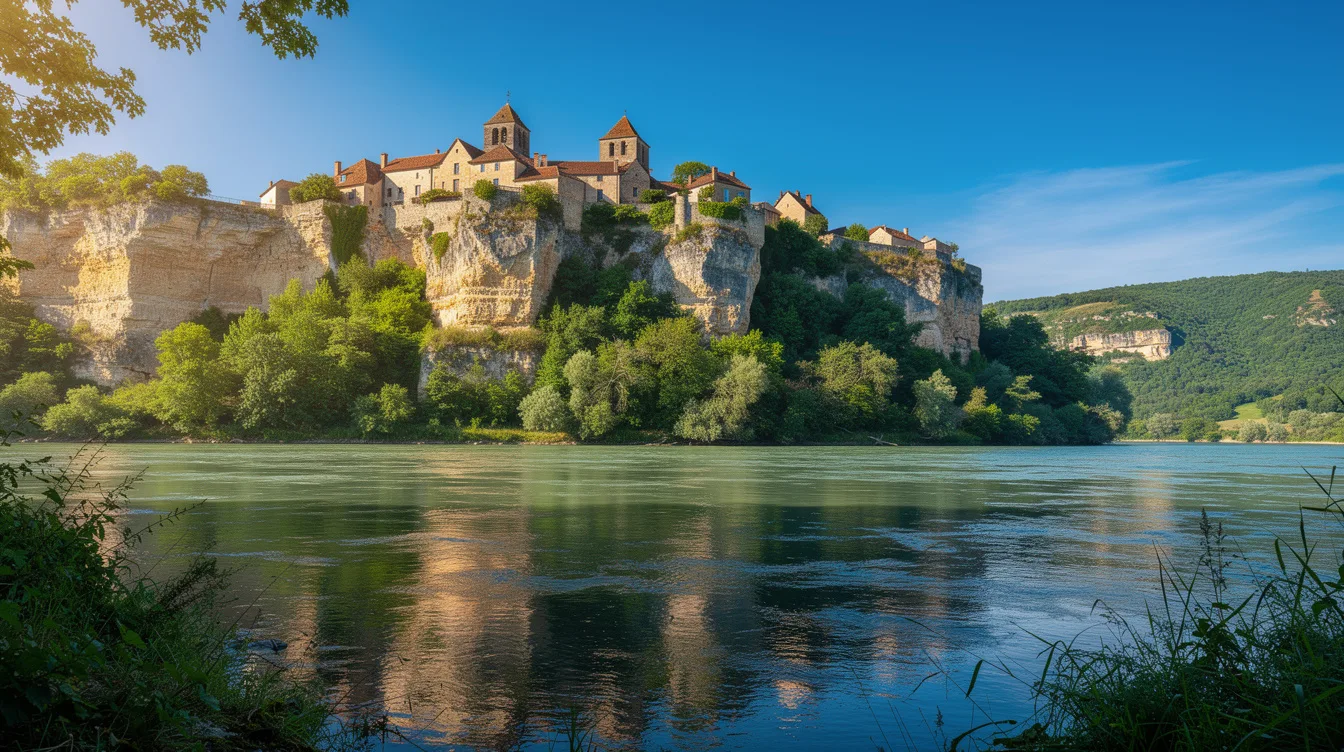
Saint-Cirq-Lapopie rises 328 feet above the Lot River because this cliff was chosen for defense. The payoff today is immediate: medieval lanes drop toward a river bend far below, while the village holds its ground above it.
It’s a view that explains the fame, though fame has its cost. This French village in the Lot can feel like an open-air museum, and it draws crowds that can make its narrow streets feel smaller than they are.
Why the cliff still defines Saint-Cirq-Lapopie
The village sits on a steep cliff above the Lot River in the Parc naturel régional des Causses du Quercy. Its defensive position shaped the settlement long before visitors came for photographs, so the old center still feels built around height, tight passages, and control of the valley.
And the climb is part of the point. Cobbled lanes are steep, brown-tiled roofs stack above timber-framed facades, and the river appears between buildings as a strip of pale light below.
You’ll find a fortified church near the former defenses and castle remains above the valley. Thirteen protected historic monuments give the small village unusual density, but don’t expect a grand monument district. The pleasure is in noticing a doorway, an overhang, then another sharp turn uphill.
A small village with a very large audience
About 200 permanent residents live here, which makes the visitor pressure easy to understand. A 2012 report put annual attendance at roughly 400,000 visitors, mostly from within France, after the village won the title of France’s favorite village that year.
But it isn’t lively in the way a city is lively. Saint-Cirq-Lapopie is compact and pedestrian-heavy, with the sound of shoes on stone replacing traffic once you leave the lower approach.
Its 2012 title, “France’s Favorite Village”, brought national attention. That recognition is deserved for the setting and preserved architecture, yet it also means midday can be the wrong time to judge the place.
When should you arrive?
Arrive before 10 a. M. Or late in the afternoon during high season.
The streets are busiest from late morning until 4 p. M., so an early start gives you more room to look up rather than follow the crowd.
And park below the historic core. Cars don’t belong in these tight, sloping lanes, and trying to force an easy arrival defeats the village’s best quality: it reveals itself slowly on foot.
What to see after you reach the upper village
Skip a rigid route through the upper lanes. Look for old workshops, projecting upper stories, and the weathered surfaces of medieval houses. The village rewards wandering because each turn changes the angle on the rooflines or the Lot valley.
Saint-Cirq-et-Sainte-Juliette Church began in the Romanesque period and was later altered in a Gothic style. Nearby castle remains recall a time when several feudal families divided control of the village.
For a different pace, walk the Bouziès towpath along the Lot River. It pairs well with the village because the riverbank makes the cliff’s scale clearer. Above, Saint-Cirq-Lapopie looks commanding.
From the water’s edge, it looks almost improbable.
The Rignault Museum, in a former residence, adds an artistic thread to the visit. Artists and writers were drawn here, including André Breton, but the village doesn’t need literary history to make its case. The stone lanes do that work on their own.
Plan for steep streets, not a quick stop
Saint-Cirq-Lapopie is about 18.6 miles from Cahors, east in the Lot department. Give the village two to three hours, or half a day if you add time by the river.
But wear proper shoes. The streets are narrow and sharply inclined, and accessibility is limited beyond Place du Sombral for travelers using wheelchairs or strollers.
You can also pair the visit with Cahors, Cabrerets, Pech Merle Cave, Rocamadour, or the Célé valley. Still, don’t overpack the day. This isn’t a place to rush through between stops.
By late afternoon, light slips down toward the Lot River, and the same cliff that once guarded Saint-Cirq-Lapopie leaves the old roofs quiet above the bend.