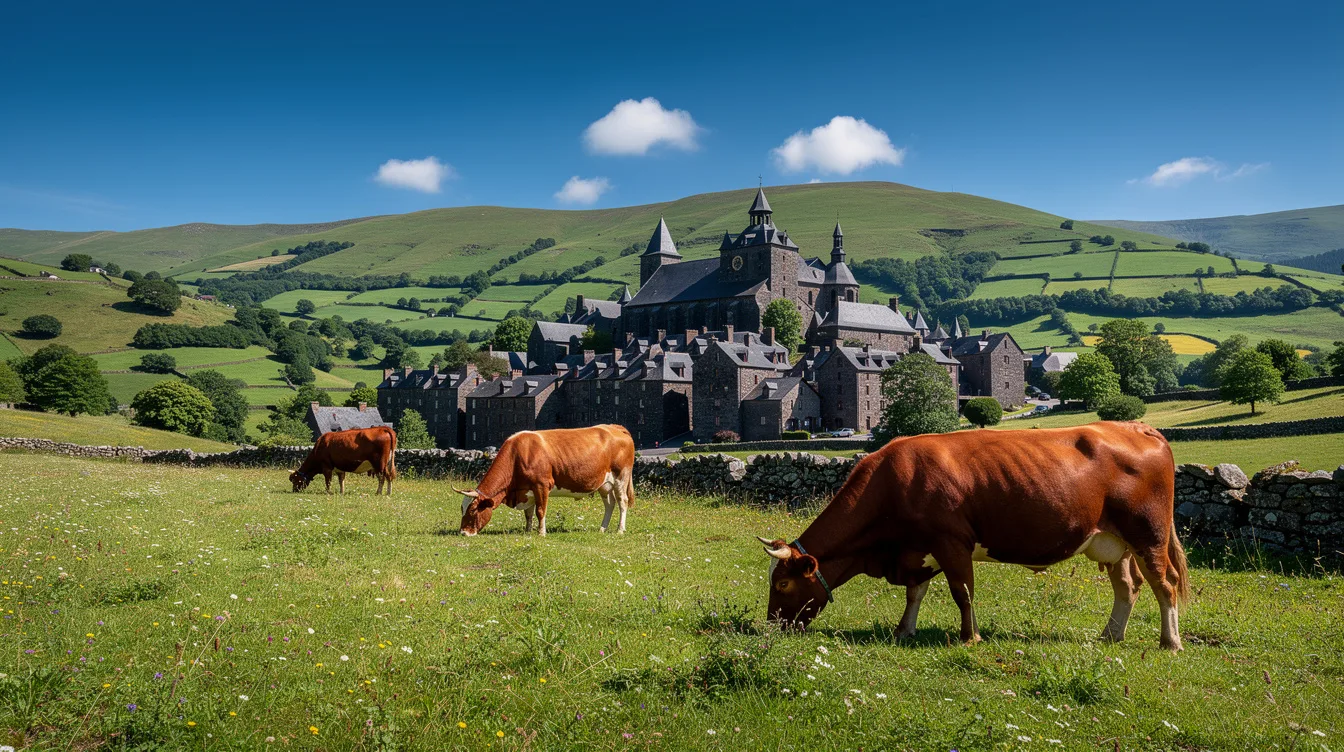
Salers gave its name to a cattle breed and to an AOC cheese because both grew from the same high Cantal country. The village is small, but its name carries far beyond its dark-stone streets.
You come here for the food story, then realize the setting explains it. At about 3,117 feet, Salers sits above pastureland where the air can feel sharp even when summer light fills the square.
A village name with two very different meanings
The Salers breed originated in this commune, and it remains easy to recognize in Cantal pastures. Its coat is mahogany-brown, its hair is long, and its pale horns curve in a lyre shape.
But the cheese is the stronger reason to linger. Salers cheese is a raw cow’s-milk cheese with an uncooked pressed paste, made only on farms, so you should expect differences from one producer to another.
That farm-only rule matters. It gives the cheese a local character without pretending every wheel tastes identical, and that variation is more interesting than a neat souvenir-counter version of rural France.
Why does the cheese carry AOC status?
The Salers AOC dates to 1961, and the cheese has held AOP status since 1996. Those designations make the village’s name more than a label, tying it to a specific way of producing cheese.
You’ll also find Salers beef on local menus, plus gentian aperitif and dishes such as truffade or aligot. The food is hearty, but the village itself doesn’t feel like a theme park built around it.
Dark volcanic stone, green pasture
Place Tyssandier-d’Escous is the natural starting point for a walk through the old center. Renaissance houses, private mansions, towers, slate roofs, and dark volcanic stone make the streets feel unusually consistent.
And the contrast is the point. The facades can look nearly black after rain, while the open ground beyond the village stays green and soft around the edges.
Take Rue Notre-Dame slowly. The center is compact and easy on foot, but you’ll want time to look up at the old lava-stone houses and pause where the view opens toward the Maronne valley.
Saint-Mathieu Church holds five 17th-century Aubusson tapestries, along with an entombment scene and a polychrome lectern. It’s a serious stop, not simply a quick church-door photograph between tastings.
Old gates and towers recall Salers’ fortified past. But the mood is quiet rather than dramatic, especially once you leave the square and hear only footsteps against stone.
The village is small, the Cantal beyond it is not
Salers lies about 26.1 miles north of Aurillac, in the Cantal and within the Auvergne Volcanoes Regional Natural Park. That location makes it a useful base for the wider mountain country.
You can head toward Puy Mary for broad views over glacial valleys and ridges. Or choose Puy Violent, the Col de Néronne, or gentler routes through the Maronne valley.
And you should treat the weather as part of the plan. Conditions can change quickly here, so bring a windproof layer, warm clothing, and suitable shoes even in summer.
The terrain gives Salers its pull, but it also sets a limit. This is not a nightlife destination, and anyone wanting constant activity after dark will likely find the village too still.
A half-day works for the village itself. Give it two to three nights if you want walks, farm visits, local meals, and time to let the surrounding ridges set the pace.
When Salers feels most like itself
May through October is the useful window for a visit. May and June bring intensely green pasture, while July and August have the broadest range of open activities and businesses.
But September and October may suit you better if crowds drain your patience. Autumn brings quieter streets and changing color, while the high setting keeps the village connected to the season outside its walls.
A weekly market takes place on Wednesday morning. It’s a practical reason to time your stay, though Salers is best approached as a place to wander rather than a checklist to finish.
By late day, the volcanic stone darkens again and the pasture views stretch beyond the last roofs. That is when a village that named a cow and a cheese feels most convincingly like the land around it.