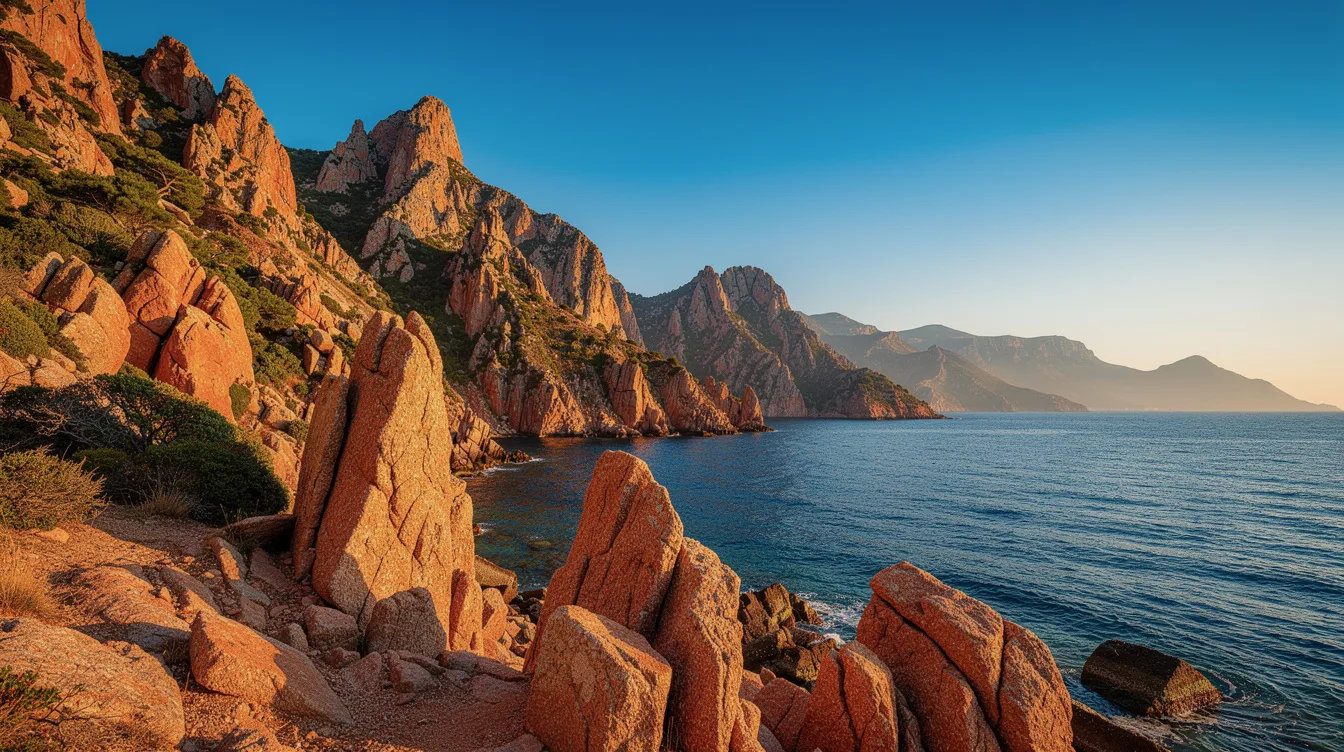
Piana rises above Corsica’s Gulf of Porto, where red-orange granite forms towers, columns, and strange weathered shapes above the sea. The reason is erosion: wind and water worked the granite into the Calanques de Piana, leaving rock walls that catch the late light like heated copper.
This is not a village you visit for a quick box-check. Its white houses sit in an amphitheater above the gulf, so even a slow walk near Sainte-Marie church keeps pulling your eyes back toward the water.
Why the granite looks red-orange above Porto
The Calanques de Piana are granite cliffs and sculpted rock formations within the UNESCO-listed Gulf of Porto ensemble. Their color becomes especially pronounced late in the day, when the low sun turns rose-colored surfaces toward copper and orange.
And the towers feel more dramatic because they rise directly over the gulf. You’re looking at hard rock cut into peaks and pillars by erosion, with the blue water below providing the contrast.
But don’t expect solitude on the road in summer. The D81 runs through the calanques between Piana and Porto, and its narrow bends can clog with traffic when everyone stops for the same view.
The D81 is the view, and the complication
The striking stretch begins about 0.9 miles after Piana when driving toward Porto. Take it slowly. The lanes tighten, parking is limited, and large vehicles are a poor fit for this road.
That inconvenience has one upside: you can’t rush through it. Pull over only where it’s safe, then let the cliffs do their work. Their rough faces change with each curve, while the sea flashes through gaps in the stone.
And go early or return late in the afternoon. Softer light improves the color, and lighter traffic makes the drive feel far less like a contest for pavement.
Piana gives the cliffs a human scale
The village has roughly 482 residents, which helps explain its quiet rhythm outside the busiest hours. It’s part of Les Plus Beaux Villages de France, though the appeal is less about polished spectacle than its position above the Gulf of Porto.
You can wander its white houses, stop near Sainte-Marie church, and look toward the Senino and Scandola peninsulas. But Piana isn’t packed with urban distractions, so come ready to spend time outside rather than shop-hop.
For water, Arone Beach lies within the commune and adds sand and swimming to a day dominated by stone. Ficajola is another cove in Piana’s territory, though the notes here are stronger on the wider setting than on logistics.
Can you hike beyond the roadside towers?
Yes. The short mule trail takes about 1.5 hours round trip, making it the sensible choice if you want a walk without turning the day into an expedition. Forest routes offer options from one to three hours among pines and chestnut trees.
But Capu d’Ortu is a different commitment. The route is listed at about 6 hours and reaches 1,965 feet, so it’s for travelers who want the day’s main event to be the climb, not the village.
The Château fort, or Tête du Chien, walk takes roughly 45 minutes round trip and delivers a Gulf of Porto viewpoint. That’s the better compromise for most visitors, especially after a morning on the D81.
Porto makes Piana easier to use as a base
Porto is 7.5 miles away, close enough to connect Piana with boat outings on the gulf. Excursions from Porto can show the calanques from the water and may continue toward Scandola, Girolata, or Capo Rosso depending on the route.
And seeing the cliffs from a boat changes the scale. From the road, the rock walls press close. From the water, they read as a long red-orange rim above the dark sea.
Piana works well for two or three nights if you want village evenings with Porto within reach. Still, the road conditions mean you should leave extra time, especially in July and August.
May, June, and September suit Piana best
May-June or September offers the better balance of agreeable weather and more manageable crowds. The D81 is still narrow, but you’ll have a better chance of enjoying its bends without a long line of cars behind you.
But summer visitors can still make it work by driving early and saving the calanques for late afternoon. The reward is simple: red-orange granite warming in the fading light, with the Gulf of Porto going dark blue below.