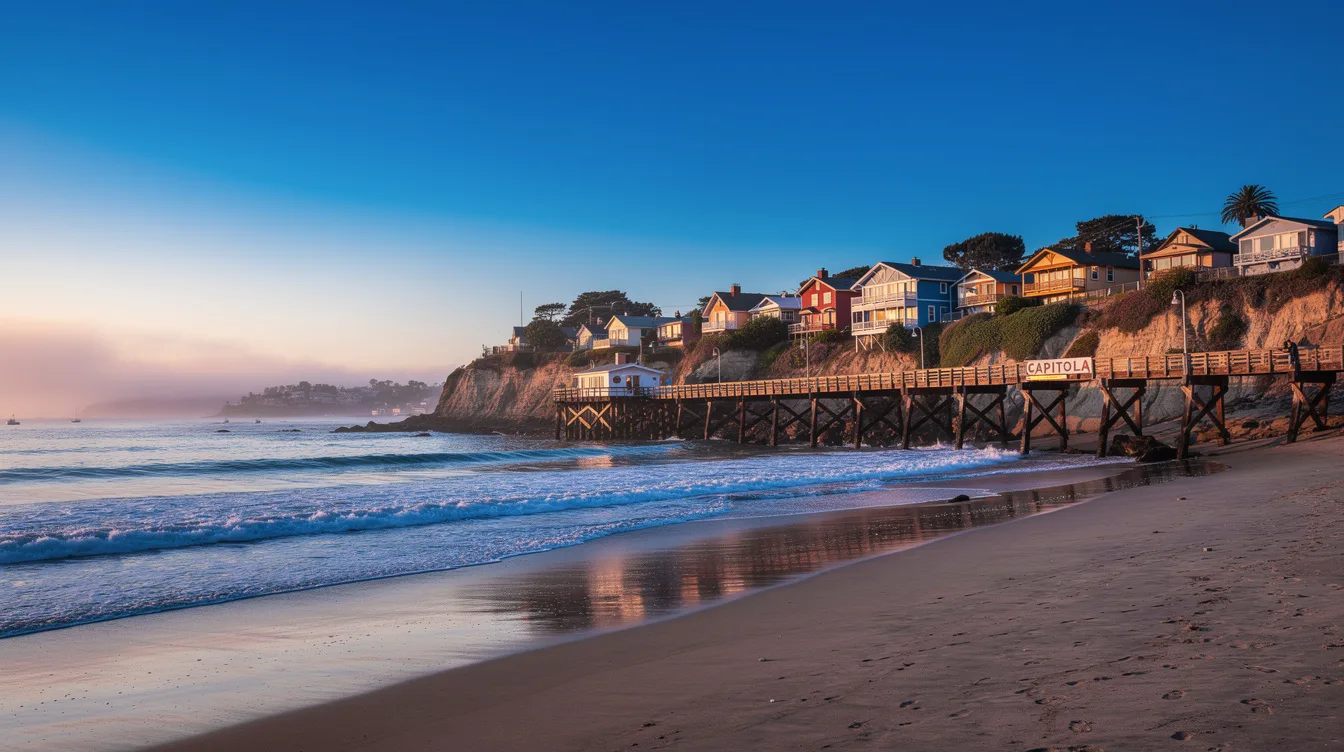
Capitola began as Camp Capitola in 1874, a tent-based escape beside Monterey Bay. That origin still explains the town’s appeal: it was built for lingering near the water, not rushing through a checklist.
About 5 miles south of Santa Cruz, Capitola sits on the bay’s north shore with its beach, creek, cafes, and waterfront homes pressed close together. You can cover the village easily, but you may not want to leave once the salt air settles in.
Camp Capitola made the coast the destination
In 1874, visitors came to Camp Capitola for a seaside stay rather than a quick stop. The town is widely promoted as California’s first beach resort, and that early ambition remains visible in its compact holiday-town rhythm.
And that history matters because the village still puts the shoreline first. You walk toward water almost immediately, then find restaurants, galleries, boutiques, and cafes folded into the same small waterfront core.
For travelers used to Santa Cruz’s bigger beach energy, Capitola feels more contained. It is tourist-oriented, but it isn’t built around noise or scale. You come here when lunch should take its time and a coastal walk should have no destination beyond the next view.
Capitola Village is small enough to slow you down
Capitola Village is the part of town that gives the old resort idea its present-day color. Waterfront homes with Venetian-style facades face the beach, while cafes and shops keep the lanes active without turning them into a theme set.
But don’t arrive expecting an all-day city itinerary. The village is compact, which is precisely why it works for a half-day: beach time, coffee, browsing, then a meal near the water before moving along the coast.
The setting also has a useful bit of geography. Soquel Creek runs through the village and meets the beach, so the town’s historic resort character feels tied to an actual waterfront rather than a road running beside one.
You can spend too long looking for an agenda here. Better to walk the Esplanade Park area, listen to the low wash of the bay, and let the close-packed buildings make the place feel like a coastal pause button.
The 855-foot pier earns the detour
The 855-foot Capitola Wharf is the town’s clearest invitation to stop moving. Benches look across Monterey Bay, and the length gives you enough distance from shore for the village to read as a neat strip of color behind you.
And you don’t need a big plan to enjoy it. Walk out after lunch, take a seat, and watch the bay change with the light. That’s a better use of Capitola than trying to squeeze every shop into an hour.
The beach below is sheltered at the mouth of Soquel Creek, which suits a relaxed coastal walk. It is not a remote stretch where you disappear for the day, but the easy access is the point when time is short.
Can Capitola work as a quick stop?
Yes. A half-day is enough for the beach, village, a meal, and the pier, especially if you are already traveling between Santa Cruz and Monterey. The trade-off is simple: this is a small-town reset, not a place with endless attractions.
Make it part of the Santa Cruz-Monterey coast
Capitola is roughly 40 miles north of Monterey, so it fits naturally into a longer coastal route. You can pair it with Santa Cruz, Natural Bridges, or Monterey and Carmel, then use Capitola as the softer stop between larger draws.
But its best quality is that it resists being treated as a mere connector. Santa Cruz can fill a day. Monterey and Carmel can fill more.
Capitola gives you a few slower hours, and the contrast makes a coastal itinerary feel less programmed.
On a practical note, check the City of Capitola’s official site for current parking, permits, events, and municipal notices before you go. The town’s small scale is appealing, though it also means details like access can shape a short visit.
By the time you leave the wharf, the beach and village sit close together again, much as they have since Camp Capitola opened in 1874. The bay is still there at the end of the walk, carrying the sound of the water back toward town.