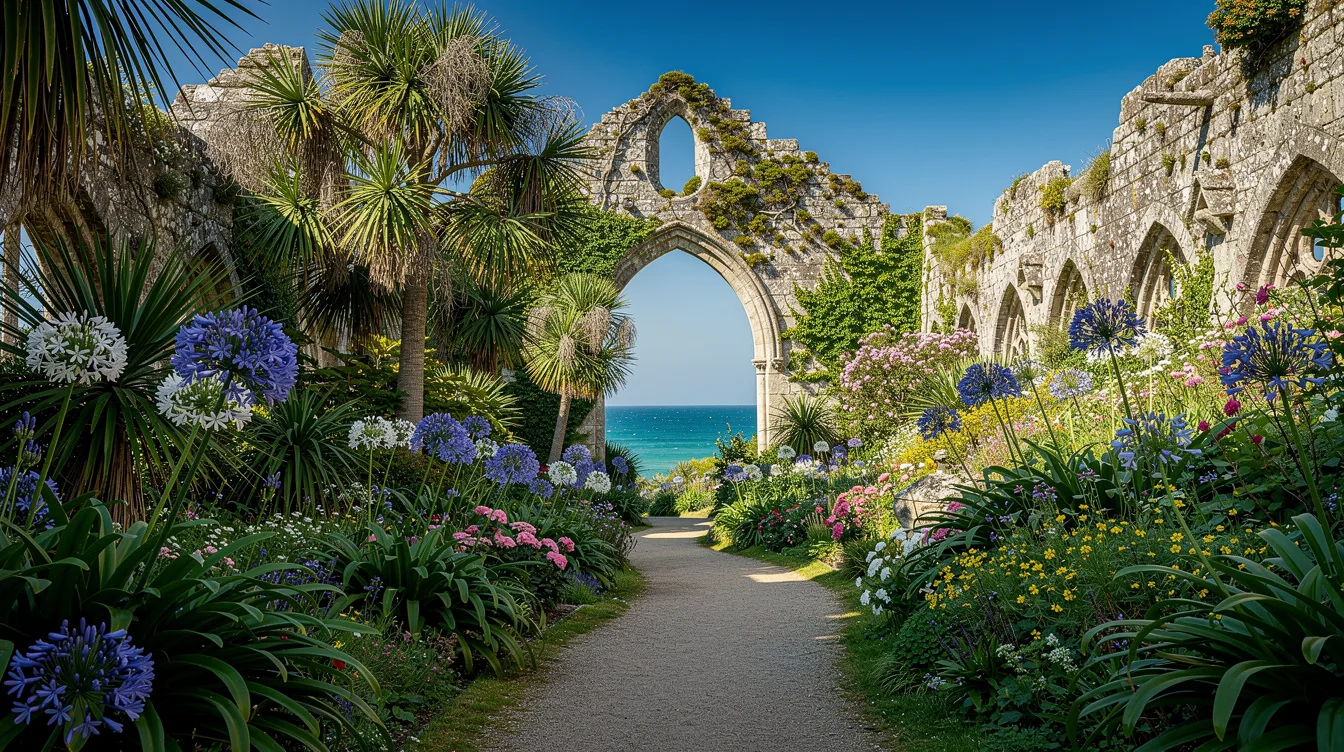
Tresco Abbey Garden answers the question before you reach its gates. On this small English island, more than 20,000 subtropical plant species grow around the ruins of a Benedictine priory because Tresco has an exceptionally mild climate, even though it sits roughly 28 miles off Cornwall’s coast.
That contrast is the point. You come expecting Atlantic weather and granite, then find foliage that feels improbable beside old stone. And the garden is not a side attraction.
It is the reason many visitors make the crossing.
Ruined priory walls, plants that should feel impossible
The priory ruins give the garden its structure, while the plants do the surprising work. More than 20,000 subtropical species fill a setting where weathered masonry and soft leaves meet. It feels curated, but the climate does much of the heavy lifting.
And you do not need a botanical education to understand the appeal. The old walls make each turn feel framed, while the mild air supports growth that would look out of place on much of mainland England.
There is a trade-off in that polish. Tresco is managed as a single family-run estate, so it has a more resort-like character than some neighboring Scilly islands. It is peaceful, but it does not pretend to be wild everywhere.
Why can subtropical plants grow here?
The exceptionally mild climate is the documented answer. Tresco lies in the Isles of Scilly, off the Cornish coast, and that setting supports the garden’s unusually broad subtropical collection around the Benedictine ruins.
But the garden works because it is more than a warm-climate curiosity. The priory remains add age and restraint. Without them, this could be an impressive collection.
With them, it becomes the kind of place that makes you slow down.
Tresco is small enough to leave the car behind
Tresco is about 2.5 miles long and 1 mile wide, so walking and cycling are not ambitious plans here. Visitor cars are not part of the experience. You can move at island pace, with no need to chase a parking space.
And that compact scale changes the day. You might begin among garden paths, then find pale sand and clear water at Pentle Bay or Appletree Bay. The island is orderly, but the coast keeps interrupting the order.
The south feels more sheltered, while the north is exposed to granite and Atlantic heath. That difference matters. You can seek a quieter beach mood, then turn north for a sharper and windier walk without crossing much ground.
The northern forts give the island some edge
Cromwell’s Castle and King Charles’s Castle sit on Tresco’s wilder northern side. Both are Civil War-era coastal fortifications, and they give a historical counterweight to the garden’s cultivated calm.
But do not expect a grand city-style history circuit. This is an island experience, with old defenses set against exposed coast and heath. The appeal is the change in atmosphere, not a long list of interiors or museums.
And if birds matter to you, the Great Pool and Abbey Pool attract birdlife. The setting asks for patience. A stretch of water, a quiet pause, and the low sound of wind can be enough of a plan.
Getting to Tresco requires one extra crossing
Most travelers first reach St Mary’s, the main island in the archipelago. Ferries run there from Penzance, while Skybus flights operate from Land’s End, Newquay, and Exeter. From St Mary’s, inter-island boats connect onward to Tresco.
Helicopter travel from Penzance may also be available, depending on the season and operator. That extra step is a useful filter. You will not arrive by accident, which helps explain Tresco’s low-key rhythm.
And once there, New Grimsby and Old Grimsby are the main settlements. Accommodation centers on cottages, apartments, and the New Inn. It suits travelers who want coastal walks and a quiet upscale break, not a packed itinerary.
A garden island that does not need to shout
Tresco is the second-largest island in the Scilly group, yet its population is about 152. That small scale makes the garden’s abundance feel even stranger, especially when the white sand and Atlantic heath are close by.
But keep your expectations honest. There is no need to rush, and there is little reason to. By the time you leave the priory walls for the coast, salt air has replaced the garden’s softer green stillness.
At the end of the day, the island’s logic becomes clear: ruined stone, mild air, and plants growing where you do not expect them.