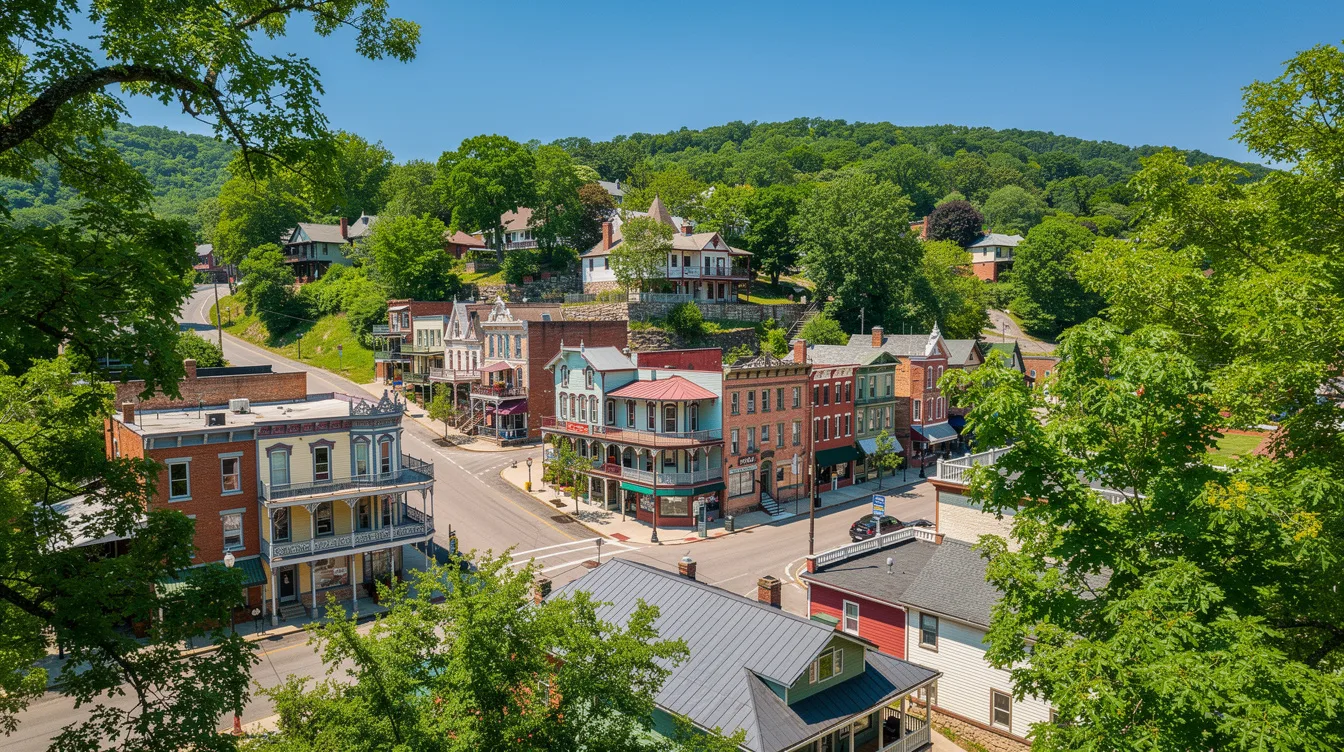
Eureka Springs isn’t a town with one preserved courthouse or a single postcard block. In 1970, the entire city within its borders at the time entered the National Register of Historic Places as the Eureka Springs Historic District. That makes the town itself the landmark.
You feel the difference underfoot. Streets tip uphill, curve around the Ozark hills, then drop toward Victorian storefronts built in local stone. It’s charming, but it asks you to watch your step and leave the heels at your hotel.
A whole town, not one historic stop
The central historic loop runs 5 miles, following the hills instead of fighting them. Few streets meet at right angles, and there are no traffic lights. Because the terrain dictated the street plan, a short walk can feel pleasantly improvised.
And that’s the pleasure of downtown: you don’t tour it in a straight line. You drift past boutiques, galleries, cafés, Victorian cottages, and manor houses, then find another steep stairway or a doorway that opens onto an unexpected level.
The city’s past began with springs believed to have healing qualities. Founded in 1879 as a resort town, Eureka Springs drew visitors seeking the water, then grew quickly into a Victorian-era escape.
But don’t mistake preserved architecture for a frozen town. Independent shops and spa services keep the center active, while its arts scene gives the streets an eclectic edge. It’s tourist-oriented, certainly, yet it doesn’t read like a row of souvenir facades.
Why the hills make the walk better
The streets rise and fall with the topography, so the town keeps revealing itself in fragments. One building may have entrances at more than one floor, and the famous Basin Park Hotel has an emergency exit at ground level behind the building’s fifth floor.
You’ll want to wander the historic commercial downtown before committing to a full agenda. Stone walls catch the shifting light, and the bends in the road keep cars from dominating the view. But the hills are real, especially if you’re carrying shopping bags.
Parking can be limited when visitor traffic builds. The trolley is often easier than driving downtown, which matters here more than in a typical small Arkansas town. Let the car rest, and let the slopes set the pace.
Beyond downtown, forest and water change the mood
Outside the center, Thorncrown Chapel puts glass and wood in a forest setting. It’s a useful counterpoint to the dense Victorian streets: less commerce, more quiet, and a reason to get out from beneath the town’s close-set roofs.
And Beaver Lake is nearby for boating, fishing, kayaking, and lakefront scenery. That switch from steep streets to open water is part of Eureka Springs’ appeal. You can spend the morning looking at architecture, then head somewhere the horizon finally widens.
The Blue Spring Heritage Center combines springs, gardens, and Trail of Tears history. It’s not a substitute for learning that history in depth, but it adds context to a town whose identity began with water.
For another outing, Turpentine Creek Wildlife Refuge is a big-cat sanctuary in the area. You should plan around your interests rather than trying to fit every attraction into one rushed day. Eureka Springs rewards slow wandering more than checklist travel.
Getting there takes a car, then a little restraint
Eureka Springs sits in the Ozarks of northwest Arkansas, near the Missouri border. Northwest Arkansas National Airport is roughly 50 miles away, and you’ll want a car after landing. This is a drive-to destination first.
But once you’re in town, driving can become more trouble than freedom. The grades, limited parking, and winding streets make walking and trolley rides the smarter choice for downtown. Save the car for the chapel, lake, or refuge.
The town had 2,166 residents in the 2020 Census. That small population helps explain the intimate scale, though it also means popular periods can feel full quickly. You won’t find a big-city grid or big-city ease.
Spring and fall give the town its best balance
Spring is greener and somewhat quieter, so it’s the better pick if you want more room on the sidewalks. Fall brings foliage and heavier visitor numbers. Both seasons suit the town, but they offer different versions of it.
And if you come in fall, book early and expect company. The reward is that Victorian stone, hillside trees, and crooked streets all seem to pull your attention in the same direction. The trade-off is less spontaneity.
By evening, the slopes soften into shadow, storefront lights come on, and the next turn in the road still looks like it might lead somewhere new.