Ten Sleep is a town whose name begins with a journey. An Indigenous travel measure placed this Wyoming stop 10 days’ travel from Fort Laramie, Yellowstone National Park, and the Indian Agency on Montana’s Stillwater River.
That is a lot of ground for a name to carry. And it gives the town more pull than its size suggests, because you arrive knowing the place was once measured in rests, not road signs.
Ten sleeps, not ten miles
The old measure meant ten nights on the route, or “ten sleeps.” You can still feel the idea behind it: this is western Wyoming, where travel has always depended on terrain, weather, and how much daylight remains.
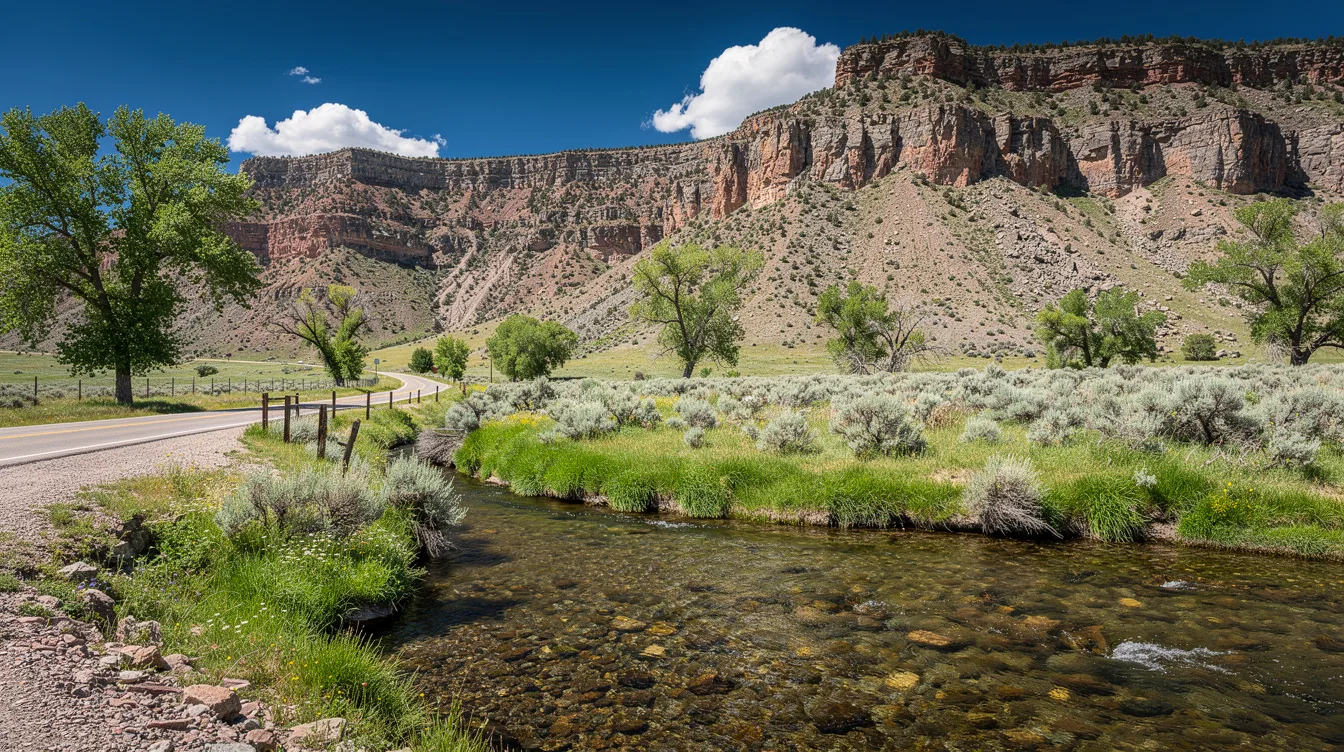
But don’t mistake that history for a theme-park story. Ten Sleep Canyon sits at the western entrance to the Bighorn Mountains, so the town feels like a real threshold between the Bighorn Basin and higher country.
You should come for that sense of arrival. My view: the name is the best reason to pause here, because it turns an ordinary road stop into a reminder that distance used to be lived one night at a time.
The town’s archaeology includes arrowheads, pictographs, and petroglyphs. And the surrounding ground holds fossil specimens of dinosaurs, plants, and sea life, proof that this quiet corner has never had just one story.
A tiny town with a long western memory
246 people lived in Ten Sleep at the 2020 census. That small count matters, because the practical center is compact: cafes and restaurants, bars, motels, a campground, a bank, a gas station, and a historic hardware store.
You won’t find endless choices, and that’s the trade-off. But the town has the useful basics for a night or two, with a ranching community still shaping the rhythm of daily life.
Ten Sleep Mercantile, also called Ten Sleep Hardware, dates to 1905. Its tall, narrow commercial form belongs to the sort of Main Street where a single storefront can still anchor the block.
There’s also a harder chapter. In March 1909, the Spring Creek Raid brought one of the last conflicts of the Sheep and Cattlemen’s War here, when cattlemen attacked sheep herders and their flock.
US Highway 16 makes the approach part of the trip
U.S. Highway 16 runs through Ten Sleep, about 26 miles east of Worland and 59 miles west of Buffalo. You can use the town as a break between those two points, but the canyon makes it worth giving more than a fuel-stop hour.
And the elevation is about 4,426 feet, which puts the town below the Bighorn Mountain country while keeping that high-country edge close. The terrain can change sharply over a small area, so bring layers even when the day begins warm.
You’ll find the Ten Sleep Fish Hatchery about 7.5 miles east of town on US-16. The Cloud Peak Scenic Byway also passes through this part of Wyoming, tying the drive to the canyon and the forest beyond.
My advice is simple: don’t rush the approach. The road has more character when you let the open basin set the pace.
Summer is when Ten Sleep gets louder
Summer is the season to aim for, especially around the Fourth of July. The annual celebration includes a two-day rodeo and parade, and the main street closes to through traffic for events and live music.
But this isn’t a big-city festival schedule. You should plan around the limited scale, because a town of 246 people can feel lively for an event and very quiet once the crowd thins.
NoWoodStock returns annually on the second weekend of August. It brings music to town, while Ten Sleep Brewing adds another easy stop after a day outside.
The recreation is broad but grounded: rock climbing in the canyon, hiking, camping, fishing, wildlife viewing, and scenic driving. You can choose your own pace, though the Bighorn Mountains are the real draw, not a packed itinerary.
The right kind of overnight stop
Ten Sleep works best for travelers who want a place with a reason behind its name. You get a very small Wyoming town, a canyon at its edge, and a route shaped by older ways of judging distance.
And it asks for a little patience. There are only a handful of businesses, but that scarcity keeps the town from becoming a polished roadside version of itself.
By the time the light falls across the road toward Ten Sleep Canyon, the old measure begins to make sense: not miles, not minutes, just one more sleep before the next stretch of country.