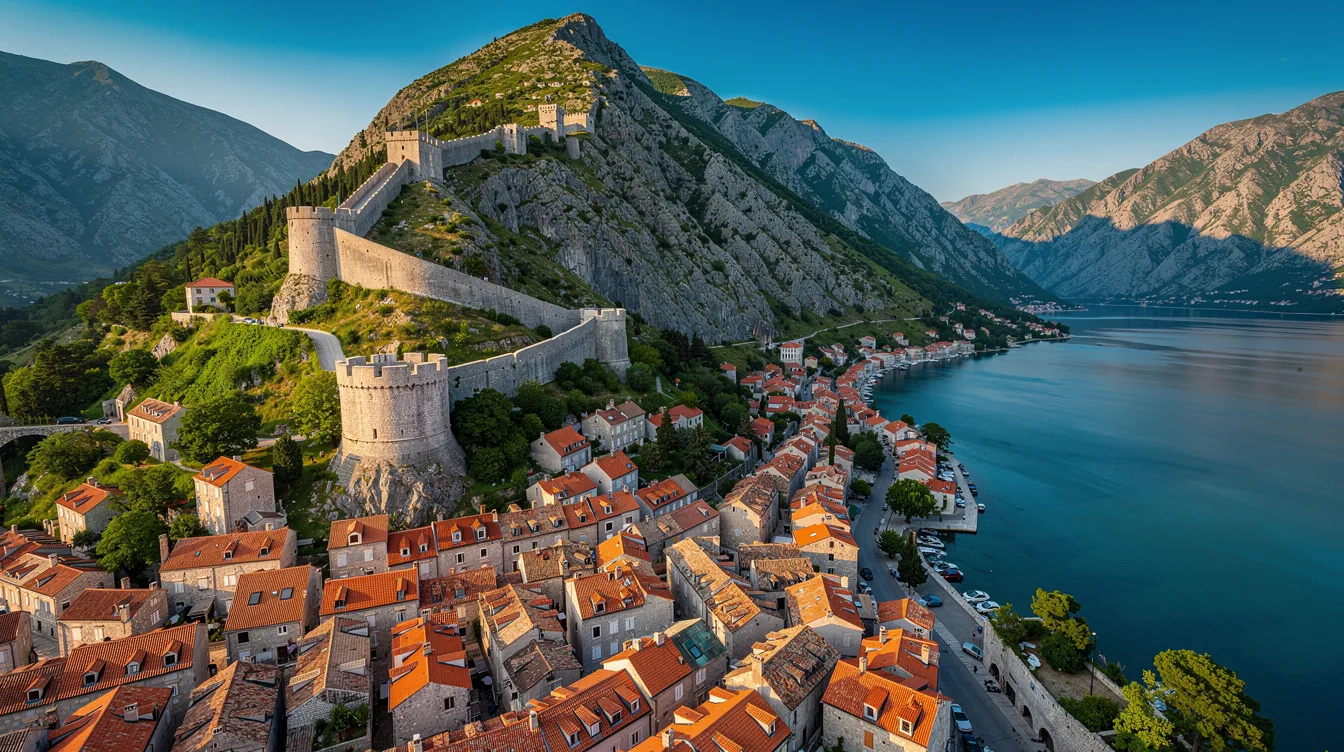
Kotor sits at the end of Montenegro’s Bay of Kotor, where steep mountains press close to the water and old stone streets disappear behind fortified gates. Its promise is unusually literal: 2.8 miles of ramparts climb directly above the old town.
That wall is the reason to come. It turns a compact Adriatic stop into a place with real vertical drama, and you can see the route rising from the tiled roofs toward the fortress of Saint John.
The walls are Kotor’s main event
The fortified old town is a double UNESCO World Heritage Site, first listed in 1979 and later included within the Venetian Works of Defence listing. That status sounds formal, but the payoff is immediate when you walk through Stari Grad’s paved lanes beneath the enclosing walls.
And the ramparts don’t politely frame the town at street level. They run upward above it, which makes the city feel smaller and the surrounding bay feel larger with every turn of your head.
You should plan to climb to Saint John Fortress. The ascent takes about 45 minutes to 1.5 hours, depending on your pace, so it’s less a quick lookout than a proper effort. But the view is the point: Kotor’s roofs sit below, and the bay curls away between mountain slopes.
The climb has a trade-off. It’s popular for good reason, and summer cruise arrivals can make the old town crowded, especially from 10 a. M.
To 4 p. M. Go later in the day, when the stone holds less heat and the streets begin to loosen up.
Stari Grad rewards slow wandering
Inside Stari Grad, Kotor works best without a checklist. Wander the small squares, Venetian-era palaces, cafés, and churches. The paving underfoot and the close-set stone buildings make even a short walk feel deliberately maze-like.
But don’t skip Saint Tryphon Cathedral. Built in 1166, it gives the old town a fixed historical center amid all those detours. The Maritime Museum is another useful stop if you want context before heading out onto the bay.
You’ll notice cats around town, too. They’re a local symbol, with Cats’ Square, cat shops, and a cat museum all part of the city’s curious daily texture. It’s charming, though some animals may be in poor health, so keep the moment in perspective.
And Kotor is lively, but it can feel compressed when ships are in port. That’s why staying within the walls is best for atmosphere, while Dobrota makes more sense if you want quieter evenings, bay views, and often better value.
Give the bay a second day
Two nights is the smart minimum. Use one day for Kotor itself, then spend the next on the water or around the shore. That pace leaves room for the fortress climb without turning every stop into a rushed photograph.
Perast and the island church of Our Lady of the Rocks are the classic boat outing. The bay has a calmer rhythm away from Kotor’s gates, and the boat ride changes the perspective completely: walls become a thin line beneath the mountain.
You can also use that extra day for Lovćen and Cetinje, or add Tivat, Budva, or a hike if you have three days. A car helps with the wider bay and the rest of Montenegro, but parking near central Kotor is difficult in season.
From Tivat, Kotor is nearby, making the nearest airport a practical entry point. Podgorica and Dubrovnik are alternatives, although travel from Dubrovnik can mean waiting at the Croatia-Montenegro border.
May, June, September, and October make sense
The best timing is May-June and September-October. Activities are open, the weather is more comfortable, and the crowds are easier to manage. July and August are busier, particularly during cruise-ship hours.
And bring some cash for small purchases. Montenegro uses the euro, while cards may not suit every small business. Book your key sights around the ship schedule if you’re visiting in high season.
Kotor can be busy, and the climb asks something of you. By evening, though, the last cruise crowds thin out, the stone lanes cool, and the walls above town fade into the mountain shadow.