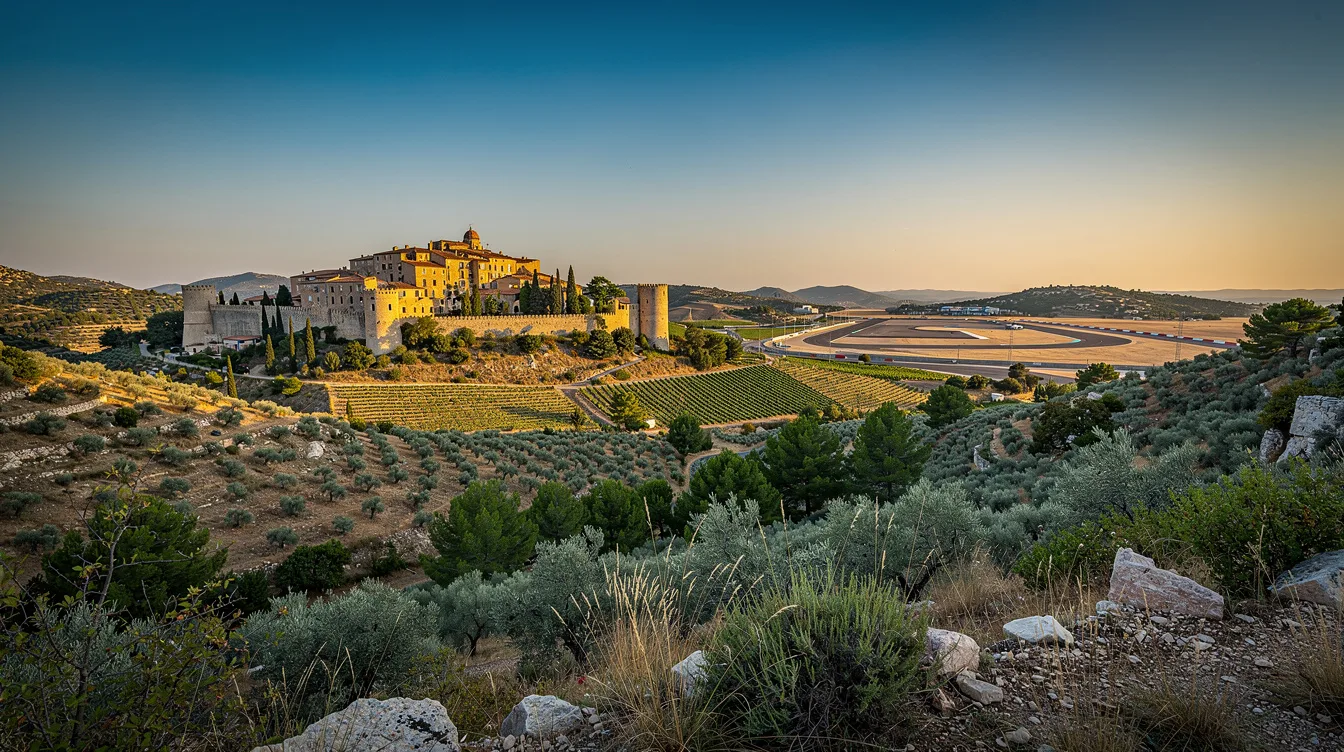
Le Castellet is the French village that put a rural corner of the Var on Formula 1’s calendar. The 14.3 miles from Toulon lead to a hilltop old town, vineyards, and the Circuit Paul Ricard, where the French Grand Prix returned from 2018 through 2022.
And that contrast is the reason to come. You can spend the morning on stone lanes and shaded squares, then watch the road toward a major motorsport venue. It feels Provençal, but the circuit gives the commune a sharper edge.
Two Le Castellet experiences share one commune
But the village and the circuit are separate experiences. The old center is compact and pedestrian, with paved lanes, fortified gates, ramparts, small squares, artisan workshops, and shops. For me, that makes it better suited to a slow half-day than a rushed stop.
And the Circuit Paul Ricard sits a short distance from the old village on the commune’s plateau. You’ll find motorsport events and high-end hotels there, while the historic center leans toward restaurants, views, wine, and quiet wandering. Check the circuit calendar before driving in, because event traffic can change the feel of the visit.
If you’re planning a broader trip, pair the village with our guide to France travel before choosing your route.
Why the 1970 circuit still matters
The circuit was inaugurated in 1970, then became the setting for the French Formula 1 Grand Prix from 2018 to 2022. That fact answers the title’s promise, but it also explains why this small commune appears in international racing coverage.
And you don’t need to attend a race to understand the divide. The old village asks for comfortable shoes and an unhurried pace, while the circuit belongs to scheduled events, engines, and grandstands. One is intimate, the other is built for speed.
But the circuit isn’t the only reason to visit. The village’s position near La Cadière-d’Azur and Le Beausset makes it a useful base for exploring the surrounding Var, especially if you want to connect heritage with wine.
What you’ll see inside the old village
The historic center is the strongest part of the visit. You’ll pass through fortified gates and along ramparts before reaching the Château, which now houses the town hall. From its esplanade, the view reaches toward the Sainte-Baume massif and the vineyards below.
And the details reward a slower walk. Look for the Saint-Sauveur church, Place de l’Ourmeau, and the Trou de Madame. The village is officially among Les Plus Beaux Villages de France and also carries the Station Verte label, but its appeal comes from how easily the center can be explored on foot.
If you want an opinion, here it is: arrive before the heat and let the lanes set the schedule. You’ll enjoy the shaded corners more before summer visitors fill the small center.
Bandol wine gives the visit its local shape
Beyond the walls, vineyards tied to the Bandol appellation spread across the nearby countryside. The village’s old stone and the wine estates belong to the same visit, so you don’t have to choose between a cultural stop and a taste of the Var.
But this isn’t a place to force into a packed itinerary. Plan a morning arrival, walk the village, eat there or in La Cadière-d’Azur, then visit a nearby Bandol estate if one fits your schedule. You’ll get more from the day by leaving room for the views.
And spring or autumn is my preferred timing. The setting feels easier then, while summer brings heavier visitor numbers, restaurant reservations, and more pressure around parking.
How to plan your half-day in Le Castellet
You can cover the main village in a half-day, especially if you arrive early. Start with the historic center and ramparts, stop for lunch, then decide whether to add a wine visit or continue toward Bandol, Sanary-sur-Mer, or the coast.
And the coast is generally about twenty minutes away by car, depending on traffic. That makes Le Castellet remote enough to feel distinct, but not difficult to add to a Var itinerary. The practical address is 83330 Le Castellet.
But reserve a restaurant in summer and check the circuit schedule before setting out. By late afternoon, the village settles back into stone walls, warm pavement, and the long view over the vines.