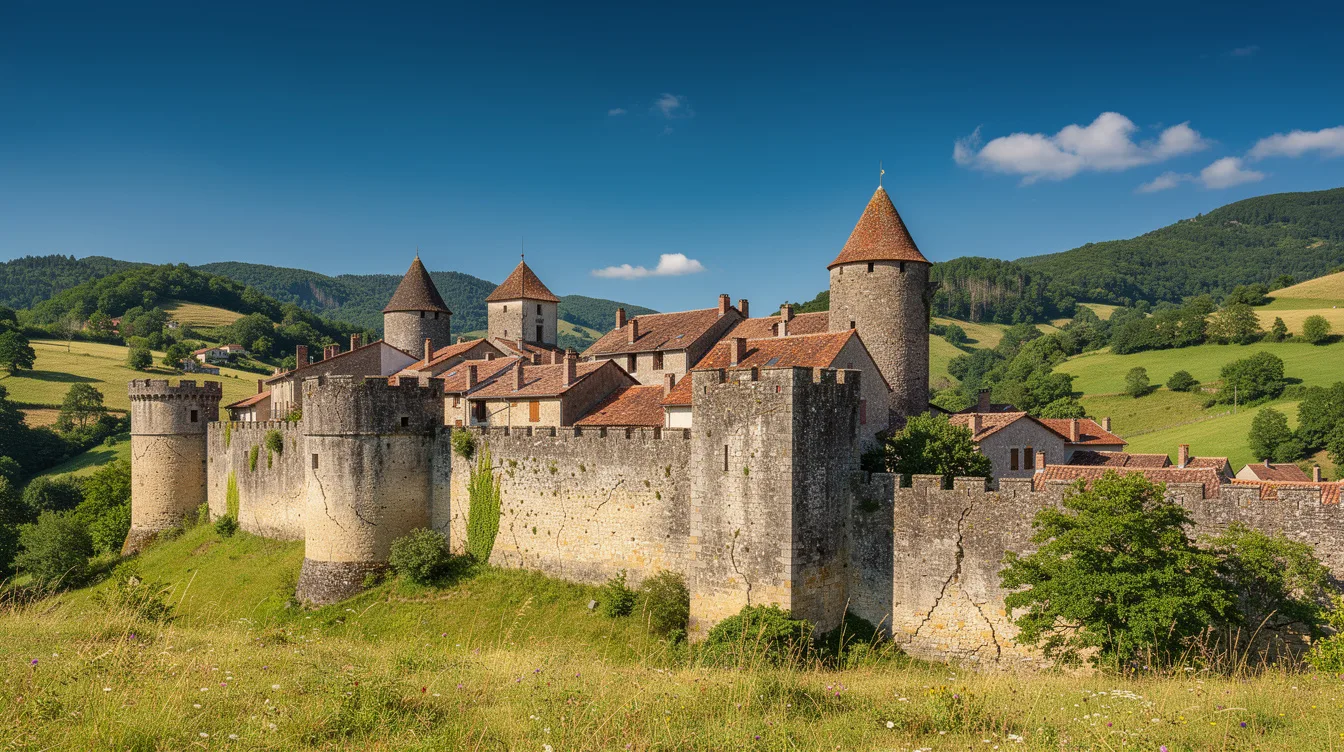
Le Malzieu-Ville has about 745 residents, yet this small village in northern Lozère belongs to Les Plus Beaux Villages de France. That distinction makes sense once you reach the old center, where fortified gates, stone houses, towers, and narrow streets still read as one medieval town. But don’t expect a large attraction with a long checklist.
The pleasure here is slower, and you can understand the place in a half-day or a full day.
Why the walls matter more than a single monument
The village’s strongest feature is its continuity. The medieval ramparts, monumental gates, towers, church, and old houses form a coherent historic center rather than a lone building surrounded by modern streets. And because the fortifications remain part of the town, you feel the defensive logic as you walk.
Look closely at the stonework, then follow the streets through the old center. But the village isn’t a museum set aside from daily life, and that gives the visit its appeal. You can pause beside a wall, hear the ordinary sounds of the town, and still see why this was once a fortified place.
Le Malzieu-Ville sits at about 2,822 feet above sea level, at the foot of the Margeride. That elevation shapes the setting without demanding a mountain expedition. And if you prefer history with a manageable physical pace, this is the kind of stop that rewards looking up rather than rushing onward.
How do you reach Le Malzieu-Ville?
Access is straightforward by road. From the A75, take exit 32 and continue on the departmental roads toward the village. From Clermont-Ferrand, the journey takes about 1 hour 30 minutes, according to the supplied travel information.
But the drive is part of the change in rhythm, as the route leads into the northern Lozère and the Truyère valley. You should plan this as a deliberate stop, not a quick photograph from the roadside. And because the village itself is compact, arriving with a few unhurried hours works better than trying to force it into a rushed itinerary.
Can you make it a short visit?
Yes. A half-day is enough to walk the historic center and see the main heritage features. Still, you may want a full day if you like to linger over the streets, the church, the fortified entrances, and the river area.
The Truyère adds room beyond the old center
The village isn’t only about walls and medieval architecture. The Truyère runs near Le Malzieu-Ville, with leisure spaces close to the village and room to extend your walk beyond the old center. That change matters because the visit shifts from enclosed streets to open river surroundings.
And if you need a pause after exploring the gates and houses, the riverside gives you one without leaving the area. You can use the village as a small base for seeing more of the Margeride, where hiking, cycling, and outdoor time are part of the local setting.
The contrast is useful: the historic core feels contained, while the valley gives the day more breathing space. But the sources don’t specify a season, so you shouldn’t build your plans around an assumed summer window. Choose your timing for the kind of walking you enjoy, then check conditions before setting out.
What does Gévaudan add to the story?
Le Malzieu-Ville lies within the historic area associated with the Bête du Gévaudan. That connection gives the village an atmospheric layer beyond its walls, especially if you already know the old Gévaudan stories. And you don’t need a dramatic reenactment to feel the subject in the background while walking the stone streets.
Keep the distinction clear, though. The fortifications are visible heritage, while the Bête belongs to the region’s legends and historical memory. But together they make the visit feel more textured than a simple architectural stop, particularly when the streets grow quiet.
Use the village as a northern Lozère base
Le Malzieu-Ville works best when you give it a little space in your itinerary. From here, nearby outings commonly associated with the area include the Réserve des Bisons d’Europe and the Parc des Loups du Gévaudan, along with the wider Margeride. You can keep the village as your cultural anchor, then spend another part of the day outdoors.
That said, don’t arrive expecting a packed resort schedule. Its strength is the combination of a compact fortified center, a valley setting, and access to northern Lozère’s wider attractions. And by the time you finish your walk, the best detail may be the simplest one: old stone, quiet streets, and the Truyère nearby.