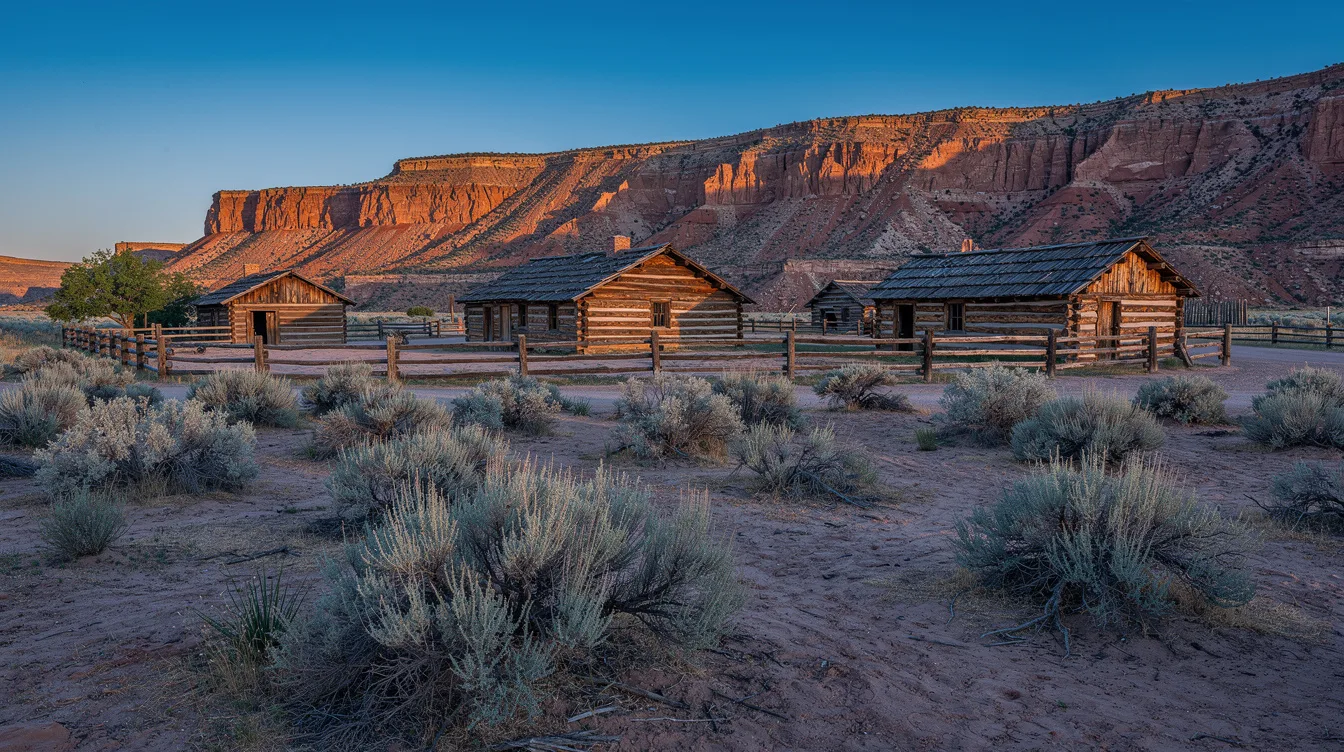
Bluff has about 240 residents, but its history is bigger than its population. This southeastern Utah outpost is home to Bluff Fort Historic Site, a free reconstruction tied to the pioneers of the Hole-in-the-Rock expedition who founded the fort in 1880.
And that story gives the town more weight than a quick roadside stop. You can stand among reconstructed buildings, then look out toward red sandstone cliffs and understand why this remote corner of the Four Corners still feels like an arrival.
The 1880 fort is the reason to stop
Bluff Fort Historic Site directly answers the town’s central claim. It recalls the fort founded after Mormon pioneers from the Hole-in-the-Rock expedition reached Bluff in 1880, so this isn’t history pasted onto a generic desert town.
But set expectations correctly: it is a reconstruction, not a preserved nineteenth-century streetscape frozen in place. The visit is free, which makes it an easy stop even if Bluff is only one night on a larger Utah route.
The settlement story lands because the setting still feels exposed. Red cliffs rise around town, and the San Juan River runs nearby, lending a green-edged contrast to the dry high-desert air.
And if you’re drawn to places where history has a physical anchor, this is more satisfying than reading a marker from a car window. The fort gives the Hole-in-the-Rock connection a location you can actually walk through.
Two sandstone towers announce Bluff
At the northeast entrance, Navajo Twin Rocks make Bluff instantly recognizable. The paired sandstone towers are the visual cue that you’ve arrived, and they’re the kind of formation that makes even a practical fuel stop feel briefly cinematic.
Bluff sits in the Four Corners region. The high-desert setting doesn’t spare the town from summer heat, so spring and fall are the better choices for walking around and driving beyond town.
But Bluff is never busy in the way nearby marquee destinations can be. There are hotels, motels, B&Bs, restaurants, and a few shops, though you should stock up before heading toward more isolated country.
The town also lies along U.S. Highways 191 and 163. That positioning is why Bluff works so well: it breaks up the route between Moab and Monument Valley without making you feel removed from the road trip.
Petroglyphs and old homes reward a slower morning
Sand Island Petroglyphs are among Bluff’s easiest cultural stops. The panels include human figures, animals, and older motifs, and their accessibility means you don’t need to turn the visit into an all-day hike.
And that matters when the sun is high. You can pair the petroglyphs with time near the San Juan River, then return to town before the heat turns a pleasant walk into a chore.
The Bluff Historic District adds another layer, with homes from the late nineteenth and early twentieth centuries. Walk or bike through it slowly, because the appeal is in the accumulated details rather than a single headline attraction.
But don’t expect a town built for nonstop entertainment. Bluff’s strength is its quiet pace, and the faint crunch of gravel or the broad red walls beyond the street often do more than another scheduled activity could.
Use Bluff as a Four Corners base
Monument Valley, Valley of the Gods, Goosenecks State Park, Natural Bridges National Monument, Bears Ears National Monument, and Four Corners all sit within roughly an hour’s drive, depending on the route and destination. That makes Bluff a sensible base for one or two nights.
And you can choose your day according to mood. Head toward Valley of the Gods and Goosenecks for open desert roads, or look toward Bears Ears and Cedar Mesa for hikes, canyons, and archaeological heritage.
Sand Island Campground sits near the San Juan River west of town for travelers who want to stay closer to the river. Otherwise, Bluff’s lodging options offer a useful reset between bigger drives.
What should you plan before leaving town?
Download offline maps, carry water and fuel, and make sure your tires suit any unpaved route you intend to take. Mobile service can be unreliable away from the main highways, which is manageable if you prepare before the signal drops.
But the practical limits are part of Bluff’s appeal. It is small, and it asks you to arrive ready, so the surrounding country still feels spacious rather than overmanaged.
By evening, the sandstone turns dark against the open sky, the road noise thins, and Bluff goes back to being a town of 240 people beside the San Juan River.