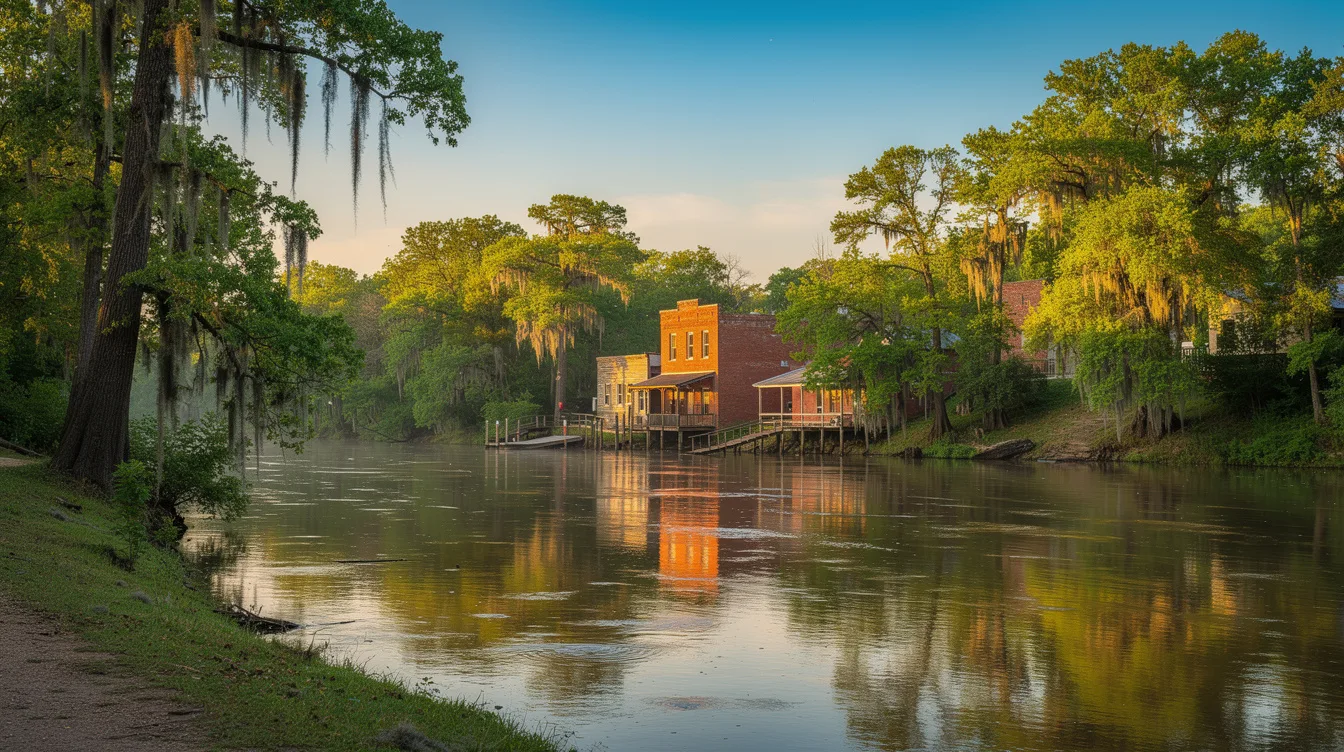
Jefferson is the Texas river town where more than 40 bed-and-breakfasts meet a past shaped by steamboats. It sits in the Piney Woods near Louisiana.
And the central story is bigger than the town suggests. In the mid-19th century, Jefferson became an inland port on Big Cypress Bayou because the Great Raft, a massive natural logjam on the Red River, created navigable conditions for steamboats carrying passengers and goods.
Steamboats made Jefferson a commercial town
And you can still read the town through that river history. Steamboats connected Jefferson with Louisiana and New Orleans, turning this inland settlement into an important commercial port during the middle of the 19th century.
But the river trade didn’t last. Navigation conditions changed, and the Texas & Pacific railroad bypassed Jefferson in the 1870s, so the town’s commercial importance faded instead of expanding into a larger city.
That decline is part of Jefferson’s appeal now. The town feels quiet, but not lifeless. You can walk the same streets, then imagine freight and passengers once moving through them.
Nearly 100 historic landmarks survived
And Jefferson’s greatest advantage is what the railroad missed. The town has nearly 100 historic landmarks, including many listed on the National Register of Historic Places, so its past isn’t confined to one museum.
But preservation doesn’t mean every building feels polished or formal. Antebellum and Victorian houses line the historic center, giving the town a lived-in quality.
You should explore on foot because the details reward a slower pace. For maps and current visitor information, the official Visit Jefferson Texas site is the sensible place to start.
More than 40 B&Bs change the weekend equation
And the town’s lodging is unusually central to its identity. Jefferson is often called the Bed and Breakfast Capital of East Texas, with more than 40 bed-and-breakfasts offering a reason to stay overnight instead of rushing through.
But this isn’t a destination built around a long list of attractions. You come for an atmospheric weekend of old houses, antiques, historic lodging, and local stories, then let the pace drop.
Choose a historic B&B if you want the town close at hand. The experience feels more convincing here than a generic hotel ever could.
What can you do beyond the old streets?
And you can fill a day without forcing a schedule. Visit the Jefferson Historical Museum, tour historic homes, browse antique shops, or join a walking tour that focuses on the town’s architecture and river past.
But Jefferson also leans into its darker folklore. Ghost tours and paranormal stories are part of the visitor experience, so you can spend the afternoon studying Victorian details and the evening listening for something less easily explained.
For a different mood, head toward Caddo Lake or Lake O’ the Pines. Jefferson itself remains the better base for history and lodging.
Can you reach Jefferson easily from Dallas?
And you can reach Jefferson in about 2.5 hours from Dallas, making it a manageable East Texas road trip rather than a major expedition. Shreveport is closer, at roughly 45 minutes by car, across the Louisiana border.
But the town’s small scale matters once you arrive. With about 2,000 residents, Jefferson sees significant tourism without feeling like a resort town, and that balance is one of its strongest qualities.
You should plan for one or two nights if you want the place to settle in. The town is tourist-oriented, but never frantic, and the quiet after the shops close may be the most memorable part.
A historic hotel keeps the story indoors
And the Excelsior House Hotel, operating since the 1850s, gives the steamboat-era story a physical address. Staying in historic lodging makes Jefferson feel less like a collection of preserved facades and more like a town with continuity.
But old buildings bring limits. The experience depends more on character than convenience. You come here for antique details and a town whose best hours arrive slowly.
By evening, Jefferson’s streets grow still beneath the Piney Woods air. Somewhere beyond town, the bayou keeps moving, while the old port settles into another quiet night.