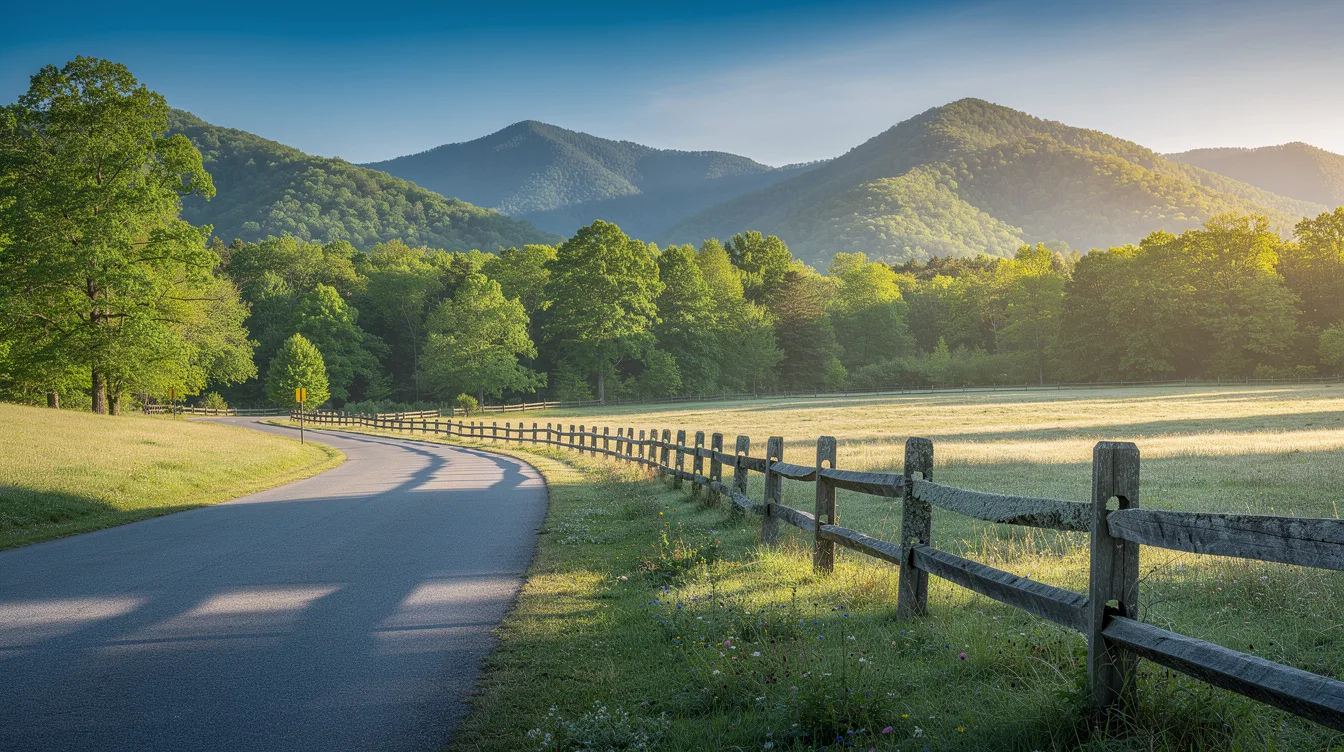
Townsend is the western gateway to Great Smoky Mountains National Park, and its real advantage is simple: it puts you on the route toward Cades Cove without making your whole trip feel like a resort corridor.
This is a town of about 550 residents, not a destination built for rushing. And that smaller scale matters when you want the Smokies to feel like a place for a long drive, a river afternoon, and an early start.
Cades Cove is the reason to base yourself here
The headline promise is real. From Townsend, you head west into the park toward Cades Cove and its 11-mile scenic loop, known for mountain scenery, historic sites, and wildlife viewing.
You should treat the loop as the day’s main event, not a quick detour between bigger plans. But it’s a drive, not a private wilderness escape, so patience is part of the deal when other visitors have the same idea.
The payoff is that Townsend feels practical before and after the loop. You can stay in a cabin, motel, or campground nearby, then return to a town whose outdoor rhythm is calmer than Gatlinburg or Pigeon Forge.
The quieter side has a real trade-off
Blount County is where Townsend sits in eastern Tennessee, roughly an hour from Knoxville. That makes it reachable for a Smokies trip, yet it doesn’t turn the town into a city-break stop.
And that is exactly why I’d choose it if the park is your priority. Townsend has a few local restaurants and outdoor operators, but don’t arrive expecting dense shopping streets or a long slate of nighttime options.
The town calls itself the Peaceful Side of the Smokies. The slogan works because the setting is low-density and outdoors-focused, not because there is some secret trick to it.
The Little River changes the pace
Townsend runs alongside the Little River, in Tuckaleechee Cove at roughly 1,076 feet. Water is the town’s counterpoint to the road trip, with tubing, kayaking, fly-fishing, and riverside cabins all part of the local pull.
You can make a full day out of the park and still leave room for the river. But choose the activity that fits your energy, because Townsend’s appeal is doing less with more attention, not packing every hour.
There’s a useful contrast here. The national park gives you scenic drives, hiking, waterfalls, fishing, and wildlife observation, while the river gives the day a softer edge, with moving water replacing the sound of traffic.
Two stops add context beyond the park
Tuckaleechee Caverns offers a different kind of outing, while the Little River Railroad & Lumber Company Museum connects the area to its logging and railroad past. Neither replaces the park, and neither needs to.
Townsend was chartered in 1921 by people connected to the Little River Railroad and Lumber Company. That history gives the town more weight than its size suggests, especially if you want a break from trailheads and scenic pullouts.
And you don’t need to turn this into an educational marathon. Pick one stop, then save the rest of the day for the reason you came: easy access to the Smokies without the heavier resort traffic.
Plan for a base camp, not a packed itinerary
For most travelers, McGhee Tyson Airport is the usual nearby airport, and Knoxville is the practical urban reference point. Townsend’s access is straightforward enough for a park-focused stay, particularly if you value a quieter home base.
You’ll find cabins, campgrounds, motels, local food, and outdoor help, but the limited density is intentional in effect. This is not the place to chase an endless choice of restaurants after dark.
But after a day on Cades Cove’s loop, that restraint can feel like relief. The river keeps moving through town, the mountains remain close, and Townsend returns to its own unhurried scale.