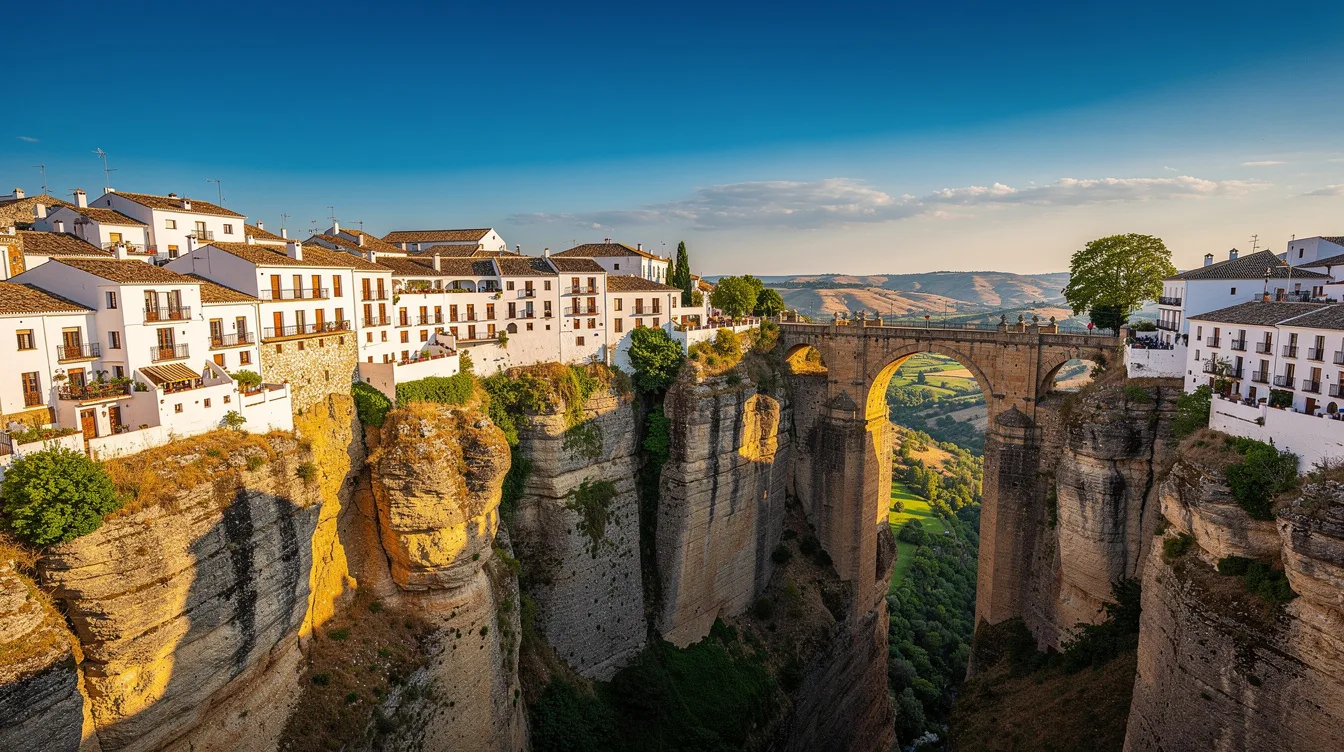
Ronda is the Spanish town where Puente Nuevo rises 394 feet above the Tajo canyon. The gorge drops more than 328 feet below the city, so the first view feels less like a bridge crossing and more like a town split open.
And the scale is the reason Ronda earns a place on an Andalusian road trip. Completed in 1793, the stone bridge connects the old quarter with the newer side of town, while the Guadalevín River cuts below.
But don’t rush through it as a quick photo stop. Ronda sits around 2,461 feet above sea level, which gives the town cooler mountain air than Málaga’s coast or the Guadalquivir valley.
You can reach Ronda in about 1 hour 20 minutes from Málaga or 1 hour 45 minutes from Seville. It’s remote enough to feel different, but simple to place between those cities on a driving route.
The bridge is only the beginning of the Tajo
Puente Nuevo gets the crowds because it delivers instant drama. Stand near the bridge and you’ll see pale cliffs, the canyon floor, and the valley opening beyond the stonework.
And the best view isn’t always the first one you find. From the Mirador de Aldehuela, the bridge frames the gorge with unusual precision, while paths below reveal how high the town really sits.
But the descent demands respect. The trail toward the canyon floor is steep, and the climb back can be strenuous, so wear shoes with a firm sole and save your energy for the return.
Can you see the bridge from below?
Yes, and you should if your legs allow it. The lower path gives you the most convincing sense of the bridge’s height.
You may prefer the upper viewpoints if uneven ground is difficult. The light changes quickly across the canyon, so even a short pause can turn gray stone warm and amber.
La Ciudad keeps Ronda from becoming a single viewpoint
La Ciudad, Ronda’s old quarter, spreads south of the Guadalevín through narrow lanes and white houses. Its Islamic influences remain visible in the street plan, courtyards, and quiet corners away from the bridge.
And this is where you should slow down. Plaza Duquesa de Parcent, small churches, palaces, and the Casa del Rey Moro create a better afternoon than another hour beside the main overlook.
But the name Casa del Rey Moro can mislead you. The house dates from the 18th century, though its water mine preserves a genuine remnant of Ronda’s Moorish past.
The Baños Árabes are another worthwhile stop. Their vaulted ceilings and star-shaped openings make the former baths feel cool and hushed, especially after the bright stone streets above.
You can also walk through Alameda del Tajo, an||||tree-lined promenade with views toward the Serranía de Ronda. It feels calmer than the bridge, but the drop beyond the railings still keeps your attention.
Stay after the day-trippers leave
One night is the sweet spot for most travelers. A few hours cover the bridge, one viewpoint, and part of the old town, but sleeping in Ronda lets you see the canyon after the middle of the day.
And you should arrive at Puente Nuevo before 9 a. M. If possible.
The air is cooler, the stone is quieter, and you can cross the bridge before visitors from the Costa del Sol fill the viewpoints.
By late afternoon, return to the Tajo overlooks. The sound softens, the walls catch the last light, and the town becomes more persuasive when nobody is hurrying past you.
But Ronda isn’t a place for effortless wandering everywhere. Streets rise and fall, paths descend sharply, and the best views often require a little work.
When should you visit Ronda?
Choose April, May, September, or October for more comfortable temperatures and agreeable light. Summer can feel less oppressive than the coast because of the elevation, though the central hours still attract heavy foot traffic.
Winter brings a different trade-off. The town is quieter, but rain can make the canyon paths unpleasant, and mountain weather changes the feel of the stone streets.
Use Ronda as a base for white villages
Setenil de las Bodegas, Grazalema, and Zahara de la Sierra fit naturally into a two-night stay around Ronda. The surrounding pueblos blancos and mountain roads reward travelers who enjoy driving, walking, and stopping when the view changes.
And a car makes the wider Serranía easier to explore. You can keep Ronda as your anchor, then spend the next day moving through the nearby hills instead of returning immediately to Málaga or Seville.
The Plaza de Toros adds another layer, though its bullfighting history remains controversial. Visit if that subject interests you, or choose the Arab baths and the viewpoints if you’d rather keep the day focused on architecture and place.
Ronda’s appeal is direct: a historic town, a river-cut canyon, and a bridge built high above it. By evening, the stone parapet cools beneath your hand while the last light settles across the Tajo.